Home » Screwless Dental Implants: A Revolution in Conometric and Bionic Restoration

Index

Screwless Dental Implants: A Revolution in Conometric and Bionic Restoration

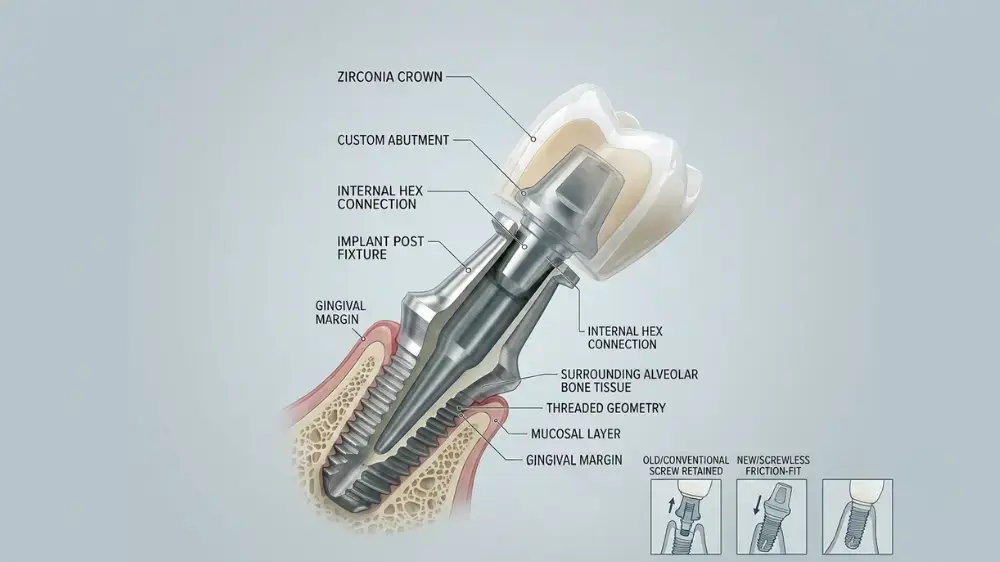
Picture of a screwless dental implant with parts and components

Screw-retained implants carry a flaw: the screw can loosen, and the pocket it leaves behind can trap bacteria. Screwless dental implants were designed to solve that exact problem. However, one type of dental implant without screws is more problematic than traditional implants: the ones with cemented crowns, which lead to unnecessary problems in an age of CAD-CAM technology.

In this article, we detail all crucial information about screwless implants, including its 3 main types, costs and how to verify the best Swiss brands.

Key points at a glance:
  • Three restoration types get called “screwless”: locking-taper, conometric, and cement-retained crowns.
  • Only the first two are truly screwless (cement-retained simply swaps a screw for adhesive).
  • Cemented crowns have a higher risk of peri-implantitis, which is why modern dentists often prefer other options.
  • Screwless implants require specific instruments for maintenance
  • They cost an average 20% more than standard implants, but often avoid bone grafting

What Are Screwless Dental Implants?

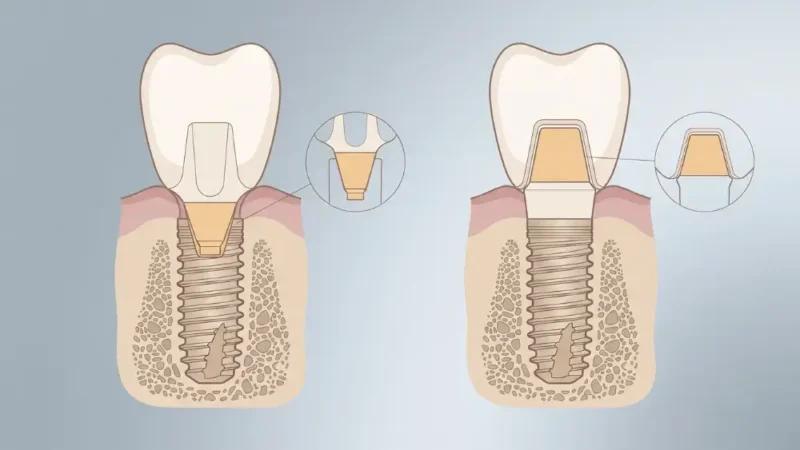
Cross-section diagram comparing the two types of screwless dental implants: conometric (left) and friction fit (right), with magnified insets of each connection.

A screwless dental implant (Conometric or Friction-Fit models) represent the third generation of implantology, engineered to solve 3 recurring issues of traditional dental implants: screw loosening, microleakage and visible screw heads. Today, 5-axis CAD/CAM milling makes friction-fit implants far more consistent than ever.

Important: an implant that replaces the screw with cement is screwless, but it can lead to documented problems. At One Life Dental, “screwless dental implants” mean a conometric/friction-fit connection, with neither a screw nor cement.

Conometric vs Friction-Fit Implants

There are two families of screwless implant systems: the locking-taper system (developed by Bicon, 1980s), and the conometric crown system (the newest formula):

  1. Locking-taper (implant-level friction-fit). The tapered connection is built into the implant fixture itself, between implant and abutment. Pioneered by Bicon in the 1980s.
  2. Conometric (restoration-level friction-fit). The cone sits higher up, between the abutment and a cap inside the crown. The best-known system is Acuris from Dentsply Sirona, available for Ankylos, Astra Tech and Xive implants.
 

Locking-taper

Conometric

Cone location

Implant ↔ abutment

Abutment ↔ crown cap

Compatible with

Its own fixtures only

Ankylos, Astra Tech, Xive

Retrofit to existing implants

No

Yes

Any cement used

None

Extraorally, in the lab

Maintenance

Specialist instrument

Manufacturer’s fixation/removal tool

Screwless vs. Screw-Retained Implants

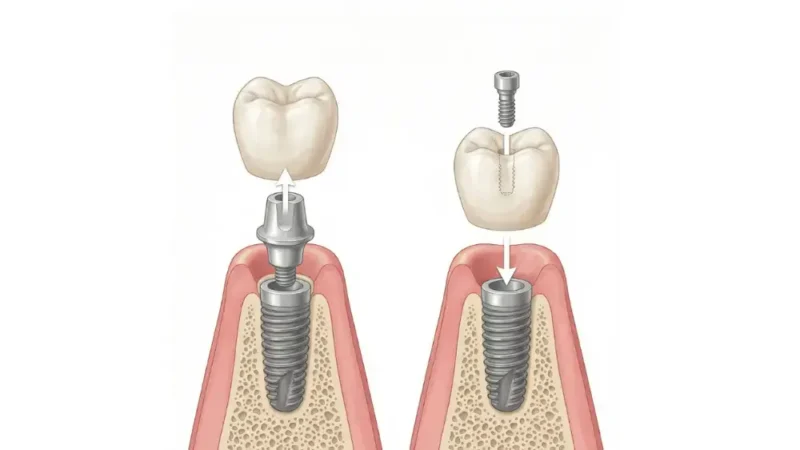
Exploded diagram comparing screwless dental implants with screw-retained implants, showing a crown seating directly onto the abutment versus a crown secured by an abutment screw.

Screwless implants substitute two failure points (the retainer screw and cement) for a single, sealed connection. This is why their long-term complication rate is the lowest of the three dental implant systems.

Screwless implants close the two failure points that affect traditional restorations:


Screw-Retained

Cement-Retained

Screwless (Friction-Fit)

Main risk

Screw loosening (up to 5-12% of single-tooth cases over time)

Excess cement trapped below the gumline

Sealed friction-lock (no screw, no cement)

Bacteria pathway

Microleakage through the screw-access channel

Cement margin sits under the gum

Hermetic seal (no access point)

Aesthetics

Visible screw-access hole in the crown

No hole, but a cement line can show

100% solid crown surface

Removability

Screw can seize or strip over time

Hard to remove without damaging the crown

Releasable with a specialised dental tool

(Source: Stanbouly et al., “Design and the future of locking-taper screwless and cementless dental implants,” Frontiers of Oral and Maxillofacial Medicine, 2024.)

When Might a Dentist Recommend Screwless Implants?

In practice, more implants cause trouble at the connection than in the bone. Abutment screws loosen, occasionally fracture, and each retightening is another dental appointment. Friction-fit systems delete those risks entirely, which is why they’re often recommended in the following patient and dental cases:
  • Frontal teeth for superior aesthetics
  • Cases with limited space of awkward angulation
  • Bruxists who apply heavy forces
  • Avoiding bone grafting and/or sinus lifting

How Do Screwless Dental Implants Work

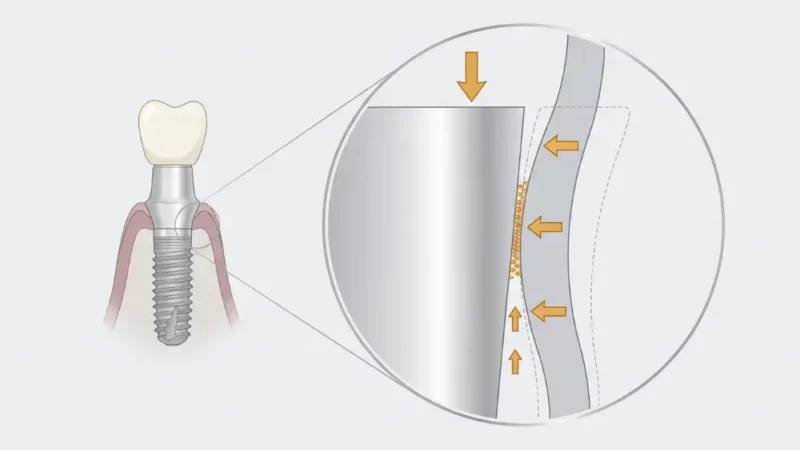
Diagram showing how screwless dental implants work, with a magnified view of the compressive forces locking the abutment into the implant's tapered walls.

The secret to friction-fit implants lies in conic geometry. Instead of using screws or cement, they lock dental crowns with a taper system. The dental abutment and the internal cap of the crown are milled through CAD/CAM technology with nanometric precision, so that the two fuse together under light pressure.

Surgery follows the next steps:

  1. 3D CBCT Scan: A digital map of your mouth to ensure the perfect fit.
  2. Implant Placement: The implant fixture is placed under local anaesthesia using a surgical guide, ensuring total safety.
  3. Healing & Osseointegration: A 3–to-6-months healing period allows the fixture to fuse with the jawbone, becoming an integral part of your body.
  4. Conometric Milling: The abutment and the crown cap are milled on 5-axis CAD/CAM equipment to guarantee a friction-tight fit.
  5. Friction-Fit Seating: The finished crown is tapped into place under light, controlled pressure with no screw nor cement.

Are Screwless Dental Implants Cheaper?

Screwless dental implants cost an average $2,500 (fixture only), with a global price of $700 to $6,000 per unit. That’s 20% more than screw-retained implants, due to the extra lab precision. However, the total cost can land below conventional implants, because friction-fit designs often eliminate the need for bone grafting.

  • US: average cost $3,000–$6,000 (implant & crown)
  • UK: £2,200–£3,800 privately; rarely NHS-funded
  • Turkey: screwless implants cost 700€–$1,400€, though few clinics have them

Single Dental Implant Cost by Country (2026)

Country

Screwless friction-fit

Availability

🇺🇸 United States

$3,000 – $6,000

Widely available

🇬🇧 United Kingdom

$2,800 – $5,900

Limited, select practices

🇨🇦 Canada

$2,500 – $5,000

Limited

🇦🇺 Australia

$2,300 – $5,200

Limited

🇹🇷 Turkey

$700 – $1,400

Rare

🇲🇽 Mexico

$1,200 – $2,800

Available in border/tourism clinics

🇭🇺 Hungary

$1,000 – $1,900

Rare

🇵🇱 Poland

$900 – $1,700

Rare

🇪🇸 Spain

$1,200 – $2,000

Limited

Figures are for single-tooth implant (fixture + abutment + crown), sourced from national dental associations, insurer guides and 2026 market reports. This range is a reasonable estimate based on comparative market reports, not an official fee schedule.
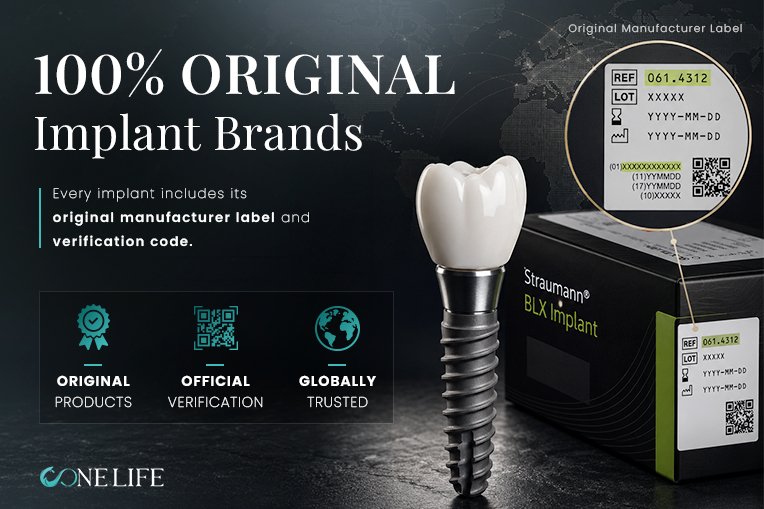
Verifying Implant Brands & Avoiding Counterfeits

Banner picture illustrating REF-code verification for Straumann and Nobel Biocare dental implants in Turkey

Because conometric systems rely on micron-level friction, non-original implants easily lead to failure. With One Life Dental, every screwless component used in your restoration is accompanied by its original REF (Reference) and LOT (Batch) codes. These codes allow you to track the provenance of the titanium and zirconia back to the manufacturer (such as Straumann or Nobel Biocare).
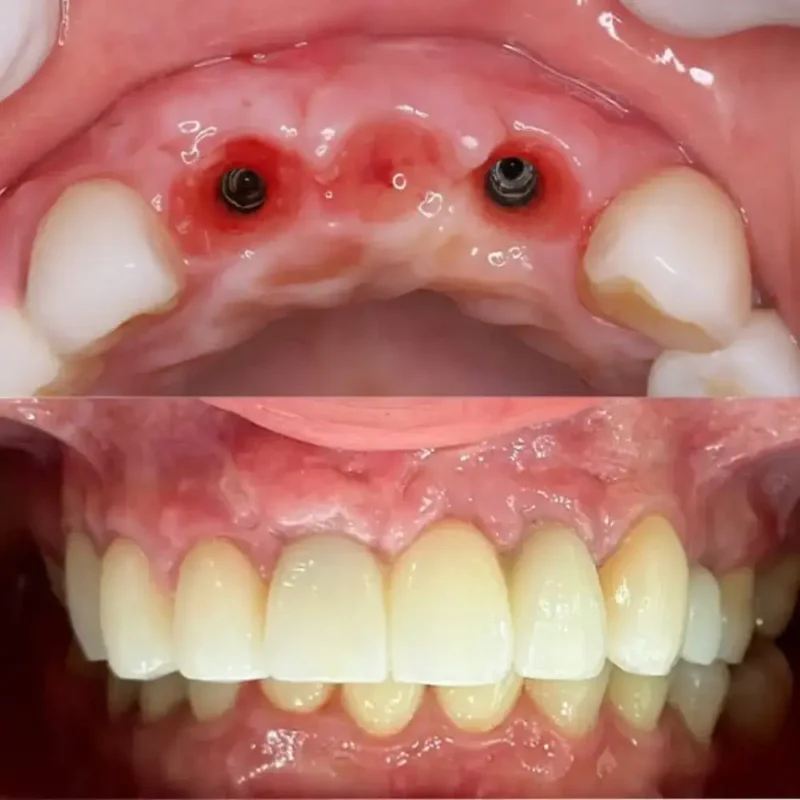
Patient Results Before and After Screwless Implants

Close-up picture of a patient mouth before and after screwless dental implants

The above image shows screwless zirconia crowns seated using a friction-fit taper. Crowns are 100% ceramic zirconia, making the restoration blend with natural teeth colour and light transmission. Notice how the gumline sits symmetrically around each crown. It’s the level of precision that CAD/CAM technology allows.

How Long Do Screwless (Conometric) Implants Last?

The fixture itself (the titanium/zirconia post) can last a lifetime; the crown typically needs replacing after 10–15 years. However, longevity depends less on the technology itself and more on how the case was planned, and how well the patient maintains it afterward.

Key Instructions to Avoid Implant Failure Include:

  • Don’t smoke during healing
  • Keep bruxism (grinding) under control
  • Attend every follow-up
  • Manage systemic health conditions

Long-Term Care & Maintenance

  • Brush and floss exactly as you would natural teeth: twice daily
  • Add a water flosser or interdental brush around the crown margin
  • Book an annual professional maintenance visit
  • Watch for early warning signs: persistent tenderness, bleeding on brushing, or any looseness, and report them on the spot

Benefits of Screwless Dental Implants

Screwless dental implants have important benefits for many patients and dentists worldwide. For example, they allow for easy cleaning and replacement. Overall, the core benefits are fewer risks, better aesthetics, and easier maintenance than traditional screw-retained options.

Here are the main advantages at a glance:

  1. No visible screw holes
  2. Lower infection risk
  3. No screw loosening
  4. Natural look and feel
  5. Easier to keep clean
  6. Fully retrievable
  7. Strong long-term success (7% at 10 years)

Are You the Right Candidate?

Most patients missing one or more teeth are usually suitable for the procedure. You’re likely a good candidate for screwless (conometric) implants if you have:

  • Healthy gums
  • Sufficient bone density and volume
  • Adequate inter-arch space
  • Well-managed general health
  • Controlled bruxism(teeth grinding)
  • Realistic commitment to aftercare

Possible Risks & Complications

Screwless dental implants eliminate failure points of traditional implants, but they introduce a few of their own. No system is risk-free and dental implant complications can happen. This being said, risks are about execution (lab precision, case selection, and surgeon experience), and post-op care. Not about the system per se.

Risks & Potential Complications

  • Implant failure (failed osseointegration)
  • Infection
  • Bleeding
  • Peri-implantitis
  • Nerve damage
  • Coupling-stability loss (screwless-specific)
  • Poor lab execution

Disadvantages

  • Replacement requires a specialist
  • Higher cost
  • Fewer providers offer it
  • Less flexibility for space constraints: Cases with very limited crown height or unusual bite geometry sometimes can’t accommodate the taper design.

Disadvantages & Limitations of Screwless Dental Implants

The friction fit that removes screw loosening also removes the screw’s convenience: there is no component to simply undo. No implant system is without trade-offs. Two consequences matter in practice.

1.     Does the friction wear off over time?

In screwless dental implants, retention depends on friction rather than a mechanical stop, and conometric systems can face gradual friction loss at the crown-cap area. Manufacturers therefore specify periodic review rather than treating the restoration as permanent.

2.     Repair & Removal of Screwless Implants

Screwless crowns are only replaceable with instruments specific to the system: the manufacturer’s tooling. Systems from major manufacturers are more widely serviced than proprietary designs, so make sure you use universal systems. Always ask your clinic to supply the REF and LOT codes of every component fitted, so any future dentist knows exactly what they are working with.

Latest 2026 Innovations in Conometric Implantology

Research in this space is moving in three main directions in 2026, even though these are still emerging technologies rather than established, widely-available options:

  • Nitinol-retained restorations: A superplastic stronger than a fastening screw or cement. Because it can be shaped and reshaped, researchers see it as a potential future alternative to today’s taper-based friction systems.
  • TRINIA and metal-free full-arch materials: Fibre-reinforced CAD/CAM composites like TRINIA are showing outcomes comparable to traditional metal-alloy, with mechanical properties closer to natural dentin.
  • Ultrashort locking-taper implants: Research on 5–6mm ultrashort screwless implants shows survival rates comparable to conventional implants — potentially reducing the need for grafting in more cases over time.

FAQs

Do screwless dental implants fall out easily?

No. While they do not use screws, they utilize Conic Geometry to create a “cold weld” or friction-lock. This connection is so stable that it requires specialized clinical tools for the dentist to remove the crown. It is designed to withstand the highest human chewing forces without ever loosening or shifting during daily use.

There is a slight premium for screwless dental implants in Turkey due to the higher cost of conometric components and the precision milling required in the lab. However, because we own the ComfyDent Lab, our price remains 70% lower than what you would pay for standard screwed implants in the UK or USA.

Absolutely. In fact, screwless technology is the gold standard for full-arch cases (like All-on-4 or All-on-6). It eliminates the multiple screw holes that can weaken a full bridge, providing a much stronger, more hygienic, and more aesthetic result for patients replacing all their teeth.

The elimination of dental glue (cement). In traditional dentistry, microscopic amounts of excess cement can get trapped under the gums, causing a chronic infection known as Peri-implantitis. By being 100% cement-free, screwless implants are the most “gum-friendly” option available in modern dentistry.

Dr. Tastan uses a specialized “pulse” tool that safely breaks the friction-lock of the conometric cap. This allows for easy removal during your annual maintenance visits without damaging the crown or the implant fixture—a significant advantage over screw-retained systems where screws can become “seized” or stripped.

The surgical placement of the implant is exactly the same as a traditional one, performed under local anesthesia to ensure it is entirely painless. The primary difference is in the restoration phase, which is actually more comfortable because there is no pressure from tightening screws into your jawbone.

We primarily utilize systems from Straumann and Medentika, who are pioneers in conometric technology. These brands provide the highest degree of “taper accuracy,” which is essential for a secure, long-term friction fit. We provide the batch codes for these brands for your peace of mind.

Because it requires a massive investment in digital infrastructure. You cannot make screwless crowns using traditional lab methods; you need 5-axis CAD/CAM milling and a surgeon who is trained in conometric protocols. Most “high-volume” clinics stick to cheaper, easier screw-retained methods.

Maintenance is identical to natural teeth. You must brush twice a day and use a water-flosser or interdental brushes to keep the gum line clean. Because there are no screw holes to harbor bacteria, many patients find screwless implants actually stay cleaner than traditional ones.

No — and this trips up a lot of patients. Both skip the screw, but cement-retained crowns are held by adhesive, which can trap bacteria under the gumline. True screwless (conometric) implants use a friction-fit taper instead — no screw, no cement, no adhesive margin at all.

Yes — they’re a well-researched, reliable option. A 10-year study of nearly 1,500 locking-taper implants recorded a 98.7% survival rate, on par with the best screw-retained systems, while avoiding screw loosening and the screw-access hole entirely.

Expect to pay roughly 10–20% more than a standard screw-retained implant, since the friction-fit taper needs extra lab precision. In Turkey, that’s around $500–$950 per tooth; in the UK or US, several thousand pounds or dollars more.

The same conometric technology, just applied to older patients — who are excellent candidates as long as they’re in good general health. Age itself isn’t a barrier; bone density and manageable conditions like diabetes matter far more than the number of candles on your cake.

No more than a standard implant. Placement is done under local anaesthetic, so you’ll feel pressure, not pain. Mild soreness for a few days afterward is normal and manageable with standard painkillers — many patients say it’s less uncomfortable than a tooth extraction.

The healing timeline is the same as any implant: 3–6 months for full osseointegration before the permanent crown goes on. Choosing screwless technology doesn’t speed up or slow down that biological healing process.

Yes, but not by hand. A dentist uses a specialised tool to release the friction-lock safely — useful for maintenance, cleaning or repairs — without damaging the crown or the implant underneath.

Absolutely — it’s the most common use case. One implant, one friction-fit crown, and no visible access hole, which is exactly why it’s such a popular choice for a single front tooth.

Often, yes. Without a screw-access hole to fill, the crown is one solid, uninterrupted surface — so there’s no filling material to discolour over time, which is a common giveaway with screw-retained front teeth.

They remove one specific infection pathway — bacteria entering through the screw channel — which is linked to their strong complication-free survival rate. But good long-term health still depends on your daily hygiene and regular check-ups.

Generally, yes. The solid, hole-free crown surface is especially valuable where aesthetics matter most — which is why it’s the preferred choice for visible teeth like the upper incisors.

They’re built to handle normal chewing forces reliably, especially in titanium form for back teeth. They’re not inherently “stronger” than screw-retained systems — the real advantage is avoiding the screw as a mechanical weak point.

Many patients find them so, yes. With no screw-access channel to trap debris, there’s one less spot for plaque to build up — though brushing, flossing and regular check-ups still matter just as much as ever.

Not really — the surgery and healing phase are identical to any implant. Where it saves time is at the final visit: the crown snaps into place with light pressure, no screw-tightening step required.

References

  1. Stanbouly D, et al. Design and the future of locking-taper screwless and cementless dental implants.Frontiers of Oral and Maxillofacial Medicine. 2024.
  2. Bicon Dental Implants. The locking taper connection — FAQ.https://www.bicon.com/product_info/pi_faq.html
  3. Bicon Dental Implants. System design: 1.5° locking taper and 360° abutment positioning.https://www.bicon.com/b_intro_design.html
  4. Moon SY, et al. Sinking and fit of abutment of locking taper implant system.Journal of Advanced Prosthodontics. 2010. https://www.bicon.com/news/pdf/J_Adv_Prostho_Moon_Locking_Taper_2010.pdf
  5. Bicon Dental Implants. Restorative manual: integrated abutment crown seating.https://www.bicon.com/tech/t_iac03.html
  6. Dentsply Sirona. Acuris conometric concept.https://www.dentsplysirona.com/en-us/discover/discover-by-brand/acuris-conometric-concept.html
  7. Microgap formation and bacterial leakage at the Acuris conometric restorative interface of three implant-abutment systems.Clinical Oral Investigations. 2021. https://doi.org/10.1007/s00784-021-04112-2
  8. Katsavochristou A, Koumoulis D. Incidence of abutment screw failure of single or splinted implant prostheses.Journal of Oral Rehabilitation. 2019;46:776–786.
  9. Jung RE, Pjetursson BE, Glauser R, et al. A systematic review of the 5-year survival and complication rates of implant-supported single crowns.Clinical Oral Implants Research. 2008;19:119–130.
  10. Preload loss of abutment screws after dynamic fatigue in single implant-supported restorations: a systematic review.https://www.ncbi.nlm.nih.gov/pmc/articles/PMC5741850/
  11. Implant screw loosening: a narrative review of medium- and long-term clinical evidence.Applied Sciences. 2026. https://doi.org/10.3390/app16126253
  12. Five-year retrospective of short locking-taper implants under 8mm.BioMed Research International. 2015. https://doi.org/10.1155/2015/197451
iMessage Us