
Dental implant recovery takes between 3 and 6 months in total but that number needs context, because there are actually two very different types of “recovery” happening at the same time.
The first is the visible recovery: swelling, mild discomfort, and diet restrictions typically last 7 to 14 days, and most patients return to work within 1 to 3 days and resume normal eating within 2 to 3 weeks.
The second is the biological recovery: the process by which your jawbone fuses permanently with the titanium implant — called osseointegration. It takes 3 to 6 months. It is silent, painless, and happens entirely beneath the surface. You won’t feel it, but it is the most important part of the entire treatment.
The 4 Stages of Dental Implant Recovery
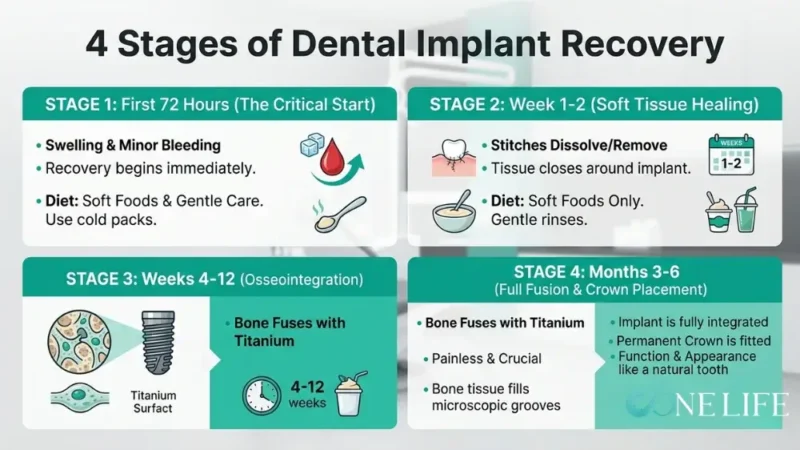
Dental implant healing occurs in four distinct stages, each serving a critical role in long-term success. Here is exactly what happens at each one.
Stage 1: The First 72 Hours — What’s Normal?
This is the most uncomfortable phase of dental implants for most patients, and also the most misunderstood. Immediately after surgery, it is normal to experience some swelling, minor bleeding, and discomfort around the surgical site.
What you should expect:
- Swelling that peaks at 48–72 hours, then gradually subsides
- Mild to moderate soreness once the anaesthesia wears off
- Slight bleeding or pinkish saliva for the first 24 hours
- A blood clot forming at the implant site (this is essential and must not be disturbed)
Stage 2: Week 1–2 — Soft Tissue Healing
By day 3 or 4, swelling begins to resolve and discomfort becomes more manageable. The gum tissue around the implant starts to close and heal. This subacute phase, dedicated to tissue repair, runs from roughly 3 days to 3–6 weeks after surgery.
During this stage:
- Stitches dissolve or are removed around day 7–10
- A soft diet remains essential — no chewing on the implant site
- Gentle salt-water rinses (3–4 times daily) help reduce infection risk
- Brushing can resume carefully, avoiding direct contact with the surgical area
Stage 3: Weeks 4–12 — Early Osseointegration Begins
This is where the real biological work starts. A 2025 review in the National Library of Medicine described this process in stages: during weeks 4–12, new bone cells (osteoblasts) begin to form directly on the implant surface.
By 4 weeks, new bone formation is observed on the implant surface. After 8 to 12 weeks, the peri-implant interface is progressively replaced by mature lamellar bone in direct contact with the implant surface.
You will feel nothing during this stage. No pain, no sensation of change. But inside the jaw, your bone is actively growing into the microscopic texture of the titanium post, creating a connection that will eventually be stronger than a natural tooth root.
Stage 4: Months 3–6 — Full Osseointegration and Final Crown
Between 3 and 6 months, osseointegration continues. For those with bone loss or who have required bone grafting, the process may take longer.
Once your surgeon confirms full integration the permanent dental crown is fitted. A well-integrated implant produces a solid sound on percussion and resists rotational forces, confirming that bone has grown around the implant without any gaps.
At this point, your implant looks, functions, and feels identical to a natural tooth. With proper care, dental implants have documented survival rates exceeding 95% at 10 years and over 90% at 20 years, according to long-term follow-up studies.
Dental Implant Recovery Time: What Affects Your Healing?
Several factors — some within your control, some not — can shorten or extend your dental implant recovery time. The following table might help you set realistic expectations and smart decisions before and after surgery.
Factors That Speed Up or Slow Down Recovery from Dental Implants
Factor | Effect on Recovery | What You Can Do |
Bone density and volume | High-density bone integrates faster, typically 3–4 months. Low density may require 5–6+ months. | A 3D CBCT scan before surgery identifies this in advance. |
Smoking | Smokers face significantly higher failure risk. Healing is slower across all stages. | Quit at least 1 week before surgery and 8 weeks after. |
Diabetes (uncontrolled) | Impairs blood flow and immune response, slowing osseointegration and raising infection risk. | Ensure blood sugar is well managed before proceeding. |
Bone grafting | May add a mandatory healing phase before implant placement. | Plan for an additional 4–6 months if grafting is required. |
Sinus lift (upper jaw) | Extends total timeline due to the added surgical site. | Upper jaw implants requiring a sinus lift typically need 6–9 months total before the final restoration. |
Number of implants | Multiple implants or full-arch restorations may produce more swelling and a longer recovery phase. | Follow post-op instructions strictly; soft diet is critical. |
Oral hygiene | Poor hygiene is the leading cause of late implant failure (peri-implantitis). | Brush twice daily, floss, and use a water flosser around the implant. |
Smoking and Dental Implant Recovery
This deserves special attention. Implant failures in smokers are 2.23 times more likely than in non-smokers — increasing the risk of failure by 123%. That’s the finding of a comprehensive review covering studies from 2020 to 2024, including over 29,500 implants in 18,300 patients.
Smoking impairs osseointegration due to reduced blood flow, oxygenation, and angiogenesis caused by nicotine and carbon monoxide. In plain terms: the implant cannot fuse properly with bone that is being starved of oxygen and nutrients.
If stopping entirely is not possible, abstaining from smoking for at least one week before surgery and up to eight weeks after is strongly recommended.
What to Eat After a Dental Implant — and What to Avoid
Diet is one of the most underestimated factors in dental implant recovery. What you eat directly affects the stability of the blood clot, the health of the surrounding tissue, and ultimately the success of osseointegration.
The rules are simple, but they must be followed consistently.
The Post-Implant Diet: Phase by Phase
Phase | Timeframe | What to Eat | What to Avoid |
Liquid & soft foods only | Days 1–3 | Yogurt, smoothies, soup (lukewarm), mashed potato, scrambled eggs | Hot foods and drinks, anything crunchy or chewy, straws |
Soft food diet | Days 4–14 | Soft fish, pasta, rice, cooked vegetables, bananas | Hard bread, raw vegetables, nuts, seeds, sticky foods |
Gradual reintroduction | Weeks 2–6 | Most normal foods, introduced progressively | Chewing directly on the implant site |
Normal diet | After crown placement | Unrestricted, once osseointegration is confirmed | Excessively hard foods directly on the implant (long-term) |
A Few Rules Worth Emphasising
- No straws for at least 72 hours. The suction pressure can dislodge the blood clot forming at the surgical site — the same risk as dry socket after an extraction.
- Lukewarm, not hot. Heat increases bleeding and inflammation. Avoid hot drinks and hot meals for the first 48 hours.
- No alcohol during the first week.Alcohol interferes with blood clotting and can interact with prescribed antibiotics or pain medication.
- Chew on the opposite side. Even once you return to a normal diet, avoid placing direct biting pressure on the implant site until the final crown is fitted and osseointegration is confirmed.
How to Speed Up Recovery from Dental Implants: 7 Evidence-Based Tips
The 3–6 month osseointegration window cannot be biologically accelerated. But what you can do is remove every obstacle that would slow it down or put it at risk. These seven steps make a measurable difference.
1. Stop Smoking (or at least pause it)
This is the single highest-impact action you can take. Nicotine and carbon monoxide reduce blood flow, oxygen delivery, and the angiogenesis that bone tissue needs to heal and fuse with the implant. If stopping entirely is not possible, abstain for at least one week before surgery and eight weeks after.
2. Follow the Soft Diet Strictly (especially in the first two weeks)
Any mechanical pressure on the implant site during the early healing phase risks disturbing the blood clot and the delicate tissue forming around the fixture. Skipping the diet guidelines is one of the most common and avoidable causes of early complications.
3. Keep the Site Clean, Gently
Oral hygiene around the implant is critical from day one. Use a soft-bristled brush, avoid direct pressure on the area for the first week, and rinse gently with lukewarm salt water 3–4 times daily. Once healed, clean the implant exactly like a natural tooth — including flossing and, ideally, a water flosser.
4. Use Cold Packs in the First 48 Hours
Applying an ice pack to the cheek in 20-minute intervals during the first two days significantly reduces swelling and discomfort. After 48 hours, switch to warm compresses if needed to help ease residual stiffness.
5. Rest (Genuinely)
Most patients return to normal activities within 1–2 weeks, but complete rest is essential immediately post-surgery. Exercise raises blood pressure and heart rate, which increases bleeding risk at the surgical site. Avoid the gym, heavy lifting, and intense physical activity for at least one full week.
6. Take All Prescribed Medication as Directed
Antibiotics and anti-inflammatories are prescribed for a reason. Completing the full antibiotic course reduces the risk of peri-implant infection (the leading cause of late implant failure).
7. Attend Every Follow-Up Appointment
Recovery is monitored, not assumed. Your surgeon needs to confirm at each stage that osseointegration is progressing correctly before moving to the next step. Follow-up visits allow the surgeon to monitor healing and ensure the implant is integrating properly.
Warning Signs: When to Call Your Dentist
Some discomfort after dental implant surgery is completely normal. The challenge is knowing the difference between expected post-op symptoms and signs that something is wrong. When in doubt, always contact your surgeon:early intervention is almost always simpler and more effective than delayed treatment.
Normal vs. Concerning: A Quick Reference
Symptom | Normal | Concerning — Call Your Dentist |
Swelling | Peaks at 48–72 hours, then gradually resolves | Swelling that worsens after day 3 or returns after subsiding |
Discomfort | Mild to moderate soreness for 3–7 days | Pain that intensifies after day 4 or does not respond to medication |
Bleeding | Minor bleeding or pink saliva for 24–48 hours | Persistent or heavy bleeding beyond 48 hours |
Bruising | Mild bruising around the jaw or cheek | Spreading bruising accompanied by fever or swelling |
Taste | Slight metallic taste in the first 24 hours | Persistent bad taste or foul smell after day 3 |
Implant sensation | Mild pressure or awareness of the implant site | Any feeling of movement or looseness in the implant |
Fever | Slightly elevated temperature on day 1 | Fever above 38°C / 100.4°F persisting beyond 24 hours |
The Most Important Warning Sign: Pain That Gets Worse, Not Better
Post-op discomfort should follow a clear downward curve: uncomfortable on day one, noticeably better by day three, largely resolved by day seven. If your pain follows the opposite trajectory (intensifying after the third or fourth day),something requires attention.
The two most common causes are infection at the surgical site and the early onset of peri-implantitis. Patients with systemic medical conditions experience substantially higher rates of peri-implantitis — 26.8% versus 8.8% in healthy patients. Neither condition resolves on its own. Both respond well to prompt professional treatment. Do not wait.
Does the Quality of the Implant Affect Recovery?
Yes. Recovery and osseointegration are directly linked to the quality of the implant material and the precision of the surgical technique.
Premium implant brands such as Straumann feature microscopically textured surfaces — sandblasted and acid-etched — specifically engineered to maximise bone cell attachment and accelerate osseointegration. A counterfeit or low-grade implant does not offer this. At OONE LIFE DENTAL, every patient receives their implants in original sealed manufacturer packaging, complete with REF and LOT codes that can be verified directly with the manufacturer,guaranteeing 100% material traceability.
Getting Dental Implants in Turkey: Does Recovery Differ?
The biological recovery process is identical regardless of where the surgery takes place. Osseointegration follows the same timeline whether you get dental implants in Turkey, London or New York. Your bone does not know which country it is in! If you’re interested in full mouth dental implant package deals in Turkey, don’t hesitate to contact us for a free online consultation!