
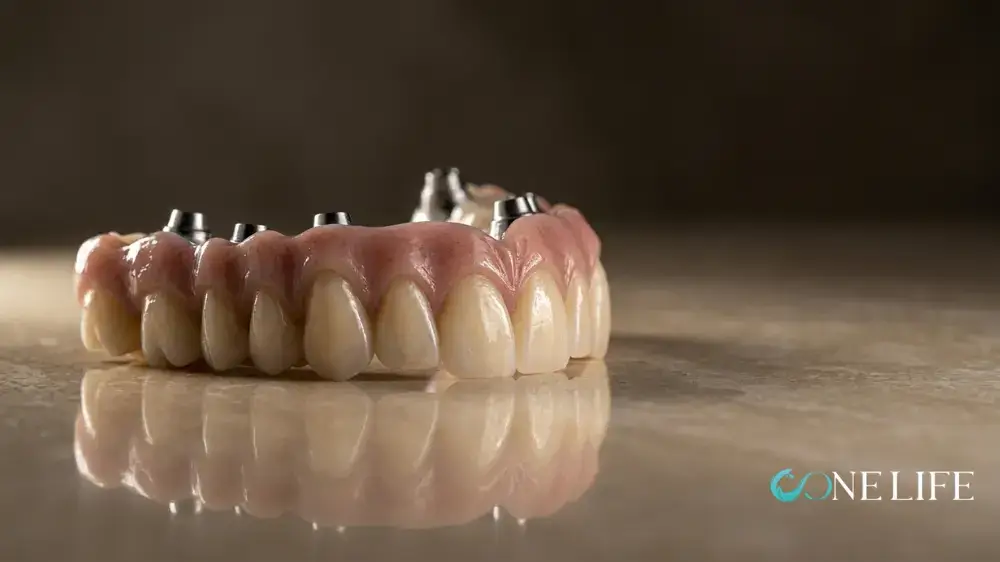
Roughly 120 million Americans are missing at least one tooth, and about 36 million have lost all of them. Yet why do dentures cost $500 in one clinic and $15,000 in another?
Dentures. The same word covers a stock acrylic plate resting on your gums and a titanium-anchored arch screwed into your jawbone with implants. These are not the same thing. Not in how long they last, not in what happens to your jawbone, and not in what your face looks like in ten years. We explore them all, in detail, in this guide.
Key takeaways:
Dentures are removable appliances that replace missing teeth and the surrounding gum tissue. They are often still widely called false teeth. They are custom-made from an impression of your mouth, now usually a digital scan, and built in a dental laboratory.
They do three jobs:
Dentures become necessary once tooth loss starts producing knock-on effects across the rest of your mouth. Four situations ac
count for most cases:
There are three broad categories: conventional removable dentures, implant-supported dentures, and fixed alternatives that are not dentures at all. The difference comes down to what holds them in place, which determines how much bite force they can handle.
Type | Held in place by | Teeth replaced | Surgery | Lifespan | Cost per arch (US) |
Full denture | suction and gum contact | whole arch | none | 5–10 yrs | $1,000–$3,000 |
Partial denture (acrylic) | clasps on remaining teeth | 1–6 | none | 5–8 yrs | $800–$2,700 |
Cast metal partial | metal framework and clasps | 2–10 | none | 7–10 yrs | $1,300–$3,100 |
Flexible partial | nylon base, no metal clasps | 1–6 | none | 5–8 yrs | $900–$2,500 |
Immediate denture | fitted the day teeth come out | whole arch | extractions | 6–12 mths | $1,200–$3,500 |
Snap-in / overdenture | 2–4 implants | whole arch | yes | 10–15 yrs | $3,000–$7,300 |
Fixed implant denture (All-on-4) | 4–6 implants | whole arch | yes | 15+ yrs | $8,000–$15,000+ |
Dental bridge | adjacent natural teeth | 2–4 | none | 10–15 yrs | $1,500–$5,000 |
Crown | the prepared tooth itself | 1 | none | 10–15 yrs | $800–$2,500 |
None of these is universally better. Each suits a specific combination of remaining bone, available anchor teeth and what you expect to be able to eat.
A removable denture rests on your gums and comes out for cleaning. No surgery, no drilling of healthy teeth, which makes it the fastest and cheapest route. The tradeoff is stability: because the chewing load lands on soft tissue rather than bone, resorption continues underneath.
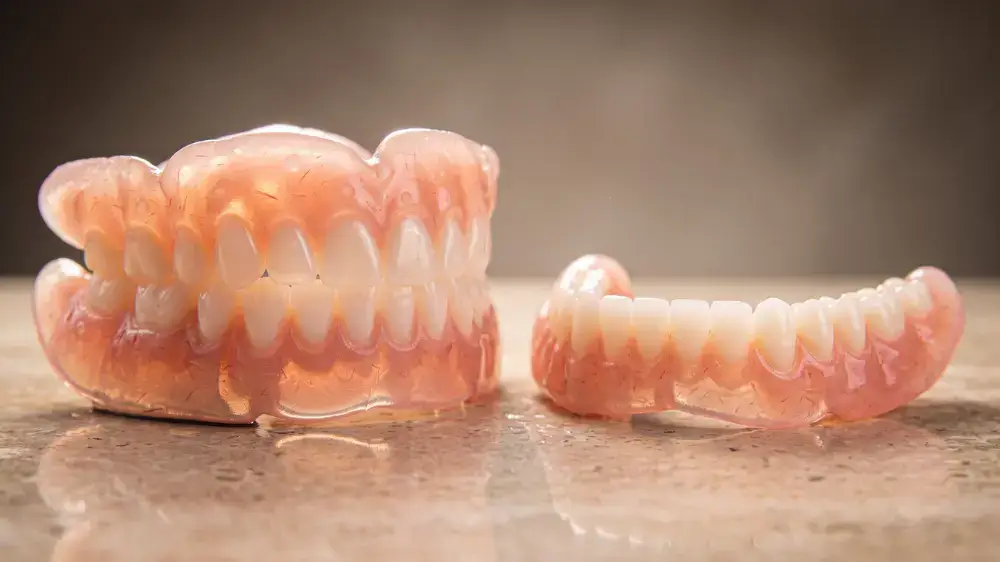
A full denture replaces an entire arch and stays put through suction. In the upper jaw it uses the palate to create a seal, which works well. The lower jaw has far less surface area and a tongue that dislodges the plate constantly, which is why lower dentures are notoriously less stable. Most complaints about “dentures slipping” are really complaints about lower dentures.
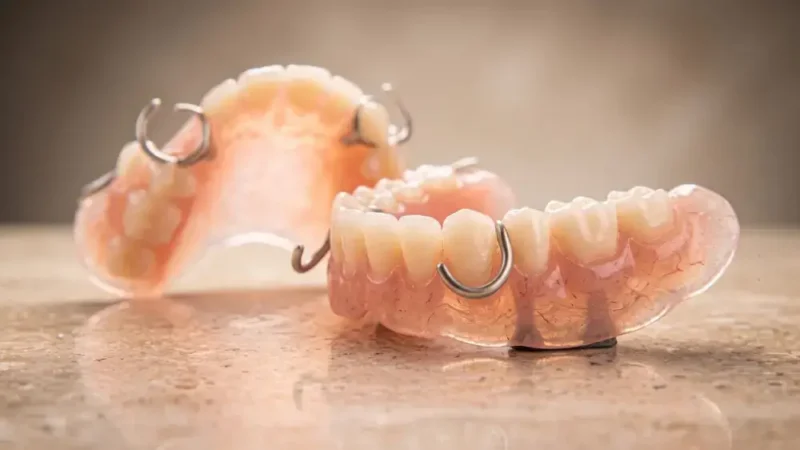
A partial denture replaces some teeth and clips onto the remaining ones with metal or tooth-colored clasps. It is the cheapest and quickest option, and it can be added to later if you lose more teeth.
It does need monitoring. The clasps pull on the anchor teeth, and without careful cleaning those teeth are the ones that develop decay and start to loosen. Partial denture wearers need to be more rigorous about hygiene, not less.
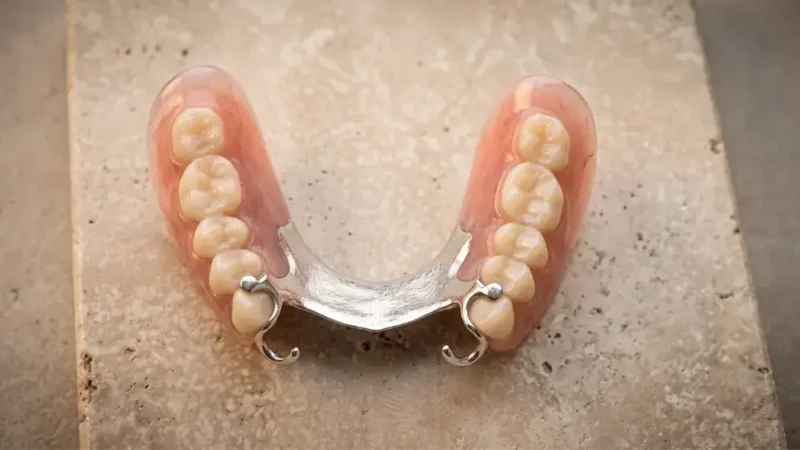
A cast metal partial, called a chrome denture in the UK, has a load-bearing framework in cobalt-chrome or titanium. It spreads chewing forces across several teeth instead of pressing into the gums. It is noticeably more stable, thinner and less bulky across the palate than an acrylic partial. Precision-attachment versions eliminate visible clasps entirely. It costs more, but when you still have healthy anchor teeth, it is the right call.
Flexible partials use a nylon-type base instead of acrylic and metal. They avoid visible clasps and are comfortable for many wearers, but they cannot be relined easily and tend to need full replacement rather than adjustment.
An immediate denture is made in advance and fitted the same day your teeth are extracted, so you are never without teeth. The catch is that gums shrink substantially as they heal, so an immediate denture loosens over the following months and needs relining or remaking. Treat it as a transitional appliance, not a final one.
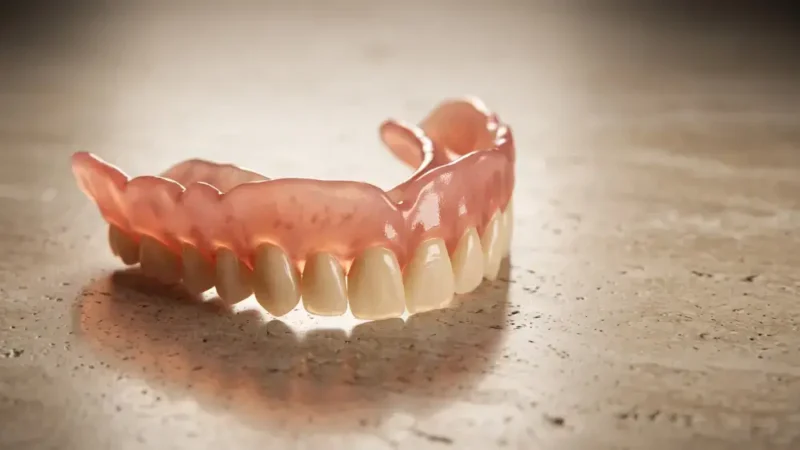
A denture without a palate restores your sense of taste and temperature and reduces gagging. But removing the palate removes the suction that holds an upper denture in, so retention has to come from somewhere else: at minimum two to four implants with ball attachments, locators or a bar. Versions without implants exist but only suit unusually favorable ridges.
This is the only category that replaces the tooth root as well as the crown. Titanium posts are placed in the jaw and become the new anchor. Because they transmit chewing force into the bone, implants slow or stop resorption instead of accelerating it. All three options below require enough bone volume, confirmed with a CBCT scan rather than a standard X-ray.
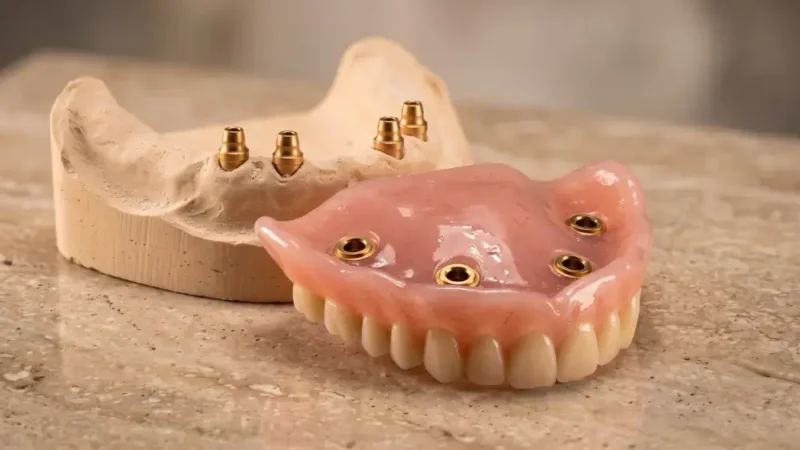
A snap-in denture clips onto two or four implants. It still comes out for cleaning, but it does not move while you eat. This is the best balance of stability and cost, and it is transformative in the lower jaw where conventional dentures have so little to hold onto.
Worth knowing: an overdenture still rests partly on the gums, so it needs periodic relining like any removable denture, and the retention inserts wear out and need replacing every year or two.
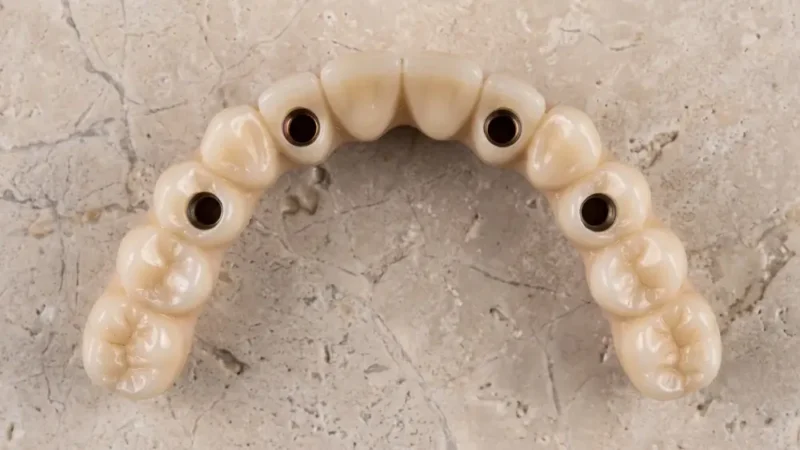
All-on-4 and All-on-6 support a complete fixed bridge on four or six implants per arch. All-on-4 suits reduced bone volume and the least invasive approach. All-on-6 gives more stability and spreads forces more evenly, which is why it is often preferred in the upper jaw where bone is softer.
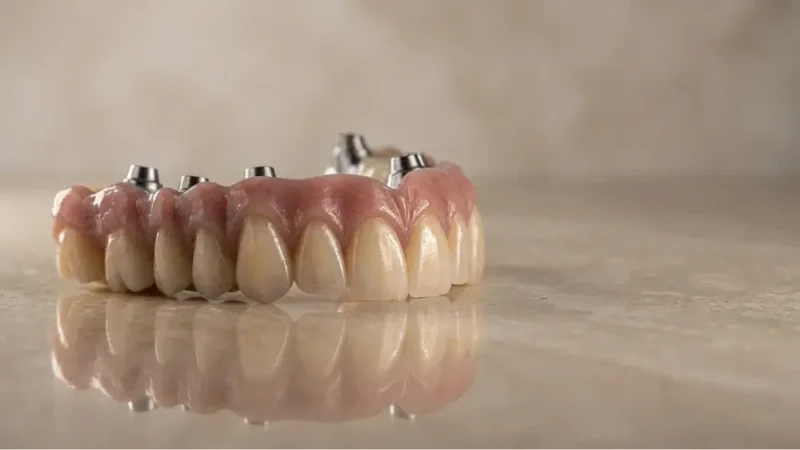
A fixed full-arch restoration is screwed onto multiple implants, now usually milled from a single block of monolithic zirconia. Unlike older acrylic-on-metal versions, zirconia resists wear and holds its color. Your dentist can unscrew it for maintenance, but you cannot remove it. It has the best documented functional and aesthetic outcomes of any option here.
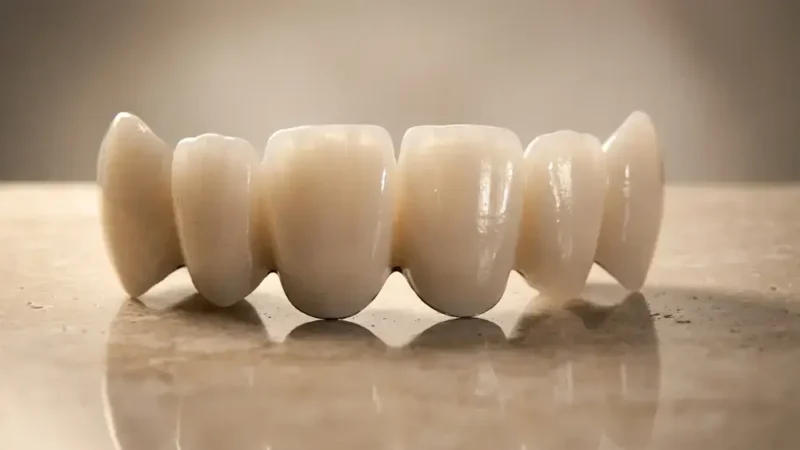
If you are only missing one or a few teeth, fixed options may serve you better than a partial denture. Neither is technically a denture, but both compete for the same job.
A dental crown caps a damaged tooth and restores its shape and strength. It requires filing down the natural tooth, which is irreversible.
A dental bridge replaces missing teeth by anchoring to the neighbors, which are crowned as supports. A three-unit bridge replaces one tooth using two as pillars. It is fast and requires no surgery, but you file down two healthy teeth to replace one, and the bone under the false tooth keeps shrinking anyway.
Partial denture | Bridge | Implant | |
Healthy teeth affected | clasped, not filed | two filed down | none |
Surgery | no | no | yes |
Bone preservation | none | none under the pontic | yes |
Cost per tooth (US) | $ | $$ | $$$ |
Lifespan | 5–8 yrs | 10–15 yrs | 15+ yrs |
No option wins on every measure. Each one pays somewhere: price, comfort, surgery, bone loss, maintenance or longevity.
Factor | Removable dentures | Bridges and crowns | Implant-supported |
Chewing comfort | low to moderate | high | very high |
Appearance | variable | very good | excellent |
Bone preservation | none, speeds up loss | none under the pontic | high |
Invasiveness | none | moderate (filing) | high (surgery) |
Maintenance | daily cleaning, relines | meticulous flossing | strict hygiene, checkups |
10-year cost | moderate to high with remakes | moderate | moderate, spread out |
The decision gets made on a CBCT scan, not on a price list. Your budget determines what you can spend; your bone, gums and remaining teeth determine what is actually possible. There is no “best denture,” only options compatible with your mouth and your priorities.
A denture does not look natural because the color is right. It looks natural because it handles light the way enamel does: letting it enter, scattering it inside the material, and giving it back with varying intensity along the tooth.
A natural tooth is more opaque at the gumline, where dentin dominates, and progressively more translucent toward the biting edge. Reproducing that gradient is the real work of a dental technician, and it is the single biggest difference between an economy denture and a premium one.
Material | Appearance | Strength | Lifespan | Best for |
Acrylic (PMMA) | fair | low | 5–8 yrs | denture bases, full and partial |
Premium denture teeth | very good | moderate | 8–10 yrs | high-aesthetic dentures |
Flexible nylon | good | moderate | 5–8 yrs | partials without metal clasps |
Cobalt-chrome | n/a (framework) | very high | 10+ yrs | cast metal partials |
Monolithic zirconia | good | maximum | 15+ yrs | fixed full-arch, grinders |
Layered zirconia | very good | very high | 15+ yrs | crowns, bridges, full arches |
Lithium disilicate | excellent | good | 10–15 yrs | front crowns and veneers |
Porcelain-fused-to-metal | fair | high | 10–15 yrs | long bridges, tighter budgets |
The practical point: an economy denture and a premium one carry the same name but use very different teeth. The difference shows the first time you smile, and it shows again in how long the color holds.
Denture costs in the US range from around $450 for an economy plate to over $15,000 per arch for fixed implant work. Prices are quoted per arch, not per set, so replacing both jaws roughly doubles the figure.
Treatment | Cost per arch |
Economy full denture (stock teeth) | $450–$900 |
Standard full denture | $1,000–$3,000 |
Premium full denture | $3,000–$6,500 |
Acrylic partial denture | $800–$2,700 |
Flexible partial denture | $900–$2,500 |
Cast metal partial denture | $1,300–$3,100 |
Immediate denture | $1,200–$3,500 |
Snap-in denture on 2–4 implants | $3,000–$7,300 |
Fixed implant denture / All-on-4 | $8,000–$15,000+ |
Single implant with crown | $1,600–$3,500 |
For a standard upper and lower set, most people land around $3,000–$5,000 before insurance.
Treatment | Cost |
NHS dentures, crowns or bridges (England, Band 3) | £332.10 |
Private acrylic full denture | £500–£1,500 per arch |
Private premium full denture | £1,500–£2,500+ per arch |
Private acrylic partial | £400–£1,000 |
Chrome (cobalt-chrome) partial | £700–£1,800 |
Flexible partial | £600–£1,400 |
Implant-retained overdenture | £3,500–£8,000 per arch |
Full-arch implant bridge | £9,000–£20,000 per arch |
NHS Band 3 covers dentures, crowns and bridges for a single flat charge, which makes NHS dentures dramatically cheaper than private ones. Charges differ in Scotland, Wales and Northern Ireland. Treatment is free in England if you are under 18, pregnant or have had a baby in the last 12 months, or receive certain income-related benefits.
These add up fast and are often quoted separately:
Most private dental plans classify dentures as major restorative work and cover roughly 40–50%. The catch is the annual maximum, typically $1,000–$2,500, which usually runs out before the treatment does. Plans commonly add a 6–12 month waiting period and a frequency limit allowing replacement only every 5–8 years. Always request a pre-treatment estimate in writing.
Original Medicare does not cover dentures. Some Medicare Advantage plans do, up to an annual cap that rarely covers the full cost. Medicaid coverage varies by state — some states cover one set every five or six years, others cover nothing for adults.
Implants are treated separately and worse. Basic plans typically exclude them entirely; better plans may cover the crown but not the implant post.
You can pay with pre-tax dollars through an FSA or HSA, which effectively discounts the cost by your marginal tax rate. Dental expenses may also be deductible as medical expenses if your total unreimbursed medical costs exceed the IRS threshold for the year and you itemize.
NHS dentistry works on a banded charge, not a percentage. Dentures sit in Band 3 alongside crowns and bridges, and the charge is the same whether you need one denture or a full upper and lower set. Implants are almost never available on the NHS except in specific clinical circumstances such as after mouth cancer or major trauma.
Conventional dentures last 5–10 years, cast metal partials 7–10, and implant-supported restorations 15 years or more. Six things determine longevity:
Type | Average | With good care | Usual reason for replacement |
Acrylic partial | 5–8 yrs | 8–10 yrs | wear and ridge resorption |
Full denture | 5–10 yrs | 10–12 yrs | bone loss, poor fit |
Cast metal partial | 7–10 yrs | 12 yrs | loss of an anchor tooth |
Flexible partial | 5–8 yrs | 8 yrs | cannot be relined |
Snap-in denture | 10–15 yrs | 15+ yrs | worn retention attachments |
Fixed implant bridge | 15+ yrs | 20–25 yrs | peri-implantitis, fracture |
The gap between a denture lasting five years and twelve is built in about three minutes a day. Plaque does not distinguish between natural teeth and acrylic. Wherever it collects, it inflames the tissue underneath.
Cleaning dentures happens outside your mouth, with products made for the job. The most common mistake is treating them like natural teeth, which is the fastest way to dull the surface within months.
Fixed restorations do not come out, so all cleaning happens in the mouth. The critical zone is underneath the bridge and around the gumline, where a normal toothbrush cannot reach.
A denture gets replaced when the anatomy underneath it has changed, or when it loses precision, grip or structural integrity. Usually the appliance still looks fine. What changed is the ridge it sits on, and continuing to wear it in that state accelerates bone loss.
Not every problem needs a new appliance. A targeted fix often restores function for a fraction of the cost.
Situation | Treatment | Time | Cost (US) |
Loose denture, base intact | chairside reline | 1 visit | $200–$400 |
Very poor fit, ridge much changed | laboratory reline | 2–3 days | $350–$600 |
Fractured acrylic base | repair | 1–2 days | $100–$300 |
Tooth broken off the denture | replace the tooth | 1–2 days | $100–$250 |
Stretched or bent clasps | adjust or replace clasp | 1 visit | $100–$250 |
Worn snap-in attachments | replace retention inserts | 1 visit | $200–$500 |
General wear after 6–8 years | full remake | 3–5 weeks | full price |
Loss of an anchor tooth | remake or convert | 4–6 weeks | full price |
Making a new removable denture takes four or five appointments over three to five weeks:
The first few days with new dentures are almost always worse than people expect, and almost always better than they fear after week one. Adjustment takes about a month. It is a neuromuscular process: your tongue, lips and cheeks have to reprogram movements they automated years ago.
Some things are not part of normal adjustment:
A $3,500 quote and a $12,000 quote for the same arch describe two different levels of risk. In prosthetics, an unusually low price is almost always a symptom of untraceable materials, reused components, or resin sold as zirconia.
Ask these before you agree to anything:
Every implantable medical device carries two identifying codes. The REF number identifies the product model; the LOT number identifies the manufacturing batch. Together they trace back to the manufacturer, specifications and production date.
In practice these are your only verifiable proof of what was actually placed in your mouth. The sticker labels from your implants go into your chart and are handed over on request. That is standard practice, not a favor.
You are entitled to receive, once treatment is complete:
People arriving for a first consultation rarely talk about tooth counts. They talk about having stopped eating in front of others, covering their mouth when they speak, not smiling in photographs. That is where the result is actually measured.
Clinically, three things are documentable: