
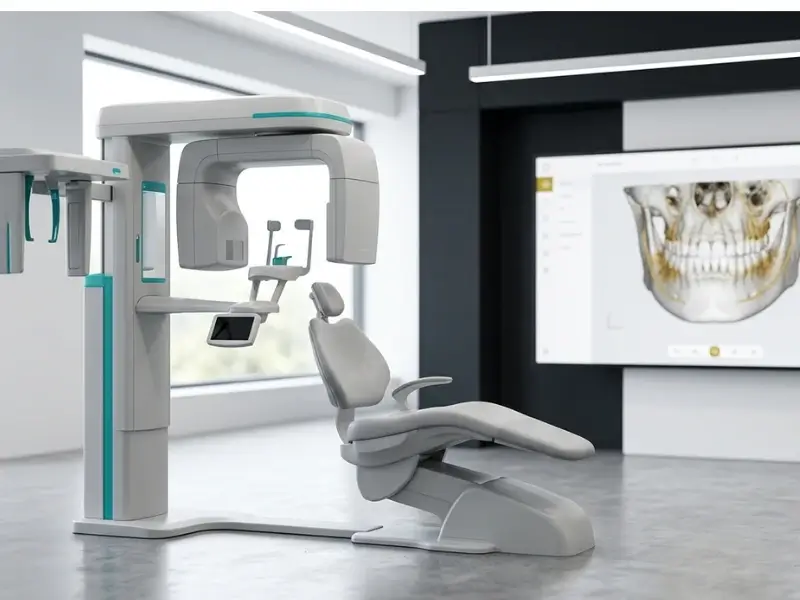
A CBCT scan dental (Cone Beam Computed Tomography) is a type of X-ray used when regular dental or facial X-rays are not sufficient. This technology generates three-dimensional (3D) images of dental structures, soft tissues, nerve paths, and bone in a single scan. By using a cone-shaped X-ray beam, the scanner rotates around the patient’s head, capturing data that is reconstructed into a detailed 3D model.
CBCT scan dental has become an essential tool for complex treatment planning. It allows visualizing anatomical landmarks that are invisible on standard 2D films, such as the position of the mandibular nerve or the thickness of the alveolar bone. This level of detail is critical for ensuring patient safety and procedural predictability in oral surgery.
How CBCT Scan Dental Images Differ from Traditional X-rays?
Traditional dental X-rays, such as bitewings or panoramic films, provide a flat, two-dimensional view of the mouth. While these are for detecting surface-level cavities or gross bone loss, they are prone to magnification errors and structural overlapping. As the human oral cavity is a complex three-dimensional environment, a 2D image hides underlying pathologies or distorts the distance between vital anatomical structures and a planned surgical site.
CBCT scan dental images provide a 1:1 ratio representation of the patient’s oral anatomy, enabling them to view the jaw from axial, sagittal, and coronal planes. Clinical data suggests that 3D imaging offers higher sensitivity for identifying periapical lesions and subtle bone density variations, ensuring that surgical planning is based on precise, undistorted measurements.
Why is it Preferred?
Unlike standard medical CT scanners, cone-beam systems are engineered specifically for the maxillofacial region, allowing for superior resolution of hard tissues like teeth and bone. By providing a true-to-life scale, clinicians can perform virtual treatment planning, virtually placing implants to assess the necessary size and positioning before the operation.
While 2D images often hide details behind bone or fillings, 3D models can be rotated and layered to reveal what’s underneath. This allows dentists to pinpoint hidden infections and nerve paths, ensuring more accurate diagnoses, safer procedures, and predictable results for the patient.
When and Why CBCT is Needed?
- Dental Implants: Surgeons use CBCT scan dental images to assess the height, width, and quality of the bone. This allows for precise implant placement while avoiding the maxillary sinus or the inferior alveolar nerve.
- Root Canal Treatment (Endodontics): 3D imaging is vital for identifying complex root canal configurations, hidden canals, or vertical root fractures that are invisible on standard 2D films.
- Wisdom Tooth Extraction: A scan is often necessary to see the exact relationship between the roots of impacted third molars and the mandibular nerve canal, significantly reducing the risk of nerve damage.
- Orthognathic and Jaw Surgery: For patients requiring corrective jaw surgery, a CBCT scan dental provides a complete 3D roadmap of the facial skeleton, allowing for computer-aided surgical simulations.
- Temporomandibular Joint (TMJ) Disorders: 3D imaging allows for a detailed evaluation of the condyle and surrounding bone structures, helping to diagnose degenerative changes or structural anomalies in the jaw joint.
Is CBCT Scan Dental Procedure Safe?
Patient safety is a priority in diagnostic imaging, and a CBCT scan dental procedure is designed to follow the ALARA principle (As Low As Reasonably Achievable). While it involves more radiation than a standard bitewing X-ray, it uses less radiation than a traditional CT scan. CBCT machines utilize pulsed radiation technology, which captures the necessary data in seconds, minimizing the total exposure time for the patient.
A typical scan exposes a patient to roughly 20 to 100 microsieverts ($\mu Sv$), which is comparable to the background radiation received during a short cross-country flight. Lead aprons and thyroid collars are used to protect non-target areas.
According to the European Academy of DentoMaxilloFacial Radiology (EADMFR), 3D imaging is essential to avoid compromising the maxillary sinus or the inferior alveolar nerve during surgery.
The Step-by-Step Experience of a Scan
The process of obtaining a CBCT scan dental is straightforward and non-invasive, taking less than a minute. Unlike medical CT scanners that require you to lie in a tunnel, a dental CBCT allows you to sit or stand comfortably. You will be asked to remain completely still while the machine’s C-arm rotates 360 degrees around your head. This rotation captures multiple high-resolution CBCT scan dental images from various angles to create a comprehensive 3D model.
Prior to the scan, you must remove any metal objects, such as jewelry, eyeglasses, or removable dental appliances, as these can cause interference with the image quality. A specialized chin rest and head supports are used to ensure your head remains in the correct position. Most patients find the CBCT scan dental procedure much easier than traditional impressions or standard X-rays, as there are no sensors placed inside the mouth to cause a gag reflex.
The Cost of CBCT Scan in Turkey vs International
A CBCT scan dental procedure in the United States or the UK can range from $300 to $600, often not covered by basic insurance unless medically necessary for surgery. In contrast, the cost for the same high-quality CBCT scan dental images in Turkey is significantly lower, typically ranging between $50 and $120 and it’s generally included in your package.
This price difference does not reflect a lower standard of care; rather, it is due to lower operational costs and a highly competitive medical tourism market. Many clinics in Turkey utilize the latest European and American 3D imaging technology, ensuring that patients receive world-class diagnostic precision at a fraction of the cost. Below is a comparison of typical diagnostic costs across different regions:
Country | Average CBCT Scan Cost (USD) | Technology Standards |
USA | $350 – $600 | High-End Digital |
United Kingdom | $300 – $550 | High-End Digital |
Turkey | $50 – $120 | High-End Digital |
Germany | $250 – $450 | High-End Digital |
Comparing Diagnostic Tools
Feature | Periapical X-ray (2D) | Panoramic X-ray (Pano) | Medical CT Scan | CBCT Scan (3D) |
Dimension | 2D (Flat) | 2D (Flat) | 3D (Volumetric) | 3D (Volumetric) |
Radiation Dose | Very Low | Low | Very High | Low to Moderate |
Primary Use | Cavities / Roots | General Overview | Internal Organs | Maxillofacial / Teeth |
Bone Detail | Moderate | Low | High | Extremely High |
Distortion | High (Overlapping) | High (Magnification) | Minimal | None (1:1 Ratio) |
Improving Implant Success with CBCT Scan Dental Images
The success of dental implants depends on the “Primary Stability” of the fixture within the bone. Without a CBCT scan dental procedure, a surgeon is working with a 2D map of a 3D landscape. By using CBCT scan dental images, the surgical team can measure the exact bone density and volume available at the site. This prevents the common complication of “fenestration,” where the implant accidentally perforates the thin vestibular bone.
Furthermore, advanced software allows for Guided Surgery. The 3D data from the CBCT scan dental is used to 3D-print a surgical guide that fits over the patient’s teeth. This guide has a pre-drilled hole at the exact angle and depth required, ensuring the implant is placed with sub-millimeter precision. This level of accuracy significantly reduces healing time and increases the long-term success rate of the restoration.
Frequently Asked Questions (FAQs)
How long does a CBCT scan dental take?
The actual rotation of the scanner takes between 10 and 40 seconds. The entire appointment, including positioning, usually lasts less than 15 minutes.
Will I feel any pain during the procedure?
No. A CBCT scan dental is completely non-invasive and painless. There are no sensors placed inside your mouth, and you will not feel the radiation.
How often should I get a 3D dental scan?
Unlike routine X-rays, a CBCT scan dental is only performed when medically necessary for a specific treatment, such as an implant, root canal, or oral surgery.
Can I get a CBCT scan if I am pregnant?
As with all X-rays, you should inform your dentist if you are pregnant. While the radiation is targeted to the head, elective scans are often postponed until after pregnancy as a precaution.
Are CBCT scan dental images better than regular CT scans?
For dental purposes, yes. They offer higher resolution for teeth and bone while exposing the patient to significantly less radiation than a medical-grade CT.