
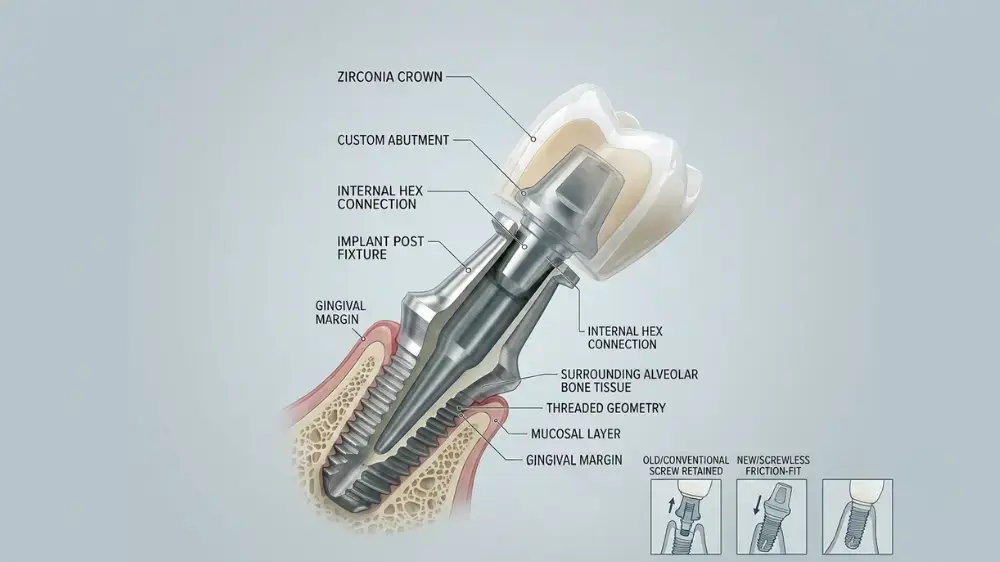
Screw-retained implants have worked well for three decades, but they carry a flaw: the screw can loosen, and the pocket it leaves behind can trap bacteria. Screwless dental implants — also called conometric or friction-fit — were designed to solve that problem. At One Life Dental, we specialize in screwless bionic systems, combining the experience of Dr. Astolfi with the precision of our ComfyDent laboratory.
A screwless dental implant (also known as Conometric or Friction-Fit implant) represents the third generation of implantology, engineered to solve 3 recurring issues of traditional dental implants: screw loosening, microleakageand visible screw heads. Today, 5-axis CAD/CAM milling makes friction-fit implants far more consistent than ever.
An implant that replaces the screw with cement is technically screwless, but it isn’t friction-fit and doesn’t solve the problem most patients try to avoid. At One Life Dental, “screwless dental implants” mean a true conometric/friction-fit connection, with neither a screw nor cement.
There are two families of friction-fit systems: the locking-taper system (Bicon, 1980s), and the conometric crown system (the newest formula):
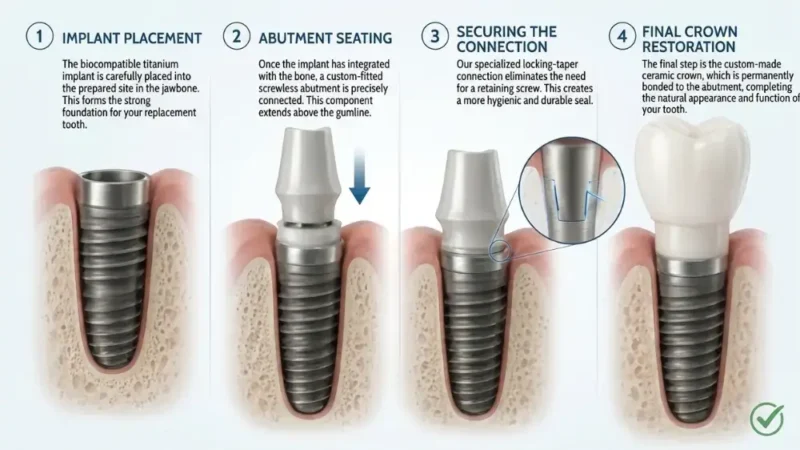
The secret to friction-fit implants lies in conic geometry. Instead of using screws or cement, they lock dental crowns with a taper system. The abutment and the internal cap of the crown are milled through CAD/CAM technology with nanometric precision, so that the two fuse under light pressure.
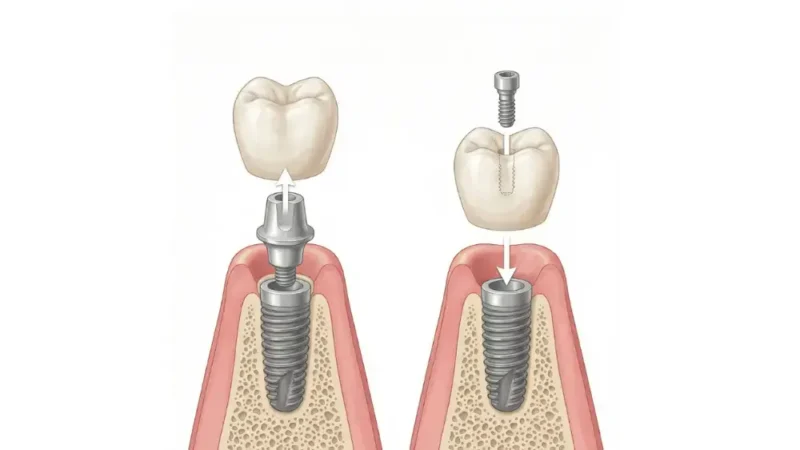
Screwless implants substitute two failure points (the retainer screw and cement) for a single, sealed connection. This is why their long-term complication rate is the lowest of the three dental implant systems.
Screwless implants close the two failure points that affect traditional restorations:
Screw-Retained | Cement-Retained | Screwless (Friction-Fit) | |
Main risk | Screw loosening — up to 48% of single-tooth cases over time | Excess cement trapped below the gumline | Sealed friction-lock — no screw, no cement |
Bacteria pathway | Microleakage through the screw-access channel | Cement margin sits under the gum | Hermetic seal — no access point |
Aesthetics | Visible screw-access hole in the crown | No hole, but a cement line can show | 100% solid crown surface |
Removability | Screw can seize or strip over time | Hard to remove without damaging the crown | Releasable with a specialised dental tool |
(Source: Stanbouly et al., “Design and the future of locking-taper screwless and cementless dental implants,” Frontiers of Oral and Maxillofacial Medicine, 2024.)
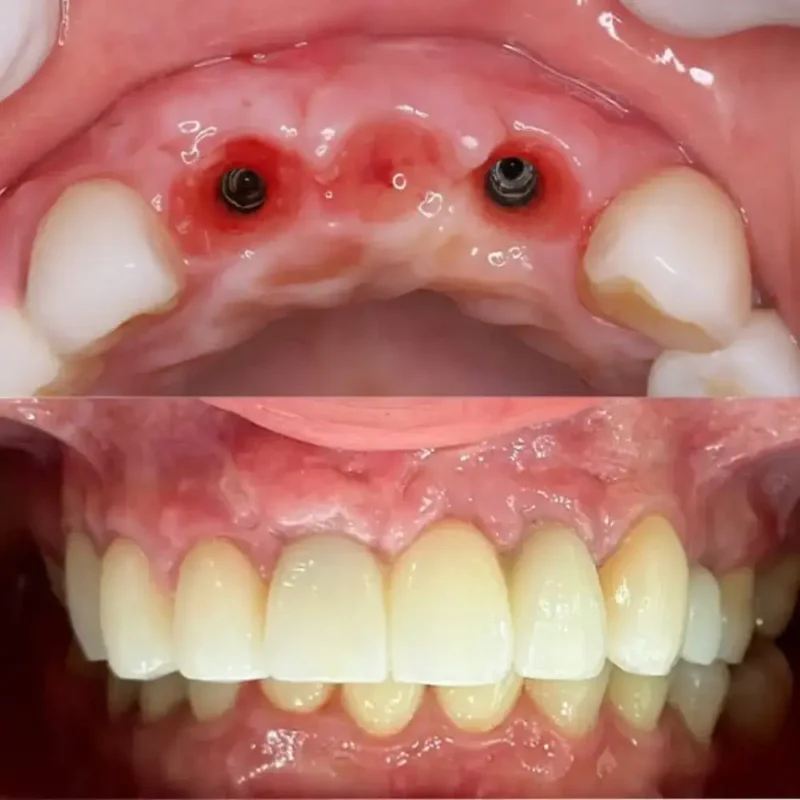
The above image shows screwless zirconia crowns seated using a friction-fit taper. Crowns are 100% ceramic zirconia, making the restoration blend with natural teeth colour and light transmission. Notice how the gumline sits symmetrically around each crown. It’s the level of precision that CAD/CAM technology allows.
Screwless dental implants have important benefits that make them the preference of many patients and dentists worldwide. For example, far from being unreachable, they allow for easy cleaning and replacement. Overall, the core benefits are fewer risks, better aesthetics, and easier maintenance than tradional screw-retained options.
Here are the main advantages of the conometric implant system, at a glance:
The crown is one solid, uninterrupted surface, there’s no filling material that can discolour or chip and giveaway the retainer screw.
With no screw channel and no cement under the gumline, there’s no obvious way for bacteria to reach the implant-abutment junction — one of the main contributors to peri-implantitis.
Screw loosening is the most common complication in dental implants, reported in up to 48% of cases over time. The friction-lock connection removes that failure point entirely.
Because the crown sits on a hermetic, one-piece seal, the result blends more seamlessly with surrounding teeth, making screwless implants particularly valuable for front teeth.
Without a screw-access hole to trap debris, most patients find the crown margin easier to brush and floss around than a screw-retained implant.
Despite having no screw, a dentist can release the friction-lock whenever the crown needs inspecting, cleaning, or replacing.
A 10-year prospective study of 642 patients and 1,494 locking-taper implants recorded a 98.7% overall survival rate (99.1% mandible / 98.3% maxilla), with an 88.6% complication-free rate (Stanbouly et al, 2024).
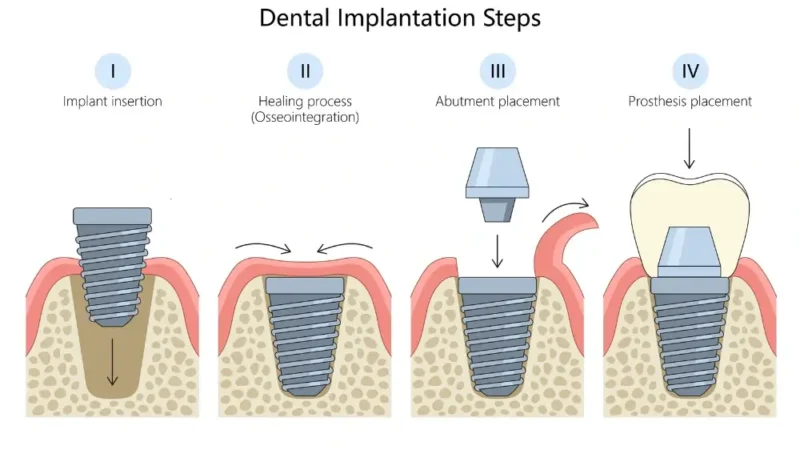
Screwless implants surgery is performed under local anesthesia. The dental implant process follows the same protocols as traditional implants, and usually lasts anywhere from 1.5 to 4.5 hours, depending on the number of implants and the complexity of the case.
Here is the typical 6-step process:
The initial step, which involves mapping your smile digitally — shade, tooth shape, and gumline, to ensure the perfect final fit.
A Cone-Beam CT scan maps bone density, nerve position and sinus boundaries, ensure precision and safety when placing the implants.
The implant fixture is placed under local anaesthesia using a surgical guide — the same step as a conventional implant, ensuring total safety.
A 3–to-6-months dental implant healing period allows the fixture to fuse with the jawbone, becoming an integral part of your body (a process known as osseointegration).
Once healing is confirmed, the abutment and the internal crown cap are milled on 5-axis CAD/CAM equipment to guarantee a friction-tight fit.
The finished zirconia crown is tapped into place under light, controlled pressure — no screw, no cement are required.
Yes, assuming an experienced periodontist or an oral and maxillofacial surgeon perform it. Screening is also key to guarantee safety and success. The friction-fit taper only performs at its best in the right conditions for the right patient.Below, you can also learn all about the risks and potential complications of screwless implants.
Most patients missing one or more teeth are usually suitable for the procedure. You’re likely a good candidate for screwless (conometric) implants if you have:
A single screwless dental implant costs between $500 and $7,500 worldwide — Turkey and Hungary sit at the low end, the US and Australia at the high end, with most Western European and North American clinics landing between $3,000 and $6,000 per tooth.
(Note: published country-by-country data covers standard implants; screwless/conometric technology typically adds a 10–20% premium over a conventional screw-retained implant, reflecting the extra lab precision required — see the exact One Life Dental Price for dental implants in Turkey further down.)
A single-tooth implant in the US typically costs $3,000–$5,000. That price normally includes the fixture, the abutment, and the final crown. Original Medicare only covers dental implants when the implant is directly tied to a procedure, such as reconstruction after head and neck cancer.
A single private implant in the UK runs £1,800–£4,500 (average around £2,500), typically including the consultation, 3D scan, fixture, abutment and crown. NHS-funded implants exist only in exceptional medical cases — severe facial trauma, cancer reconstruction, or congenital conditions like hypodontia.
In Turkey, a screwless (conometric) implant costs $500–$950 per tooth, with the Digital Smile Design, custom conometric abutment, and your accommodation often included in that price. You can also find attractive full mouth dental implants package deals in Turkey.
Country | Approx. USD |
🇺🇸 United States | $3,000 – $5,000 |
🇬🇧 United Kingdom | $2,280 – $5,700 |
🇨🇦 Canada | $2,150 – $4,300 |
🇦🇺 Australia | $1,950 – $4,550 |
🇹🇷 Turkey | $500 – $950 |
🇲🇽 Mexico | $1,000 – $2,500 |
🇭🇺 Hungary | $800 – $1,500 |
🇵🇱 Poland | $700 – $1,400* |
🇪🇸 Spain | $1,000 – $1,500 |
Figures are for single-tooth implant (fixture + abutment + crown), sourced from national dental associations, insurer guides and 2026 market reports. This range is a reasonable estimate based on comparative market reports, not an official fee schedule.
Because conometric systems rely on micron-level friction, non-original implants easily lead to failure. With One Life Dental, every screwless component used in your restoration is accompanied by its original REF (Reference) and LOT (Batch) codes. These codes allow you to track the provenance of the titanium and zirconia back to the manufacturer (such as Straumann or Nobel Biocare).
A good clinic will welcome every one of these questions. If you’re getting vague, rushed, or defensive answers to any of them, treat that as useful information in itself. Here’s what’s worth asking at your consultation.
The fixture itself (the titanium/zirconia post) can last a lifetime; the crown typically needs replacing after 10–15 years. However, longevity depends less on the technology itself and more on how the case was planned, and how well the patient maintains it afterward.
Screwless dental implants remove two failure points of traditional implants, but it’s important to consider they introduce a few of their own. No implant system is risk-free. This being said, the risks associated with screwless implants are about execution — lab precision, case selection, and surgeon experience — and patient habits post-op. Not about the system per se.
Research in this space is moving in three main directions in 2026, even though these are still emerging technologies rather than established, widely-available options:
Screwless technology isn’t the right fit for every patient or every case. Here’s how it compares to the main alternatives:
The most widely used system worldwide, with the longest overall track record and full retrievability at virtually any dental practice.
No visible access hole and a lower lab-precision requirement than screwless systems, but excess subgingival cement can contribute to peri-implant bone loss, and the crown is harder to remove without damage if repair is ever needed.
Narrower-diameter implants used when bone volume is too limited for a standard-diameter fixture, often avoiding the need for bone grafting.
A non-implant option that anchors a false tooth to the two adjacent healthy teeth. Faster and cheaper upfront, but requires grinding down healthy teeth and does nothing to stop the jawbone loss that follows a missing tooth root.
The lowest upfront cost, but function at a fraction of natural chewing efficiency, accelerate bone loss over time, and typically need replacing or relining every 5–7 years.
For patients missing most or all of an arch, these use 4–6 strategically placed implants instead of one per tooth, and can be built with either a screw-retained or screwless full-arch bridge depending on the case.