
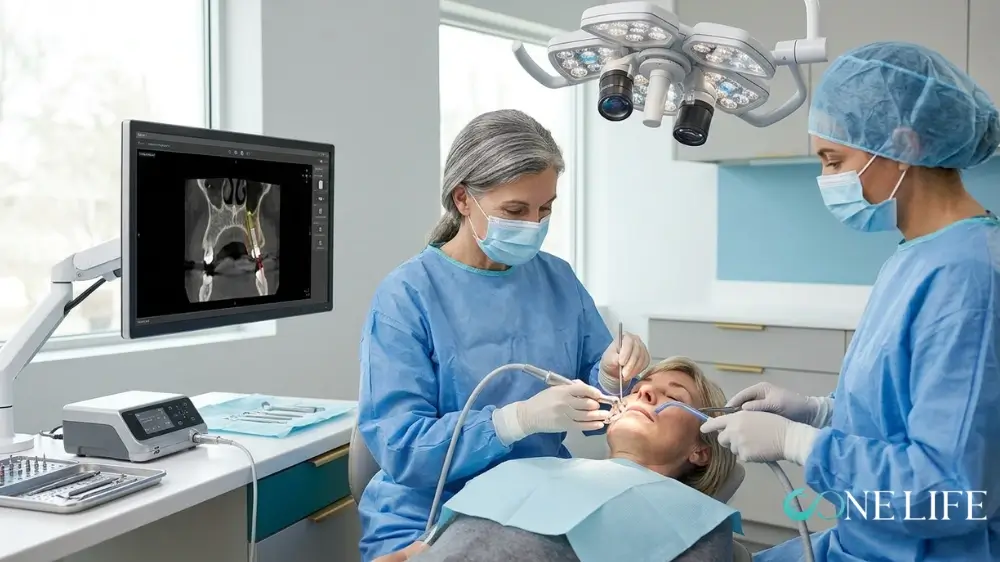
The best dentist in Turkey for dental implants is not necessarily the most popular, the cheapest, or the one with the most social media followers. From a clinical standpoint, it is a specialist who has been trained to operate inside the human jaw, bone, and face: an oral and maxillofacial surgeon.
TDental implant surgery requires anatomical expertise, the ability to manage complications, and the capacity to perform bone grafts, sinus lifts, or full-arch reconstructions. At OONE LIFE, every implant case is reviewed and operated on by Dr. Astolfi & Dr. Serkan, an oral and maxillofacial surgeon with specialist credentials.
How to Pick the Best Dentist in Turkey?
The single most important criterion is surgical specialisation in dental implant specifically. Choose a clinic led by an oral and maxillofacial surgeon — not a general dentist. Here is what to verify before you book:
- Specialist credentials. Your implant surgeon should hold a recognised post-graduate qualification in oral and maxillofacial surgery.
- Verified implant brands. Insist on internationally recognised systems — Nobel Biocare, Straumann, or Zimmer. OONE LIFE provides REF and LOT sticker codes so you can verify authenticity independently.
- 3D diagnostic imaging. Any clinic worth trusting uses CBCT 3D scanning before surgery. This is non-negotiable for safe implant planning.
- Independent reviews. Look beyond the clinic’s own website. Check Trustpilot and Google reviews for consistent, verified patient feedback over time.
- Transparent guarantees. A confident surgeon backs their work in writing. Ask for the terms of the implant guarantee.
- Post-operative support. Confirm that the clinic offers structured remote follow-up, not just a WhatsApp number.
- Clear, itemised pricing. Avoid clinics that quote a headline price and add costs later. Your treatment plan should be costed in full before you travel.
What Is an Oral & Maxillofacial Surgeon?
An oral and maxillofacial surgeon (OMS) is a specialist who has completed dental school and an additional 4 to 6 years of hospital-based surgical residency, covering head and neck anatomy, bone surgery, facial trauma, reconstructive procedures, and all levels of anaesthesia.
This distinction becomes critical the moment a dental implant is involved, because:
- The implant is placed directly into the jawbone, not the tooth
- The procedure requires precise 3D anatomical planning to avoid nerves and sinus floors
- Complex cases involvebone grafting, sinus lifts, or zygomatic implants — advanced surgical acts
- Complications, when they arise, require surgical judgment to resolve safely
General Dentist vs. Oral & Maxillofacial Surgeon
To put it plainly: a general dentist is trained to care for your teeth. An oral and maxillofacial surgeon is trained to operate on the structures beneath them — the bone, the nerves, the sinus cavities, and the jaw.
Many patients don’t realise that any licensed dentist can legally place dental implants in Turkey (and in most countries!). There is no universal law requiring a surgeon. And yet, the clinical quality of your procedure depends entirely on who you choose!
Here is a direct comparison:
General Dentist | Oral & Maxillofacial Surgeon | |
Education after dental school | None required | 4–6 years hospital surgical residency |
Bone surgery training | Limited or none | Extensive |
Anaesthesia administration | Local only (in most cases) | All levels, including IV sedation |
Bone grafting & sinus lifts | Rarely performed | Routine part of training |
Zygomatic / complex implants | Not qualified | Core specialist procedure |
Complication management | Limited | Trained for surgical emergencies |
Full-arch rehabilitation | Occasional | Standard scope of practice |
Why Dental Implants Are a Surgical Procedure
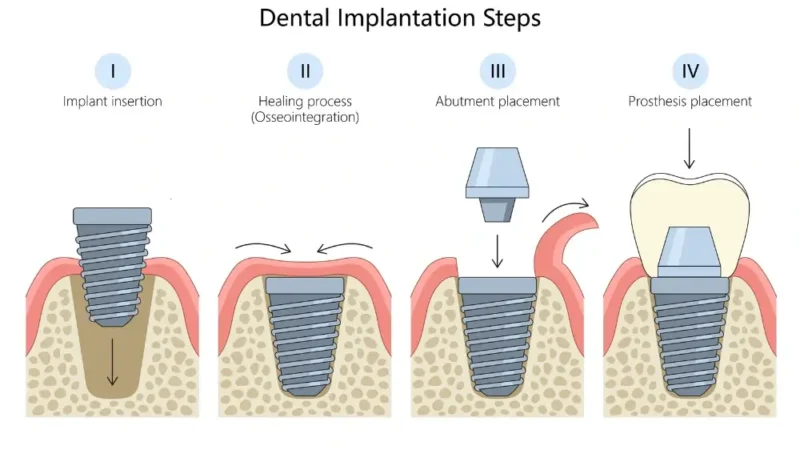
During the tooth implant process, the surgeon drills into living bone tissue, positions a medical-grade screw at a precise angle and depth. At OONE LIFE, Dr. Astolfi and Dr. Serkan treat every implant case as what it actually is: a surgical intervention. Pre-operative 3D imaging, detailed anatomical planning, and surgical protocols are standard.
This is bone surgery. And bone surgery carries surgical risks that demand surgical expertise:
- Nerve proximity. The inferior alveolar nerve runs through the lower jaw. Placing an implant too deep can cause permanent numbness or pain.
- Sinus floor integrity. Upper jaw implants sit millimetres below the maxillary sinus. A poorly planned placement can perforate it.
- Bone volume. Patients with bone loss — common after years of missing teeth — require grafting procedures before implants can even be placed. These are standalone surgical acts.
- Infection management. Post-surgical infection in the jaw is not a dental problem. It is a medical one.
Specialist Surgeons and Implant Success Rates

Board-certified oral surgeons and periodontists with advanced implant training consistently report higher success rates than general dentists placing implants. This reflects the cumulative impact of surgical experience, anatomical knowledge, and the ability to anticipate and manage complications before they escalate.
Here is what the current evidence shows:
- The cumulative prosthetic survival rate of All-on-4 dental implants is 8% — when performed under specialist protocols
- The overall 10-year implant success rate is currently 2%, up from 94.6% in previous studies, reflecting advances in implant surface technology, surgical techniques, and treatment planning DentalImplantOC
What Can Go Wrong When a Non-Specialist Places Your Implants?
Implant complications are rarely discussed openly in the dental tourism industry. But they happen — and when they do, the consequences can be serious, painful, and expensive to correct. At OONE LIFE, pre-operative risk assessment, 3D imaging, and surgical contingency planning are built precisely to prevent these outcomes.
The most common dental implant complications seen when non-specialists place implants include:
- Nerve damage. Incorrect depth or angulation can impinge on the inferior alveolar nerve, causing numbness, tingling, or chronic pain in the lip, chin, or tongue.
- Sinus perforation. In upper jaw cases, an implant placed without precise sinus floor mapping can penetrate the maxillary sinus, leading to chronic sinusitis and implant failure.
- Failed osseointegration. Poor primary stability is one of the leading causes of implant failure, accounting for 22.4% of cases — and it is almost always a consequence of inadequate surgical technique or planning.
- Implant malpositioning. An implant placed at the wrong angle compromises the final prosthetic result, affects bite function, and may be impossible to restore correctly without removal and replacement.
- Bone loss around the implant. Known as peri-implantitis, this inflammatory condition affects 38% of implant failures and is significantly more likely when surgical technique is suboptimal.
- Inadequate bone grafting. Patients with bone loss who receive implants without proper grafting face dramatically higher failure rates.
Why Choose Turkey for Dental Implant Surgery
Turkey’s rise as a global dental destination reflects a convergence of specialist clinical infrastructure, accredited technology, and exceptional value that is difficult to match.
What does Turkey offer that your home country often cannot?
- Cost savings of 60–80% compared to the UK, US, or Western Europe — even after adding flights and hotel.
- Premium implant brands — the same Nobel Biocare, Straumann, and Zimmer systems used in London or New York, at a fraction of the cost.
- No waiting lists.
- State-of-the-art diagnostics — 3D CBCT imaging, intraoral digital scanning, and CAD/CAM prosthetics are standard at leading clinics
- Internationally accredited facilities — top-tier Turkish clinics operate under Turkish Ministry of Health regulation and international quality standards
Dr. Serkan: Oral & Maxillofacial Surgeon at OONE LIFE
Choosing OONE LIFE means choosing a clinic designed around surgical precision and dental implants from the very first consultation and providing the mandatory free medical complication insurance. Here is what that looks like in practice.
Planning That Protects You
Every implant case at OONE LIFE begins with a comprehensive diagnostic workup — not a quick X-ray and a quote. Dr. Astolfi and Dr. Serkan review full 3D CBCT imaging to map bone volume, sinus proximity, nerve position, and implant angulation before a single incision is made. If bone grafting or a sinus lift is required, it is identified and planned at this stage — not discovered mid-surgery.
During Surgery: Specialist Hands
At OONE LIFE, implants are placed by Dr. Astolfi and Dr. Serkan — oral and maxillofacial surgeons, not general dentists delegating to junior staff. For full-arch cases such as All-on-4 or All-on-6, temporary prosthetics are fitted immediately after surgery, so you leave the clinic with functional teeth on the same day.
After Surgery: Support Continues at Home
The treatment does not end when you board your return flight. OONE LIFE provides:
- Detailed post-operative protocols and medication guidance
- Remote follow-up monitoring throughout the osseointegration period
- A written guarantee on implant work
- Direct access to the clinical team for any concerns during recovery