
Reviewed and approved by Dr. Víctor Astolfi, Periodontologist & ITI member.
530 MPa is the flexural strength of an IPS CAD emax crown after crystallisation. That’s 3-4 times stronger than tooth enamel (the hardest material in the human body). For an upper front tooth, that is close to perfect. But on a second molar in a patient who grinds, it isn’t enough. Ivoclar itself (the company that invented e.max) says so: three units maximum, no further back than the second premolar.
Below, find all key facts about this popular tooth restoration, its benefits and disadvantages, patient results, how much it costs and its surprising properties.
Key takeaways:
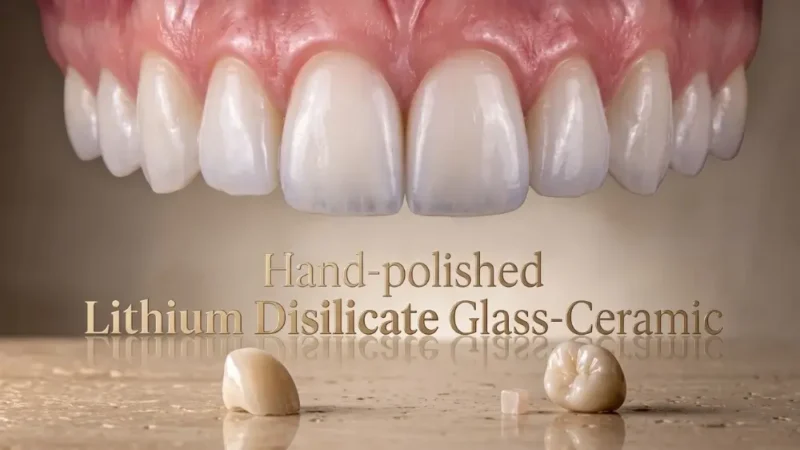
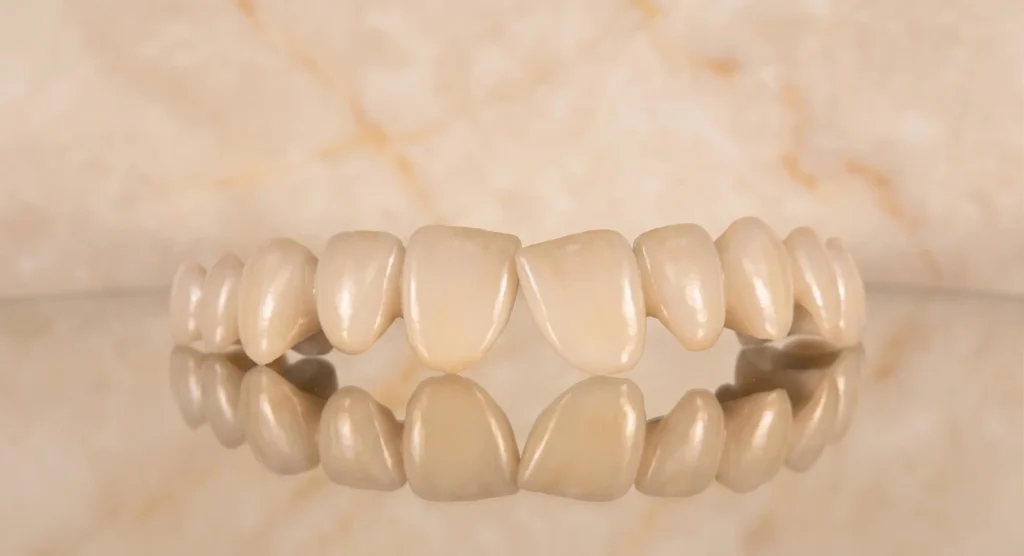
An e.max crown is a tooth cap made of lithium disilicate, a glass-ceramic developed by Ivoclar Vivadent in 2005. Light passes through an e.max crown the way it passes through natural enamel, rather than stopping at the surface. That is why lithium disilicate has been considered the premium type of dental crown for over 20 years now.
Zirconia cannot transmit light the same way. That’s because e.max’s lithium disilicate crystal are locked inside a glass matrix. That gives it its two main properties:
The 2 different types of e.max crown. IPS Press is an older version, beautiful but more fragile, made of leucite crystals. It is still used today for ultra-thin veneers where load is minimal.
IPS e.max replaced leucite crystals with lithium disilicate, roughly tripling strength while keeping its light-reflecting properties.
IPS e.max CAD | IPS e.max Press | |
Method | Milled from a block, then crystallised in a furnace | Pressed from an ingot in the laboratory |
Flexural strength | 530 MPa | 470 MPa |
Milling state | Soft “blue” state at ~130 MPa | Not applicable |
Best for | Chairside and digital workflows, single units | Thin veneers, complex layering, multiple units |
Indication limit | 3-unit bridges to the second premolar | 3-unit bridges to the second premolar |
An e.max crown reaches 530 MPa flexural strength after crystallisation, around five times the strength of traditional porcelain crowns, and half that of full-strength zirconia. For most non-molar teeth, that is comfortably enough.
Key Note: 360 MPa is the ISO-certified minimum value; 530 MPa is Ivoclar’s own tested mean. Independent guides sometimes cite 360–400 MPa for that reason.
Material | Flexural strength | Translucency | Best suited to |
Feldspathic porcelain | ~100 MPa | Excellent | Thin veneers, anterior units |
IPS Empress (leucite) | ~160 MPa | Excellent | Minimal-prep veneers |
IPS e.max Press | 470 MPa | Excellent | Front teeth, veneers, single crowns |
IPS e.max CAD | 530 MPa | Excellent | Front teeth, premolars, single crowns |
5Y-PSZ zirconia | ~500–800 MPa | High | Anterior crowns, low-load zones |
3Y-TZP zirconia | 900–1,200 MPa | Low | Molars, long-span bridges, grinders |
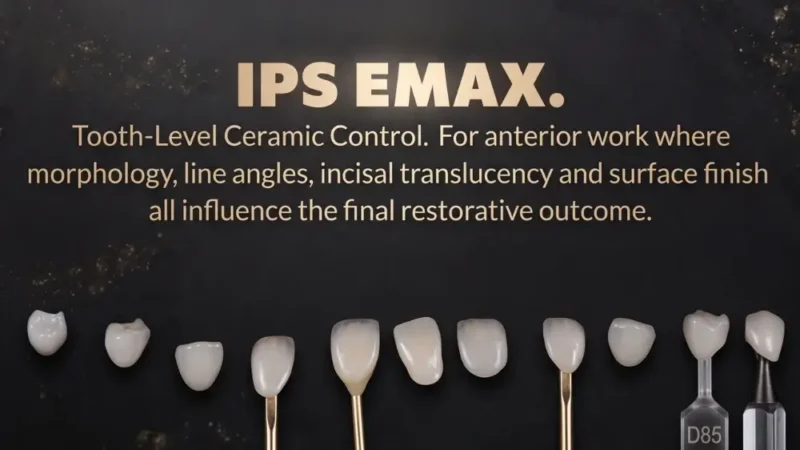
Natural teeth are layered: an opaque dentine core carrying the hue, covered by semi-translucent enamel that thins toward the edge and produces a faint blue-grey shimmer at the tip, called opalescence.
E.max crowns reproduce that reflecting property because their glass matrix transmits light rather than simulating it with surface staining.
Three secrets decide how beautifully your new crown blends in. These depend on the artistry and handcraft of lab technicians:
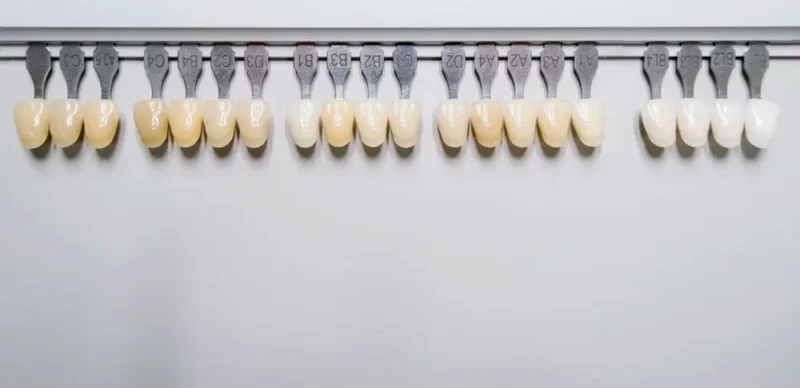
Your exact tooth shade is measured against the VITA Classical and VITA 3D-Master systems. Because e.max is translucent, the colour of the tooth underneath shows through.
Group | Hue family | Shades | Best for |
A | Reddish-brown | A1 · A2 · A3 · A3.5 · A4 | A common natural color |
B | Reddish-yellow | B1 · B2 · B3 · B4 | Lighter, warmer smiles |
C | Greyish | C1 · C2 · C3 · C4 | Ressembling ageing enamel |
D | Reddish-grey | D2 · D3 · D4 | Less frequent, muted tones |
BL | Bleach shades | BL1 · BL2 · BL3 · BL4 | Whitened and cosmetic cases |
An e.max crown normally takes two appointments, spread across five to seven working days. What follows is the treatment as it unfolds for most patients at One Life Dental.
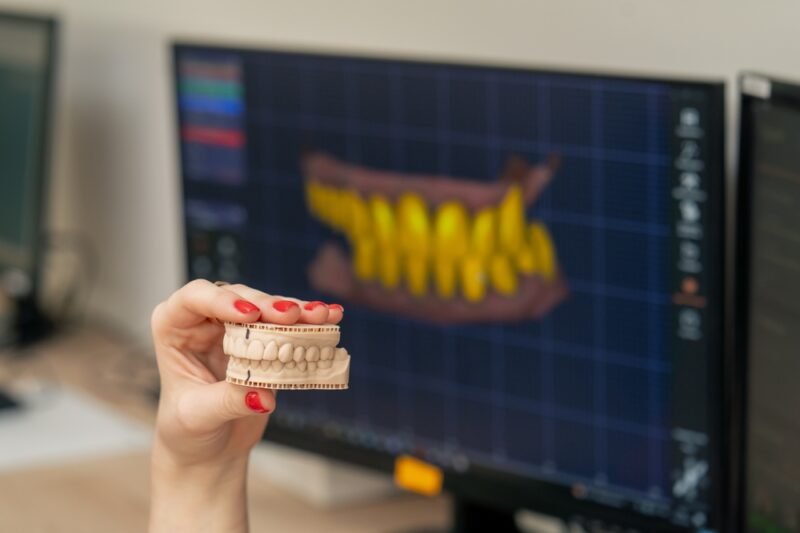
A 3D CBCT scan checks the health of each tooth and the bone beneath it, alongside a periodontal assessment and a bite analysis. Only then is a material chosen.
This is also where Digital Smile Design happens. An intraoral scan and facial photographs let the clinician design the restoration against your face. The reference points:
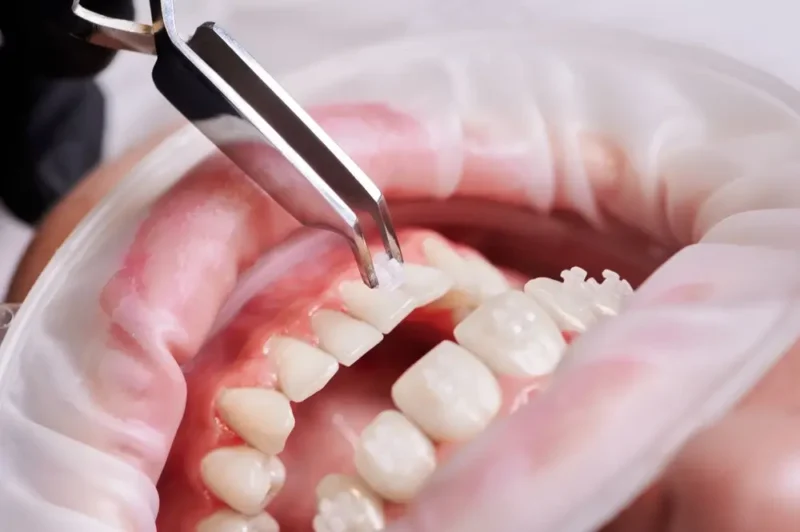
Under local anaesthetic, the tooth is reduced to create space for the ceramic. E.max requires roughly 1–1.5 mm, compared with 0.5–1 mm for a monolithic zirconia crown.
A prepared tooth will need a crown from that moment forward, permanently. An honest clinician should tell you whether a veneer, an onlay or bonding would serve you better.
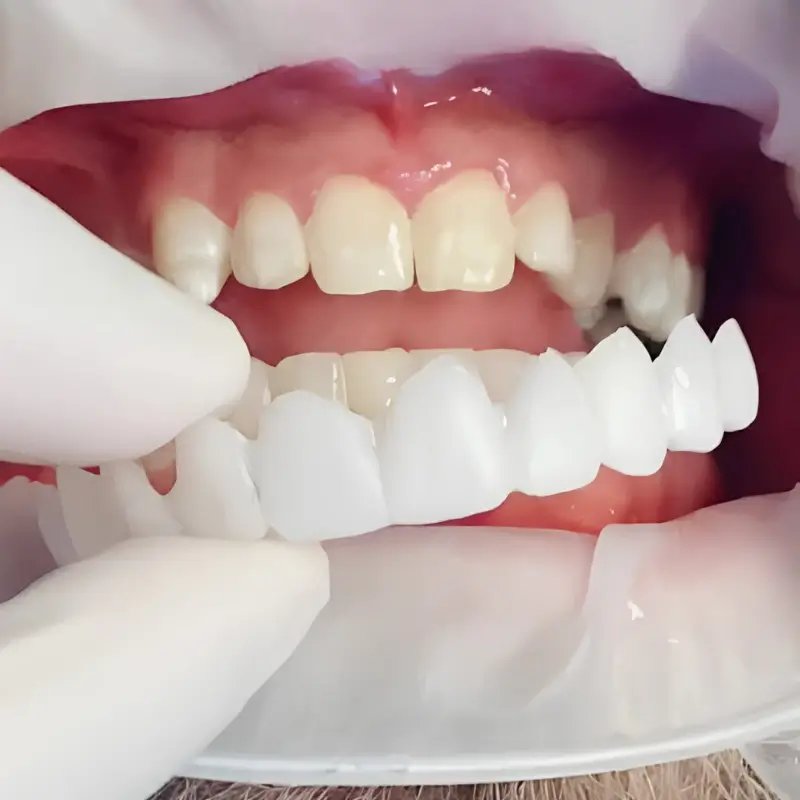
You wear the shape and length as temporaries and test them against real life: speech, eating, photographs, your own face in daylight. Length, shape and midline can all still be changed at this stage.
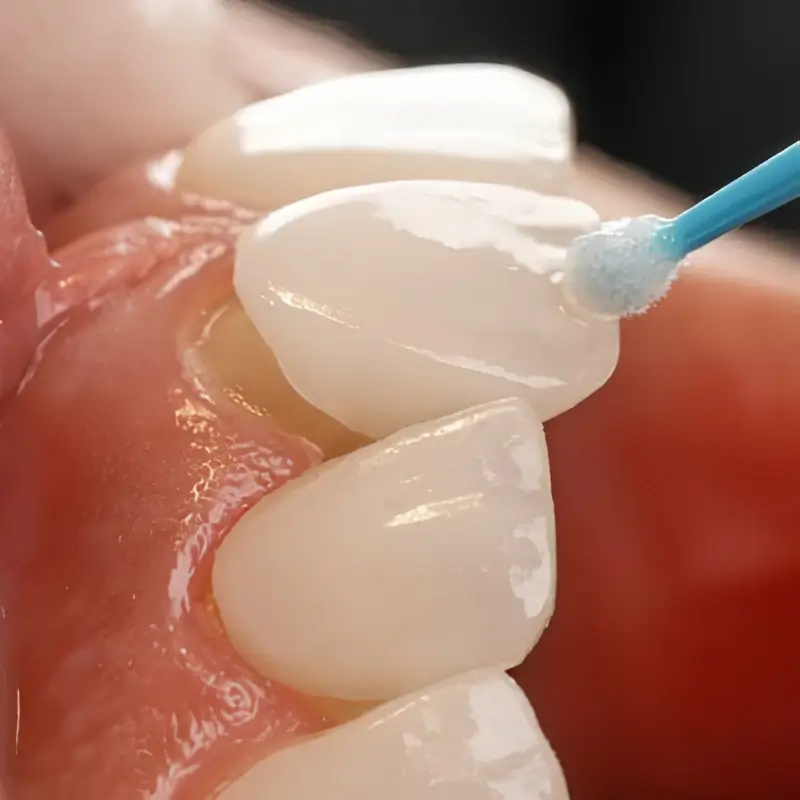
An e.max crown can be adhesively bonded, cemented or self-adhesive cemented with resin. The first option is the most common, following a 4-step sequence:
A single e.max crown costs £550–£1,200 in the UK and $1,200–$2,500 in the US. In Turkey, all-inclusive Turkey teeth packages bring down the cost to £175–£300 per unit. On insurance, most plans treat a crown as restorative work and pay around 50% of the allowed amount.
Country | E.max crown (per tooth) |
United Kingdom | £550–£1,200 (London routinely £750–£1,500) |
United States | $1,200–$2,500 (premium cosmetic practices to $3,000) |
Canada | CAD $1,100–$2,000 (laboratory fee often billed separately) |
Australia | AUD $1,500–$3,200 |
Ireland | €650–€1,500 (indicative; tracks UK private fees) |
New Zealand | NZD $1,500–$2,800 (indicative) |
Turkey (all-inclusive) | £175–£300 per unit |
Expect 15+ years from an e.max crown, in well-maintained cases. Ivoclar’s own data reports an average survival of 95.2% across studies of up to 15 years.
Key Note: Survival means the crown is still in place and functioning. Success means it is still in place with no complications at all. Those are very different bars, and marketing pages rarely separate them.
Time in service | Monolithic e.max | Veneered glass-ceramic |
5 years | ~98% survival | ~95–96% survival |
10 years | ~96–97% survival | Limited long-term data |
15 years | ~95% survival (pooled manufacturer data) | Limited long-term data |
The most common causes of failure of an emax crown are tooth decay, fracture of the tooth underneath, and overload(conditions of the tooth below the crown, not the ceramic!).
E.max crown limitations are specific and well documented. The core trade-off is strength. The glass that produces the translucency is the cause of this. You cannot have the optical performance without accepting the load ceiling at 530 MPa— no manufacturer has solved that.
Disadvantage | What happens | How it’s controlled |
Fractures under heavy load | At 530 MPa, e.max is roughly half the strength of full-strength zirconia. Molars and clenchers put it at risk. | Reserve for anterior teeth and premolars; specify zirconia posteriorly; prescribe a night guard for bruxists. |
Narrow bridge indication | Not indicated beyond 3 units, with the second premolar as the furthest abutment. | Longer spans go in zirconia. No clinical exceptions to this limit. |
Substrate shows through | Translucency cuts both ways: a dark stump, metal post or titanium abutment can grey the final shade. | Assess the underlying tooth at diagnosis; select a more opaque ingot; consider zirconia over dark cores. |
Technique-sensitive bonding | Performance depends on hydrofluoric etching, silane and resin cement being executed correctly. | Confirm the bonding protocol in writing before treatment begins. |
Irreversible preparation | 1–1.5 mm of natural tooth is removed permanently. | Confirm a crown is genuinely indicated over a veneer, onlay or composite bonding. |
Shade is permanent | Colour is fixed during crystallisation and cannot be whitened afterwards. | Whiten your natural teeth before the shade is selected, never after. |
Fracture usually means replacement | A fractured monolithic e.max crown is rarely repairable in any durable way. | Composite repair as an interim measure only; plan for remake. |
Poor fit on implants | Lithium disilicate over a titanium abutment risks show-through and offers no strength advantage there. | Zirconia or screw-retained restorations are generally the better implant solution. |
E.max is the wrong material for roughly half the mouth. The clinics producing the worst outcomes are often using one material everywhere, because it is faster and cheaper to run. A well-planned smile makeover almost always mixes two.
On molars, long-span bridges and in heavy grinders, zirconia wins decisively. The gap is 530 MPa against 900–1,200 MPa, and posterior teeth generate bite forces that live inside that gap.
However, on an upper central incisor, zirconia’s opacity is an aesthetic limitation, even in modern 5Y and multilayer grades, eyes read that as artificial.
E.max (lithium disilicate) | Zirconia | |
Flexural strength | 470–530 MPa | 500–1,200 MPa by grade |
Translucency | Excellent — light passes through | Good to fair; best in 5Y/multilayer |
Tooth removed | ~1–1.5 mm | ~1.5–2 mm |
Bonding | Etchable, chemically bonded | Not etchable; MDP primer required |
Bridge limit | 3 units, to second premolar | Long-span and full-arch capable |
Wear on opposing teeth | Similar to natural enamel when polished | Harder than enamel; polishing critical |
Best position | Front teeth, premolars, veneers | Molars, bridges, full arch, implants |
An implant crown sits on a titanium abutment: a dark grey core. Because an e.max crown transmits light, that greyness can be seen through, particularly at the gumline as tissue thins with age. On implants, most clinicians prefer a zirconia crown, or a screw-retained restoration.
E.max | Zirconia | PFM | Porcelain | |
Material type | Glass-ceramic, metal-free | Ceramic, metal-free | Porcelain over metal alloy | Glass ceramic |
Flexural strength | 470–530 MPa | 500–1,200 MPa | Metal core, porcelain surface | ~100 MPa |
Aesthetics | Excellent | Good to excellent | Fair — grey margin risk | Excellent |
Best position | Front teeth, single units, veneers | Molars, bridges, full arch | Back teeth, budget cases | Veneers, front units |
Main weakness | Fractures under heavy load | Opacity in low grades; hard on opposing teeth | Dark line at gumline over time | Chips easily |
Typical price (UK) | £550–£1,200 | £550–£1,600 | £400–£800 | £500–£1,000 |
If your teeth are sound and the issue is only appearance, a crown removes tooth you did not need to lose. That decision is permanent. That is why we usually recommend veneers. However, many patients go for crowns due to budget issues.
Overall, a crown requires 1–1.5 mm of tooth shaving. A veneer covers the front surface only, typically at 0.3–0.7 mm.
Option | Tooth removed | Suitable when |
Bonding | Essentially none | Small chips, gaps, minor shape changes |
Veneer | ~0.3–0.7 mm, front surface | Tooth structurally sound; issue is appearance |
Onlay | Biting surface only | Cracked cusp, large old filling, healthy walls |
Crown | ~1–1.5 mm circumferential | Tooth structurally compromised, post-root canal, extensively filled |
Your crown is milled soft and blue, then fired into its final strength and colour. That explains most of what happens between your scan and your fitting appointment.
The sequence, as it runs in our ComfyDent Lab, is the following:
For IPS e.max Press, the route differs: an ingot is pressed into an investment mould in the laboratory, finishing at 470 MPa.
“E.max” is a registered Ivoclar Vivadent trademark, but the word is used loosely across the dental market. Generic lithium disilicate blocks exist, they cost considerably less, and a crown made from one still gets marketed as an e.max crown.
Three checks separate a documented restoration from a promise: