
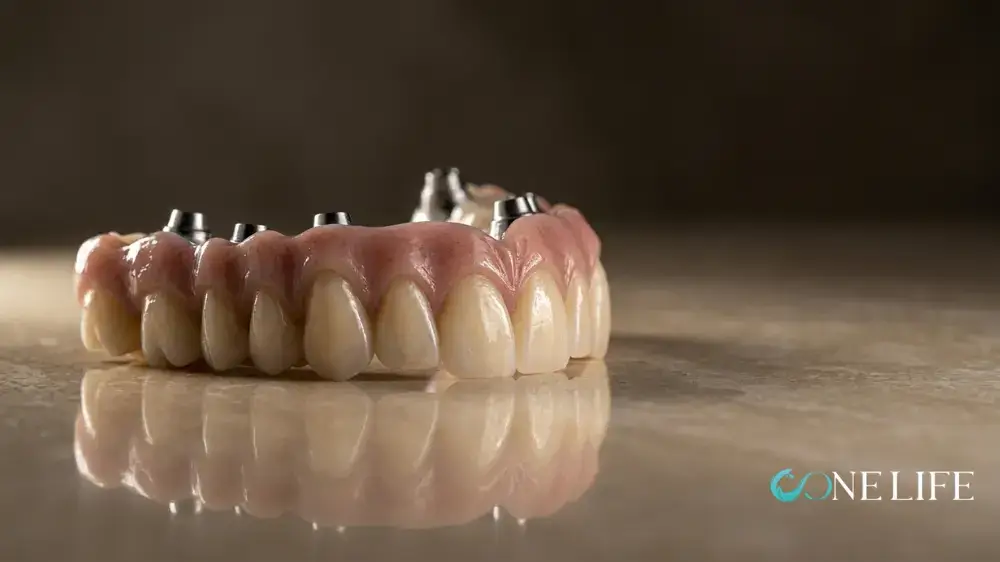
Permanent dentures cover four very different treatments, three tiers of implant brands and from one tooth to full arches of teeth anchored in the jawbone. Some are genuinely fixed. Some snap on and off at the bathroom sink. The price gap between them is roughly £9,000 per arch. We give you all crucial information in this guide extracted from the experience of One Life’s expert dentists.
Key takeaways of the article:
Permanent dentures are replacement “false teeth” anchored to dental implants placed in the jawbone, rather than resting on the gum tissue. That is what separates them from a conventional denture, providing greater stability, bite force, bone preservation and lifespan.
They can be divided into 2 types:
Your jaw begins to shrink the day the tooth leaves it. Up to 50% disappears within the first twelve months. This is why long-term denture wearers develop a collapsed lower face. Permanent dentures are the only solution that stops jawbone loss.
Four situations account for most cases:
As a general rule, we recommend our patients to choose removable dentures if cost, speed and avoiding surgery are your priorities. On the other hand, permanent dentures might be better for you if bite force, bone preservation and a longer-lasting solution matter more for you.
Factor | Removable denture | Permanent dentures |
Chewing force | 10–20% of natural | 70–95% of natural |
Jawbone health | Resorption continues | Resorption slowed or halted |
Surgery required | None | Yes |
Treatment Time | 3–5 weeks | 3–6 months |
Lifespan | 5–10 years | 15–25 years |
Maintenance | Relines every 1–2 years | Hygiene visits every 4–6 months |
Cost per arch (US) | $1,000–$3,000 | $3,000–$36,000 |
We have divided all permanent dentures into main types. They differ by how many implants carry the load and whether you can remove them yourself. The choice is made on a CBCT scan depending on your jawbone and current dentition.
The table below is the short version. Each option is explained underneath, including the cases where it is the wrong choice.
Type | Removable at home | Best for | Cost per arch (US) |
Snap-in overdenture | Yes | Lower jaw, tighter budgets | $3,000–$13,500 |
All-on-4 | No | Moderate bone loss | $14,000–$26,000 |
All-on-6 | No | Upper jaw, heavy bite | $18,000–$30,000 |
All-on-8 | No | Soft bone, complex cases | $24,000–$36,000+ |
3-on-6 segmented | No | Natural feel, easier hygiene | $18,000–$32,000 |
Zygomatic implants | No | Severe maxillary atrophy | Quoted case by case |
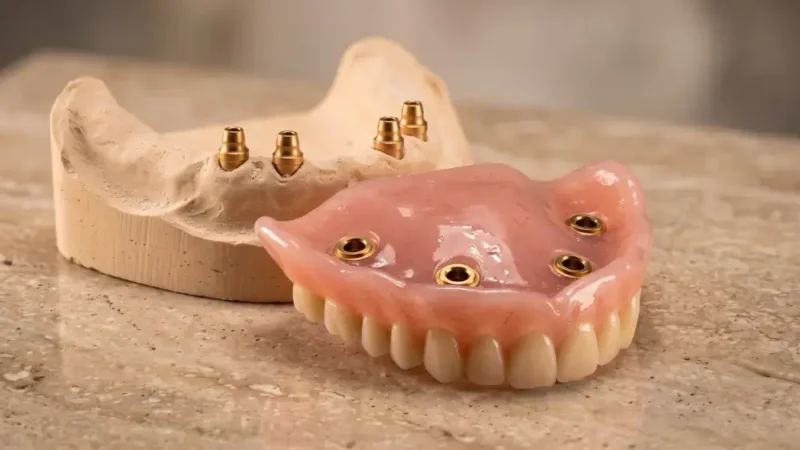
A snap-in denture clips onto two to four implants and stays immobile while you eat, but comes out nightly for cleaning. The overdenture still rests partly on the gum, so it needs periodic relining like any removable. And the nylon retention “snap” needs replacing every one to two years.
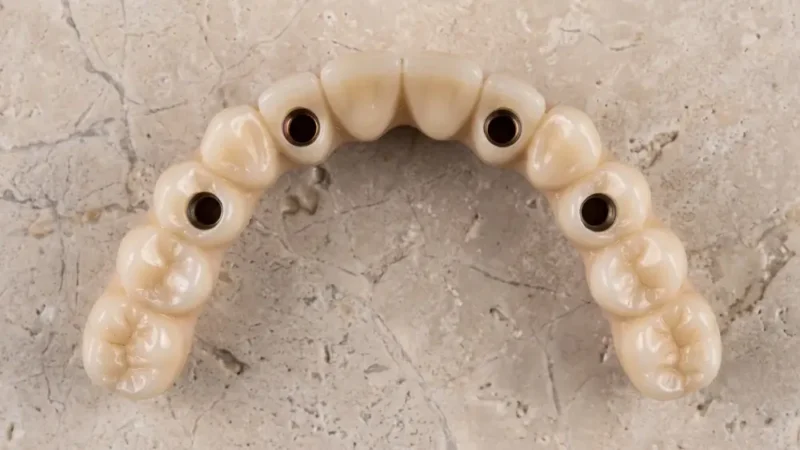
A fixed bridge on four implants, with the two-rear tilted to exploit available bone and avoid grafting. In Turkey full mouth dental implants package deals start from around £3,200 per arch, rising to £4,750–£5,750 for Straumann or Nobel Biocare.
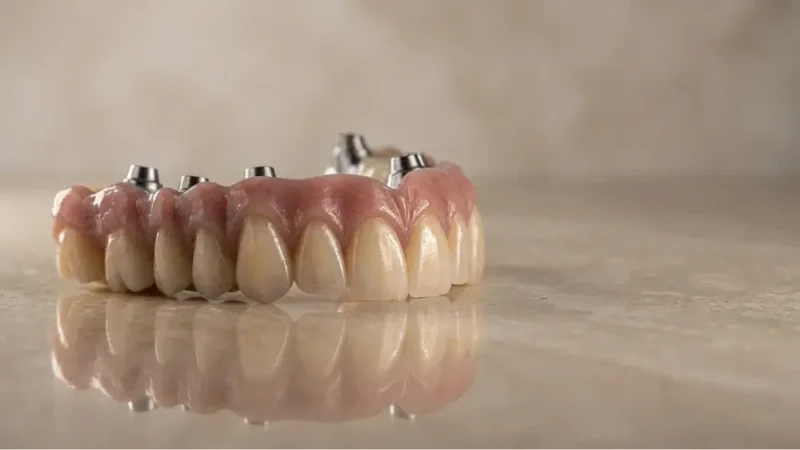
All-on-6 distributes chewing forces more evenly and for significantly higher stability. It is the preferred for the upper jaw, where bone is softer and less dense than in the mandible, and for patients with a strong bite or a history of bruxism.All-on-8 is reserved for genuinely complex cases: poor bone quality and maximum support required..
3-on-6 dental implants split the denture into three separate bridges carried by six implants. Segmenting the prosthesislets it move more like natural teeth, which many patients describe as the closest feel to their own teeth.
There are two practical advantages beyond feel. If one segment fractures, only that segment is repaired. And the gaps between segments make flossing and interdental cleaning easier.
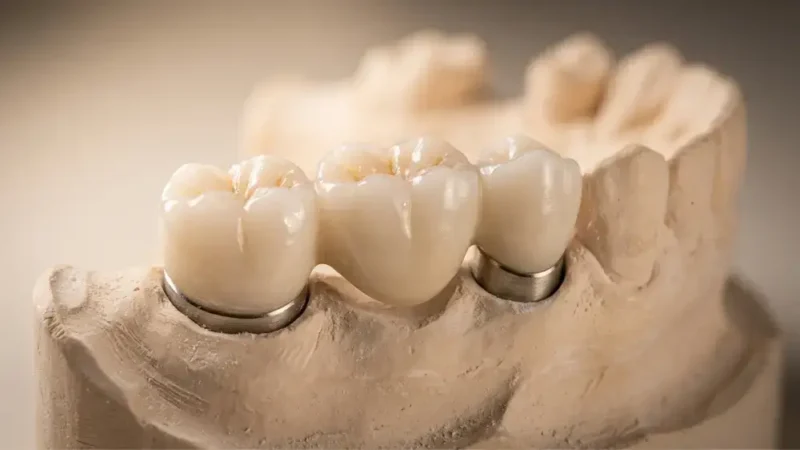
A single implant with a crown replaces one tooth without touching the neighbours. A three-unit implant bridge replaces two or three adjacent teeth on two implants.
Zygomatic implants anchor into the cheekbone, making fixed teeth possible for patients with insufficient bone. They bypass the atrophied maxilla entirely, eliminating the need for extensive grafting. Zygomatic placement is performed only by oral and maxillofacial surgeons, never by generalist dentists.
Two arches can carry identical implants and look identical in a photograph, yet one is milled monolithic zirconia and the other is acrylic on a metal bar. They will not age the same way.
A restoration looks natural not because the shade is correct, but because it handles light the way enamel does. Reproducing that gradient is the real work of a dental technician, and it is the clearest difference between an economy arch and a premium one.
Material | Used for | Appearance | Strength | Lifespan |
Monolithic zirconia | Fixed full arches | Good | Maximum | 15–25 yrs |
Layered zirconia | Bridges, full arches | Very good | Very high | 15–25 yrs |
Lithium disilicate (e.max) | Front crowns, single units | Excellent | Good | 10–15 yrs |
Porcelain-fused-to-metal | Long bridges | Fair | High | 10–15 yrs |
Titanium (Grade 4/5) | Implants, frameworks | N/A | Maximum | Lifetime |
Acrylic / composite (PMMA) | Temporaries, hybrid arches | Fair to good | Low | 10–15 yrs |
Monolithic zirconia resists wear, holds its colour indefinitely and tolerates the bite forces of grinders. Expect 15 to 25 years from a well-made zirconia arch. Its one limitation: it’s slightly more opaque than natural tooth enamel. Layered zirconia solves this by adding hand-applied porcelain to the surface, gaining beauty at a small cost in strength.
Lithium disilicate, sold as e.max, looks the closest to natural enamel. Its strength is lower than zirconia’s, however, which makes it unsuitable for patients with bruxism. In practice you will see e.max used on individual implant crowns and short bridges, often combined with zirconia elsewhere in the same mouth.
PFM bonds a porcelain layer onto a metal substructure, giving high strength at a lower price than zirconia. It has decades of clinical data behind it with a realistic lifespan of 10 to 15 years. The compromise is visible over time. The metal core blocks light, producing a flatter appearance, and gum recession can eventually expose a dark line at the margin.
Titanium is the structural material. Medical-grade Grade 4 and Grade 5 titanium forms the implant itself and, in some hybrid restorations, the framework that carries the acrylic or ceramic teeth.
Acrylic is the material of temporaries. After implant surgery you will typically wear a fixed PMMA provisional bridge for three to six months while osseointegration completes.
Bone preservation and no sunken face is one of the main benefits, but also no calculation before speaking, no covering your mouth in photographs, no mentally auditing a restaurant menu.
Functional gains are also important:
Permanent dentures require surgery, a three-to-six-month treatment time and more hygiene discipline than a removable plate. The honest list of trade-offs:
A panoramic X-ray is not enough to plan implant placement, as it cannot measure bone density or map the inferior alveolar nerve in three dimensions. Candidacy is determined by a 3D CBCT scan. You can always contact us for a free online consultation with Dr. Astolfi.
Four factors decide the outcome:
Most patients require two treatments separated by three to six months of healing. You are never without teeth at any point. Below, we detail the process such as it is commonly undergone at One Life Dental when performing dental implants in Turkey.
During this window, the jawbone bonds to the titanium surface, creating the foundation the final bridge will load. Progress is monitored remotely through photographs and video calls. This period cannot be safely shortened.
After dental implant surgery, swelling peaks at 48–72 hours and subsides within a week; soft diet lasts considerably longer. Local anaesthesia is fully effective for the procedure itself, with IV sedation available for severe dental anxiety.
Period | What to expect | Diet |
Days 1–3 | Swelling and bruising peak; some bleeding is normal | Liquids and purées, nothing hot |
Days 4–7 | Swelling recedes; sutures settle; discomfort fades | Soft foods — eggs, fish, pasta |
Weeks 2–4 | Gums heal over; speech normalises | Soft to medium textures |
Months 2–6 | Osseointegration progresses silently | Soft diet maintained on the temporary bridge |
After final fitting | Full function; chewing efficiency improves for several months | Unrestricted |
Call your clinic if pain increases rather than fades, swelling worsens after day four, you develop fever or discharge, or you experience persistent numbness or tingling in the lip or chin.
Permanent dentures cost $3,000–$13,500 per arch for snap-in overdentures and $14,000–$36,000 per arch for fixed full-arch restorations. UK private treatment runs £24,000–£40,000; the equivalent all-inclusive package in Istanbul runs £7,900–£14,500 ($10,000–$18,500), including accommodation, transfers, prosthetics and aftercare.
Treatment | Implants | Cost per arch (USD) | Cost per arch (GBP) | Cost per arch in Turkey |
Snap-in overdenture | 2–4 | $3,000–$13,500 | £2,500–£10,500 | £2,500–£4,500 ($3,200–$5,800) |
All-on-4 fixed | 4 | $14,000–$26,000 | £11,000–£20,500 | £3,200–£5,750 ($4,100–$7,400) |
All-on-6 fixed | 6 | $18,000–$30,000 | £14,000–£23,500 | £3,950–£7,250 ($5,100–$9,300) |
All-on-8 fixed | 8 | $24,000–$36,000+ | £19,000–£28,500+ | From £7,000 ($9,000), custom-quoted |
3-on-6 segmented | 6 | $18,000–$32,000 | £14,000–£25,000 | £4,900–£7,500 ($6,300–$9,600) |
Single implant + crown | 1 | $3,000–$6,000 | £1,600–£2,500 | £450–£900 ($580–$1,150) |
Realistic total for extras in a complex case run £700–£1,200. Budget a further $100–$300 for food if you need to travel, flight tickets and $200–$400 for insurance, which is strongly advised.
Typical additional costs:
Implant dentistry is surgery, and every surgery carries risk: a clinic reporting a 0% complication rate is simply lying. Top-tier clinics report 95–97% success, which means errors do happen.
Four complications account for most cases:
A monolithic zirconia bridge lasts 15–25 years; acrylic hybrids last 10–15; the titanium implants underneath can last a lifetime. Six factors determine which end of those ranges you land on: hygiene discipline, smoking status, bruxism control, bone stability, material quality and the consistency of professional maintenance.
Component | Average lifespan | Usual reason for replacement |
Titanium implant | 20+ years to lifetime | Peri-implantitis, mechanical failure |
Monolithic zirconia bridge | 15–25 yrs | Wear, fracture in heavy bruxism |
Layered zirconia | 15–25 yrs | Chipping of the veneering porcelain |
PFM bridge | 10–15 yrs | Margin exposure, porcelain fracture |
Acrylic hybrid arch | 10–15 yrs | Wear, staining, tooth debonding |
Snap-in retention inserts | 1–2 yrs | Loss of grip — routine, inexpensive |
The care routine for a fixed arch is different from a removable plate, because nothing comes out. All cleaning happens in the mouth, and the critical zone is the junction between bridge and gum, where a standard toothbrush cannot reach:
If cost, surgery or insufficient bone rules out implants, three alternatives remain viable.