
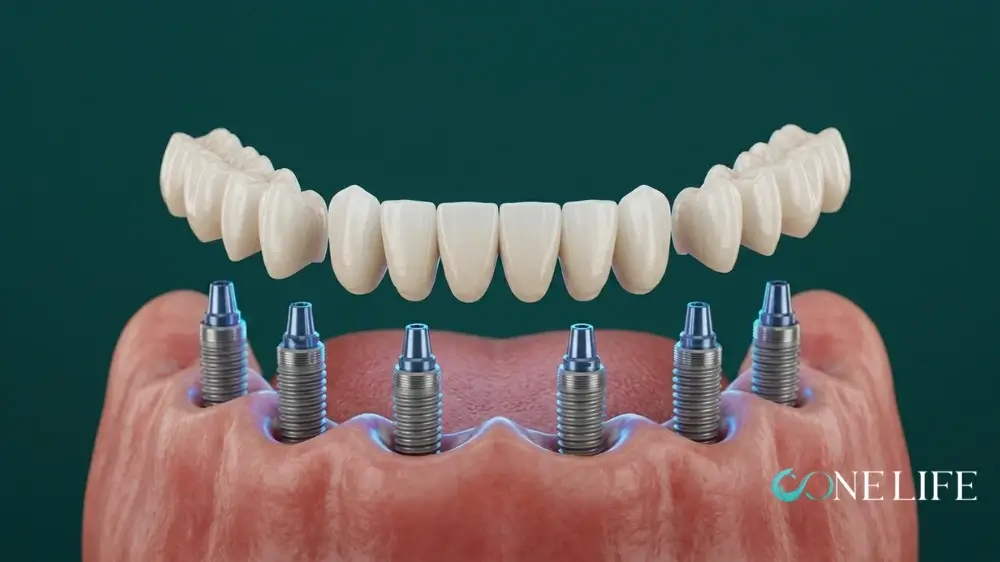
3-on-6 dental implants may be the most natural-feeling option available today for edentulous patients. Its uses six implants to anchor three separate bridges, giving you a chew function and look remarkably like natural teeth.
What Are 3-on-6 Dental Implants?
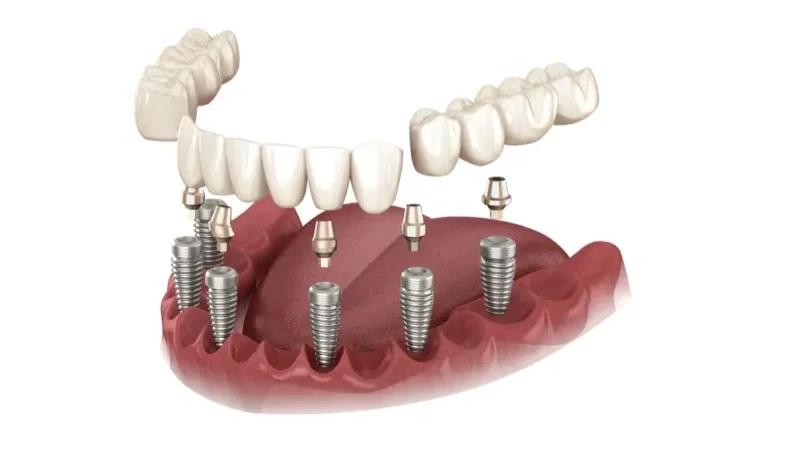
3-on-6 dental implants are a full-mouth tooth replacement. The name describes three dental bridges, each supported by two implants, totalling six implants per jaw. The bridges are screwed onto the dental implants and stay fixed, they are not removable without specialist help. Studies show a success rate of up to 95%, and when properly maintained, they can last a lifetime.
How the Split-Bridge Design Works
The 3-on-6 system is divided into three small bridges of roughly four teeth each, with each bridge independently supported by two implants.
This matters for several practical reasons:
- Easier hygiene: Gaps between the three bridges allow you to clean underneath with ease
- Better load distribution: Six-implants reduce stress on individual implants
- Repairability: If one bridge ever needs attention, only that section is removed
- Natural appearance: The bridges are custom-made to match your facial anatomy
Pros and Cons of All-on-6 Dental Implants
The 3-on-6 system has clinical advantages — but it is not the right solution for every patient. Just like everything, they have disadvantages with regards to other options, whether in terms of costs, or long-term maintenance.
Advantages:
- More implants, more stability
- No artificial gum tissue – important distinction. Because the bridges sit closer to your natural gumline, there is no need for the pink acrylic “gum” material common in All-on-4 prostheses.
- Simpler long-term maintenance
- Independent repairability
- Preserved jawbone
Disadvantages:
- Higher upfront cost than All-on-4
- Long treatment timeline (requires 2 visits over a 3-6 months period)
- Requires healthy bone
- Limited track record (new technique)
How Does 3-on-6 Compare vs All-on-4?
All-on-4 has decades of published clinical data. The 3-on-6 system is newer and has a limited track record. It is also more expensive, more technical and requires a longer surgery, with a longer downtime.
The right choice requires weighing the pros and cons against your medical data, such as your bone volume, bite force, but also your budget, and key questions, such as: how important is natural feel for you? On top of your aesthetic goals.
3-on-6 vs All-on-4: What Actually Matters
3-on-6 | All-on-4 | |
How many implants? | 6 per jaw | 4 per jaw |
One piece or separate sections? | 3 separate bridges | 1 full-arch piece |
Does it look like real teeth? | Very natural — no fake gum material | Often includes pink acrylic “gum” |
Can I clean underneath easily? | Yes — gaps between bridges | Harder — one solid piece |
What if one part breaks? | Only that bridge is replaced | The whole arch may need attention |
Do I need good bone? | Yes — more bone required | No — works even with bone loss |
How strong is the bite? | Excellent — 6 implants share the load | Very good — slightly more strain per implant |
How long has it been around? | Newer — less long-term data | 20+ years of clinical evidence |
Cost in Turkey (per arch) | From £3,500 / $4,500 | From £1,750 / $2,200 |
Cost in the UK (per arch) | From £8,000 | From £5,000 |
Cost in the US (per arch) | From $12,000 | From $8,000 |
Best for | Good bone, want the most natural result | Bone loss, or tighter budget |
Are You a Good Candidate for 3-on-6 Dental Implants?
3-on-6 dental implants have specific requirements that your surgeon will assess. Mind that the only reliable way to confirm candidacy is a 3D CBCT scan. This gives your surgeon a precise map of your bone volume, nerve positions and jaw anatomy before a single incision is made. The below information is a general guideline that does not substitute professional assessment.
You are likely a good candidate if:
- You are missing most or all teeth
- You have sufficient jawbone density and volume to anchor six implants per arch
- Your gums are healthy, or any active gum disease has been treated
- You are a non-smoker, or willing to stop around the procedure
- You have no uncontrolled systemic conditions such as uncontrolled diabetes
You may need additional assessment if:
- You have significant bone loss
- You are a heavy smoker
- You have certain medical conditions (uncontrolled diabetes, autoimmune disorders, or are on bisphosphonate medication for osteoporosis)
- You have limited budget
The Procedure Step by Step
The 3-on-6 treatment is completed across two visits, typically separated by three to six months. Here is what to expect at each stage.
Visit 1 — Assessment & Implant Placement
- Consultation and 3D imaging. A CBCT scan maps your bone structure in three dimensions. Your surgeon uses this digital map to plan the exact position, angle and depth of each implant.
- Extractions (if needed). Any remaining compromised teeth are removed, often in the same session as implant placement.
- Implant surgery. Under local anaesthesia — or sedation if preferred — six titanium implant posts are placed precisely into the jawbone. The procedure typically takes two to four hours per arch.
- Temporary bridges. In most cases, a set of temporary fixed teeth is attached the same day or within a few days. You leave the clinic with functional teeth.
Post-OP Healing & Recovery
Most patients return to normal daily activity within five to seven days post-op. Full recovery takes three to six months, though this period is largely pain-free.
What to expect week by week:
- Days 1–3: Swelling, mild bruising and discomfort are normal. Prescribed pain relief and anti-inflammatories manage this well for the majority of patients. Cold compresses reduce swelling effectively in the first 48 hours.
- Days 4–7: Swelling peaks around day three and then subsides. Most patients feel comfortable enough to return to desk work and light activity.
- Weeks 2–4: Soft tissue continues to heal. A soft diet — soups, fish, pasta, eggs — is essential during this phase to avoid pressure on the implant sites.
- Months 2–6: Osseointegration proceeds silently beneath the surface. Most patients are entirely comfortable and eating a near-normal diet by week four to six.
Visit 2 — Final Bridges
- Impressions or digital scans are taken of your healed implants and bite.
- The three permanent bridges — typically in zirconia or porcelain-fused-to-metal — are fabricated to your exact specifications in a dental laboratory.
- Final bridges are fitted, adjusted and torqued into place. Total chair time across the second visit is usually six to eight hours spread over two or three appointments.
Potential Risks & Complications
3-on-6 dental implants are a well-established, safe procedure — but like any surgery, they carry a set of risks. This said, the vast majority of complications are avoidable with proper planning, candidate selection and diligent post-op care.
Most common short-term effects (normal, temporary):
- Swelling and bruising around the jaw and cheeks
- Mild to moderate pain in the first three to five days
- Temporary sensitivity or numbness in the lips or chin
- Minor bleeding at the surgical site in the first 24 hours
Less common complications to be aware of:
- Infection
- Implant failure
- Nerve injury
- Sinus damage
- Peri-implantitis
How reputable clinics reduce these risks:
- Mandatory CBCT 3D scanning before any treatment plan is confirmed
- Use of premium implant brands with documented osseointegration data (Straumann®, Nobel Biocare®, MegaGen®)
- In-house laboratory for precise prosthetic fitting
- Structured follow-up protocol including remote aftercare for international patients
How Much Are 3-on-6 in the United States?
The average cost for 3-on-6 dental implants in the US is $12,474 per arch, with a range from approximately $9,700 to $24,000, based on 2024 research across all 50 states. For a full mouth (both arches), patients typically invest $25,000 to $90,000+ depending on the provider, city and materials chosen.
Is it covered by insurance?
Dental insurance in the US rarely covers implants in full. Most plans classify them as a cosmetic or elective procedure, offering partial coverage — typically 10–50% of the crown component only.
3-on-6 Cost in the United Kingdom
A single dental implant in the UK typically costs between £2,500 and £4,000. Multiply that across six implants plus three prosthetic bridges and the total investment becomes clear.
Private UK costs for a 3-on-6 system per arch typically range from:
Treatment | UK Private Cost |
3-on-6 per arch (standard titanium + PFM bridges) | £8,000 – £14,000 |
3-on-6 per arch (premium brand + zirconia bridges) | £14,000 – £22,000 |
Full mouth, both arches (premium) | £28,000 – £44,000+ |
3-on-6 Cost in Turkey
Dental implants in Turkey cost 60–75% less than equivalent UK prices, with clinics using the same brands — Straumann®, Nobel Biocare® and Osstem®. Full mouth 3-on-6 dental implants in Turkey cost from £2,500 to £5,000 per arch all-inclusive, with the final price depending on the individual treatment plan and implant brand.
Treatment | Turkey (per arch) | UK equivalent | Saving |
3-on-6 standard package | £3,500 – £4,500 | £8,000 – £14,000 | ~60% |
3-on-6 premium (Straumann® + zirconia) | £4,500 – £6,000 | £14,000 – £22,000 | ~70% |
Full mouth, both arches | £7,000 – £11,000 | £28,000 – £44,000 | ~70–75% |
Before and After Results
Most patients tell us that the ability to eat freely post-op, speak confidently and smile without self-consciousness has a positive impact on their daily life and self-esteem. Visualizing 3-on-6 before and after photos is key to deciding whether the treatment is right for you.
When reviewing clinic galleries, assess:
- The natural profile of the teeth at the gumline
- Whether the gum colour and texture look realistic
- Facial proportion
- Consistency across different patients, not just the best-case examples
How Long Do 3-on-6 Implants Last?
With correct maintenance, the titanium implant fixtures can last a lifetime. The bridges typically last 15 to 25 years before requiring replacement.
3-on-6 dental implants have a high clinical success rate, with figures reaching up to 95%. Dental implant success rates globally range from 95% to 98%, making them one of the most reliable surgeries in modern dentistry.
Factors that extend implant lifespan:
- Daily oral hygiene
- Regular professional maintenance
- Avoiding excessive force
- Not smoking
- Stable general health
Long-Term Maintenance & Care
3-on-6 implants are easier to maintain than a single full-arch prosthesis. This is because the gaps between the three bridges allow easier cleaning access that a monolithic All-on-4 arch. The multi-bridge configuration also allows for easier repair and replacement in case of implant or bridge failure.
Daily cleaning routine:
- Brush twice daily.
- Use a water flosser (oral irrigator): Highly recommended for 3-on-6 patients.
- Use an antibacterial mouthwash once daily
What to avoid:
- Smoking
- Excessive tea/coffee
- Abrasive whitening toothpastes
- Standard dental floss
- Prolonged use of alcohol-based mouthwashes