
Do your frontal teeth sit over the lower ones? If yes, don’t worry. An overlap is normal. The important question is whether the overlap is excessive, damaging, or related to a problem with the teeth or jaws.
Some people with an excessive overbite, also called a deep bite, have no symptoms, while others experience tooth wear, gum or palate irritation, difficulty biting, or changes in facial balance.
The most appropriate treatment depends on its cause. An orthodontic assessment can determine whether the condition comes from tooth position, jaw development, or a combination of both.
What Is an Overbite?
An overbite is diagnosed with a simple test: first, clench your back teeth together. While your molars are aligned and touching each other: do your upper front teeth overlap over the lower ones? If the gap is large enough, the condition may be described as an excessive overbite, deep overbite, or deep bite.
In a severe deep bite, the lower front teeth may contact the gum behind the roof of the mouth. Treatment becomes important if the bite causes tissue injury, tooth wear, functional difficulty, or damage.
Overbite vs. Underbite, and Other Bite Types
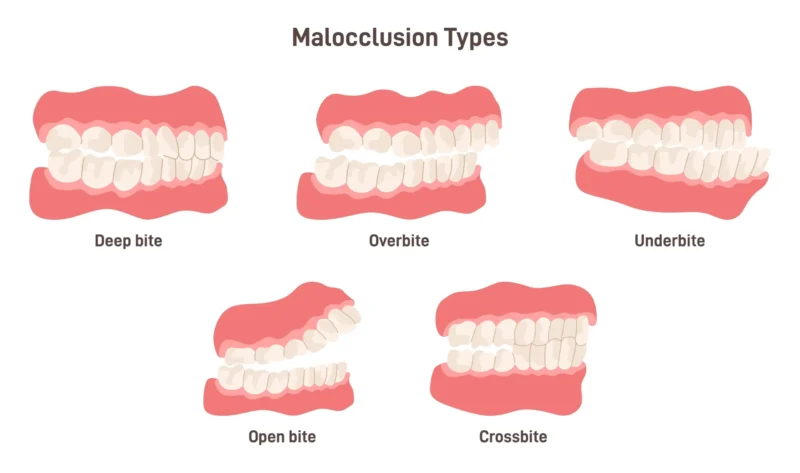
Overbite and overjet are frequently confused, but they describe different directions of tooth overlap.
Bite type | Direction or relationship | What it generally looks like | Important distinction |
Normal overbite | Vertical overlap | Upper front teeth cover a modest portion of the lower teeth | Some overlap is normal and functional |
Deep bite | Excessive vertical overlap | Upper front teeth cover too much of the lower teeth | Severe cases may injure the opposing gums or palate |
Overjet | Horizontal projection | Upper front teeth project too far in front of the lower teeth | “Buck teeth” usually describes overjet, not overbite |
Underbite | Reversed front-to-back relationship | Lower front teeth sit ahead of the upper teeth | Often associated with a Class III bite relationship |
Open bite | Vertical separation | Upper and lower front teeth do not meet | A gap remains when the back teeth close |
Crossbite | Reversed tooth relationship | Some upper teeth bite inside the corresponding lower teeth | It may affect the front, back, one side, or both sides |
Overbite vs. overjet
A person can have a deep overbite without prominent upper teeth, significant overjet without a deep vertical overlap, or both conditions at the same time. The distinction matters because the causes, risks, and treatment mechanics are not identical.
The simplest way to remember the difference is by direction:
- Overbite is vertical: How far do the upper teeth cover the lower teeth?
- Overjet is horizontal: How far do the upper teeth project in front of the lower teeth?
What Causes an Overbite?
Overbite causes are often multifactorial. Genetics, facial growth, tooth eruption, oral habits, wear, and tooth loss may all influence how the bite develops.
1. Genetics and facial growth
Jaw size, jaw position, tooth size, and facial-growth patterns can run in families. Some vertical growth patterns reduce lower facial height and encourage a deeper bite. A jaw discrepancy may also coexist with excessive vertical overlap or increased overjet.
2. Tooth position and eruption
Front teeth can erupt farther than expected, particularly when they do not develop stable contact with the opposing teeth. In other cases, the back teeth may not provide enough vertical height to open the bite. Crowding and inwardly tilted incisors can deepen the overlap further.
3. Missing or severely worn teeth
Missing back teeth may reduce bite support and allow the remaining teeth to change position. Significant wear can also shorten teeth and alter how the jaws close. These cases may require restorative and periodontal assessment alongside orthodontic care.
4. Childhood oral habits
Prolonged thumb-sucking, pacifier use, and certain tongue or lip habits can influence developing teeth and dental arches. However, these habits are more commonly associated with increased overjet or an open bite than with every form of deep overbite. It is inaccurate to assume that all overbites result from childhood habits.
5. Teeth grinding
Bruxism—clenching or grinding—does not cause every overbite, but it can accelerate wear when a deep bite already places excessive pressure on particular teeth.
Dental Overbite vs. Skeletal Overbite
An excessive overbite may be dental, skeletal, or combined. Identifying the source is essential because orthodontics can move teeth, but it cannot substantially reposition mature jawbones.
Feature | Dental overbite | Skeletal overbite |
Primary source | Position, angle, or eruption of the teeth | Size, position, or growth pattern of the jaws and facial bones |
Possible pattern | Front teeth have erupted too far, back teeth have insufficient vertical height, or the incisors tilt inward | Facial growth or a jaw discrepancy contributes to excessive vertical overlap |
Jaw relationship | The underlying jaws may be reasonably balanced | A measurable skeletal relationship affects how the jaws and teeth meet |
Possible treatment | Braces or clear aligners, sometimes with additional orthodontic mechanics | Growth-related treatment in selected younger patients, orthodontic camouflage, or combined orthodontic-surgical care |
Can orthodontics alone correct it? | Often, depending on severity and oral health | Sometimes through camouflage, but tooth movement cannot fully correct every mature skeletal discrepancy |
Many patients have a combined problem. For example, a jaw-growth pattern may influence the bite while the front teeth have also erupted or tilted in a way that increases the overlap. Treatment should therefore address the individual anatomy rather than the label alone.
How to Fix an Overbite
Overbite treatment depends on the cause, severity, age, oral health, and effect on function. A treatment plan may move the front teeth, change the height or position of the back teeth, create space, address a jaw discrepancy, or combine several approaches.
Can braces fix an overbite?
Braces can correct many dental overbites in children, teenagers, and adults. Brackets, wires, bite turbos, elastics, and other components may be used to control tooth position and reduce excessive overlap.
Braces can also camouflage selected mild skeletal discrepancies by changing how the teeth meet. Camouflage moves the teeth; it does not change the underlying size or position of mature jawbones.
Can Invisalign fix an overbite?
Invisalign® is one brand of clear aligner therapy. Invisalign or another professionally supervised clear-aligner system can treat selected mild-to-moderate deep bites and some more complex cases.
Treatment may include attachments, elastics, or bite ramps. Suitability depends on the movements required, severity, gum and bone health, previous dental work, and consistent wear. The brand name alone does not determine whether aligners are the right option.
Functional appliances
Functional appliances may be recommended for selected growing patients when a Class II jaw relationship accompanies the bite problem. These appliances posture the lower jaw forward and influence the developing dental relationship. They may be fixed or removable and are often followed by braces.
Results depend on growth, timing, appliance selection, and—in the case of removable devices—consistent wear. A functional appliance is not a universal solution for every deep bite.
Palatal expansion or tooth extraction
A palatal expander may be included when a narrow upper jaw, crossbite, or lack of space is part of the diagnosis. Expansion is not a standard standalone treatment for an overbite.
Extraction is occasionally considered when crowding, tooth protrusion, or the planned orthodontic mechanics require more space. It must form part of a carefully controlled plan because removing teeth does not automatically correct a deep bite.
Restorative treatment
When worn, broken, or missing teeth contribute to the bite problem, an orthodontist may work with a restorative dentist or prosthodontist. Orthodontics can create appropriate positions and space before restorations rebuild worn surfaces or replace missing teeth. Restorative treatment alone cannot correct every underlying orthodontic or skeletal cause.
Corrective jaw surgery
Orthognathic surgery, or corrective jaw surgery, may be considered after facial growth is complete when a severe skeletal discrepancy cannot be corrected predictably with orthodontics alone. Depending on the anatomy, surgery may reposition the upper jaw, lower jaw, or both. Braces are commonly required before and after the procedure.
Retainers after overbite correction
Retention is an essential part of orthodontic treatment. Retainers help maintain the corrected tooth positions while the surrounding tissues adapt. The type and duration depend on the original bite and its risk of relapse, and long-term wear may be recommended.
Overbite Treatment in Children vs. Adults
Treatment factor | Children and adolescents | Adults |
Jaw growth | Remaining growth may be used in selected cases | Facial growth is generally complete |
Main assessment | Tooth eruption, habits, jaw development, bite trauma, and growth pattern | Dental versus skeletal cause, oral health, tooth wear, function, and goals |
Common options | Monitoring, braces, aligners, functional appliances, or other orthodontic devices | Braces, aligners, restorative coordination, camouflage, or orthodontic-surgical treatment |
Ability to influence development | Possible in appropriately selected growing patients | Conventional appliances cannot substantially alter mature jawbones |
Retention | Usually required and may continue during growth | Usually required, sometimes long term |
Neither group has one universally ideal treatment. Children may have growth-related opportunities, while adults may require greater attention to restorations, gum health, bone support, wear, or missing teeth.
What Is the Best Age to Treat an Overbite?
There is no single ideal age because overbites do not all have the same cause. The American Association of Orthodontists recommends a first orthodontic check-up no later than age seven. This does not mean every seven-year-old needs braces. The purpose is to recognize developing concerns and decide whether treatment should start early or be monitored.
Selected children may benefit from growth-related treatment, especially when a jaw relationship contributes to the bite. Others are observed until more permanent teeth have erupted.
Adults can also undergo successful overbite correction. Adult teeth can be moved orthodontically, but facial growth is generally complete. A significant skeletal discrepancy may therefore require orthodontic camouflage or combined orthodontic and jaw-surgery planning.
Can You Fix an Overbite Naturally?
There is no scientifically established exercise, massage, chewing routine, or home device that can reliably correct an established dental or skeletal overbite.
“Mewing,” pushing teeth with the tongue or fingers, excessive chewing, and unsupervised orthodontic products cannot safely reproduce planned tooth movement. Uncontrolled pressure may move teeth unpredictably, damage the gums or supporting bone, and make the bite less stable.
Helping a child stop a persistent oral habit may remove an influence on dental development, but it does not guarantee that an existing bite problem will reverse. Good oral hygiene, routine dental care, and clinically appropriate management of grinding can protect the teeth, but they do not replace professional overbite correction when treatment is needed.
Can an Untreated Overbite Cause Problems?
Not every overbite is harmful, and not every deep bite requires correction. Treatment becomes more relevant when the condition is traumatic, progressive, unstable, difficult to clean, or associated with functional or oral-health problems.
1. Tooth wear and damage
Excessive contact can gradually wear the enamel on the front teeth. Teeth may become flattened, chipped, sensitive, or more vulnerable to fractures. Because lost enamel does not grow back, established wear may eventually require restorative care as well as bite correction.
2. Gum or palate injury
In an impinging deep bite, the lower teeth may repeatedly contact the palate or gum behind the upper teeth. The upper teeth may likewise traumatize the gum around the lower teeth. Persistent contact can cause tenderness, sores, recession, or damage to supporting tissues.
3. Difficulty biting and cleaning
Excessive overlap may interfere with biting through food and distribute pressure unevenly. An overbite does not directly cause cavities or gum disease, but accompanying crowding can create areas that are harder to brush and clean between.
4. Jaw discomfort
Some people with a deep bite experience jaw-muscle fatigue or temporomandibular joint symptoms. However, jaw pain, headaches, and clicking have many possible causes and should not automatically be blamed on the overbite.
5. Changes in facial appearance
A skeletal deep bite may influence lower-face proportions, lip posture, or the appearance of the chin. Appearance does not make treatment medically necessary, but personal concerns are a legitimate part of shared treatment planning.
When Should You See a Dentist or Orthodontist?
Consider arranging an assessment if:
- The lower front teeth are barely visible when you bite
- Teeth contact or injure the opposing gums or palate
- Front teeth are wearing, chipping, or becoming sensitive
- The bite seems to be getting deeper
- Biting or chewing is difficult
- Crowding makes oral hygiene difficult
- Jaw discomfort persists
- A child’s teeth or jaws appear to be developing unevenly
- Tooth loss or extensive wear has changed the bite
A dentist can evaluate general oral health and decide whether an orthodontic referral is appropriate. An orthodontist assesses the teeth, jaw relationships, facial growth, and mechanics required for correction.
Diagnosis may include a clinical examination, bite analysis, photographs, digital models or scans, panoramic X-rays, and sometimes a cephalometric radiograph—a side-view X-ray used to analyze dental, jaw, and facial relationships.