
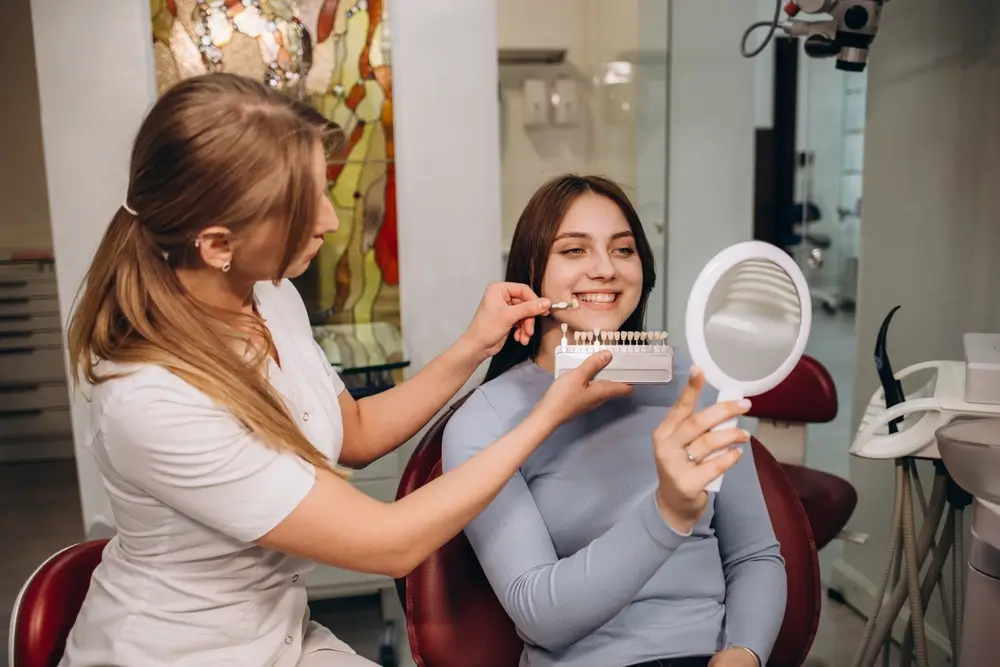
The VITA teeth color chart helps dentists & patients identify your current tooth shade, monitor whitening, and select hues for bonding, whitening, veneers and crowns. Perhaps you prefer a subtle touch that looks perfectly natural. Your teeth could be creamy A2 or cool C1. Maybe you want a noticeably brighter smile. You could go for a dazzling B1.
The appropriate color depends on many factors, including skin color. Perhaps the most important consideration is this: the secret to perfect results lies on the dental lab making the prosthetics (not so much the dentist placing them).
Now, let’s decode the VITA dental shade guide and reveal all crucial insider knowledge as we cruise through the different shades of white.
What is the VITA Dental Shade Guide?
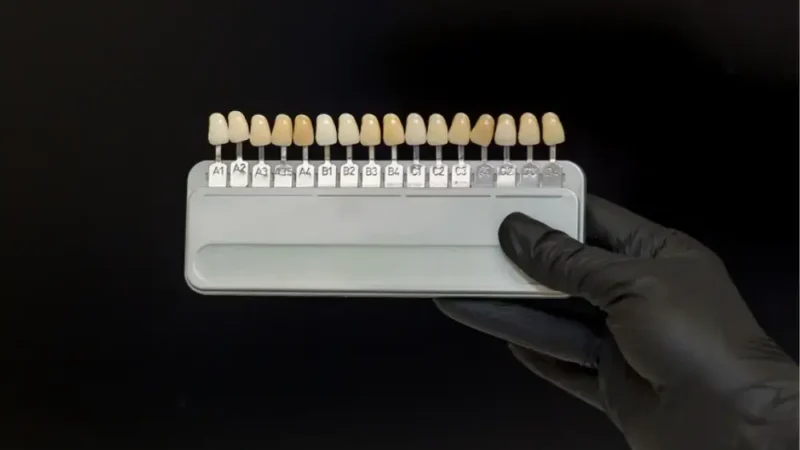
The VITA classical dental shade guide is the most famous A1–D4® teeth color chart. It contains tooth-shaped samples representing 16 natural tooth shades organized into four general color families.
Dentists compare these samples with natural teeth for two main reasons:
- Identify the starting shade
- Select the color of a restoration
Shade family | General undertone | Visual impression |
A | Reddish-brown | Warm, creamy, or ivory |
B | Reddish-yellow | Warm and often brighter-looking |
C | Gray | Cooler and more muted |
D | Reddish-gray | A blend of warm and cool tones |
Within the same color family, lower numbers identify lighter shades. A1, for example, is lighter than A3. However, A-B-C-D families have different undertones. The guide is not a simple ladder running from white to dark.
Key Note: Screens, cameras, room lighting, lipstick, and surrounding colors can all alter the way teeth look. An online chart may help you understand the categories, but it cannot reliably identify your exact clinical shade.
How to Read the Chart
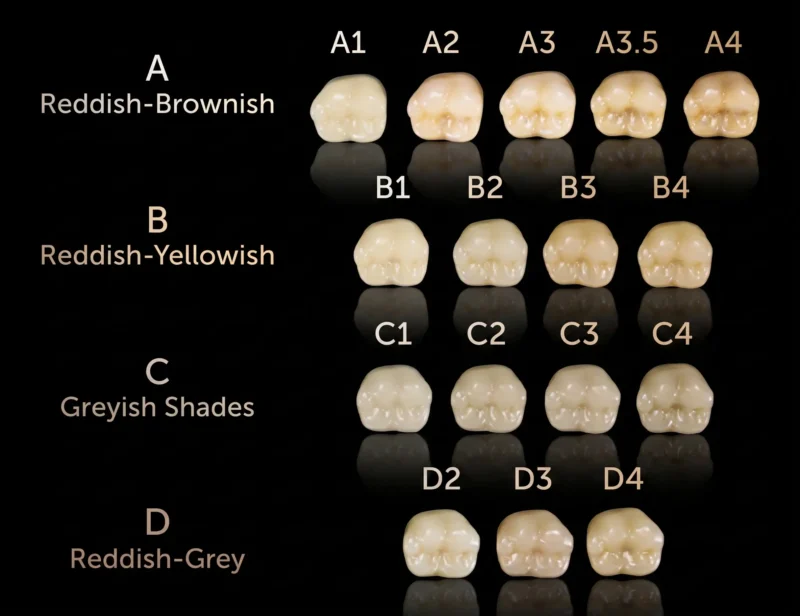
Every shade code on the VITA chart carries three pieces of information:
- Hue is the letter. It tells you which colour family the shade belongs to: A as reddish-brown, B as reddish-yellow, etc. A1 and A4 are the same colour in principle. One is simply far more concentrated than the other.
- Chroma is the number, and it describes how saturated or intense that colour is. A1 is the palest, most diluted version of the reddish-brown hue; A4 is the same hue at full strength.
- Value is brightness, the property patients actually notice. Value runs in the opposite direction to chroma: as the number goes up within a family, brightness goes down.
The Full Teeth Color Chart, Ordered by Brightness
Position | Shade | Hue family | Chroma level | Brightness |
1 | B1 | Reddish-yellow | Lowest in family | Brightest of all 16 |
2 | A1 | Reddish-brown | Lowest in family | Very bright |
3 | B2 | Reddish-yellow | Second | Bright |
4 | D2 | Reddish-grey | Lowest in family | Bright |
5 | A2 | Reddish-brown | Second | Upper middle |
6 | C1 | Grey | Lowest in family | Middle |
7 | C2 | Grey | Second | Middle |
8 | D4 | Reddish-grey | Highest in family | Middle |
9 | A3 | Reddish-brown | Third | Lower middle |
10 | D3 | Reddish-grey | Second | Lower middle |
11 | B3 | Reddish-yellow | Third | Lower middle |
12 | A3.5 | Reddish-brown | Fourth | Dark |
13 | B4 | Reddish-yellow | Highest in family | Dark |
14 | C3 | Grey | Third | Dark |
15 | A4 | Reddish-brown | Highest in family | Very dark |
16 | C4 | Grey | Highest in family | Darkest of all 16 |
A1 Tooth Color
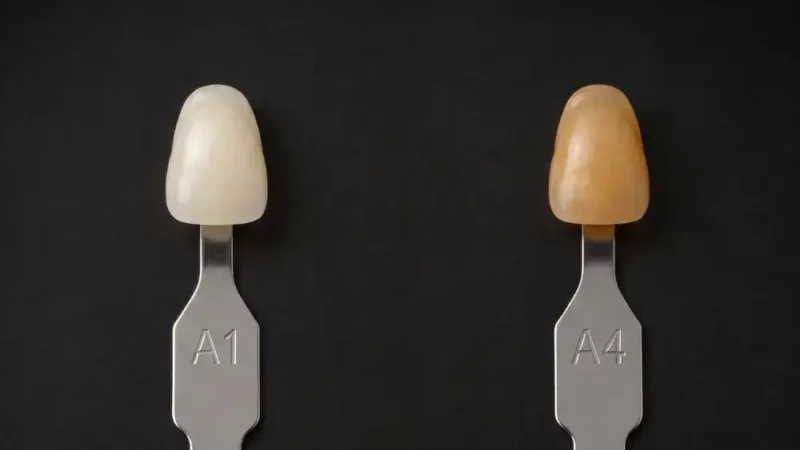
A1 is one of the most requested veneer shades. It is the lightest tab in the reddish-brown family and the second brightest shade on the whole chart. It reads as a clean ivory, because the warmth is still there, just heavily diluted. It suits bestpatients who want a bright result that still looks like natural enamel.
A1 Tooth Shade vs the Rest of the A Family
If your natural teeth already sit in the A family, moving up to A1 usually looks more natural than jumping across to B1 or C1. Staying in the same hue means the change reads as brightness rather than as a colour swap.
A2 Tooth Color
A2 is a warm, believable mid-tone and one of the two shades most frequently recorded as a starting point in adult patients. It suits best anyone matching a single crown, veneer or composite filling into an untreated smile. Because so many adults sit at or near A2, it is often the safest choice for a restoration.
A3 Tooth Color
A3 is frequently cited as the most common natural adult tooth shade. It is most commonly used as a baseline rather than a target. If a dentist records A3 before whitening, the discussion is usually about how far up the A family the treatment can realistically move.
A3.5 Tooth Color
A3.5 was added to fill a gap patients kept falling into between A3 and A4, which is a good illustration of how the guide grew by observation rather than by design. It is best used to match restorations into teeth with noticeable warmth, often in patients over 40 where dentine has thickened and enamel has thinned.
A4 Tooth Color
A4 is the most saturated reddish-brown on the chart and the second darkest shade overall. It is used for matching heavily discoloured natural dentition, particularly a single tooth restoration where the rest of the mouth is untreated. Rarely selected as a cosmetic target.
B1 Tooth Color
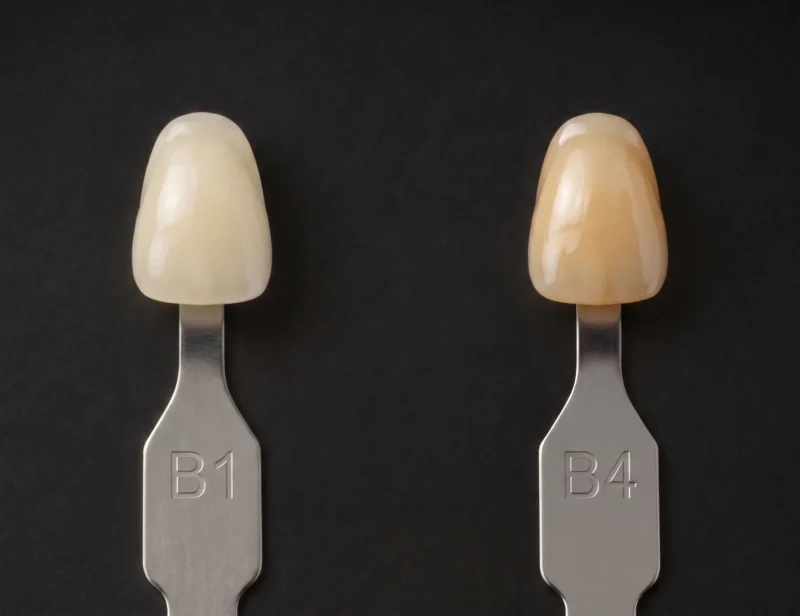
B1 is the brightest shade in the classical guide and the reference point most people mean when they say they want “white” teeth without going artificial. It suits best patients whose natural shade already leans yellow rather than grey or brown. It is a common veneer and crown target for people who want a clearly bright smile.
B2 Tooth Color
B2 is warm, bright and, in brightness terms, sits above A2 despite the matching number. It suits best patients with naturally yellow-toned enamel who want a lift without a hue change. Basically, it’s for patients who want a result that looks age-appropriate rather than new.
B3 Tooth Color
The B3 tooth color is for matching restorations into distinctly yellow dentition. B3 comes up in shade matching more often than its brightness would suggest, because yellow-dominant discolouration is common.
B4 Tooth Color
Used for matching purposes almost exclusively. B4 is a deep, saturated yellow and is not selected as a cosmetic goal.
A1 vs B1 Tooth Color: Which Should You Choose?
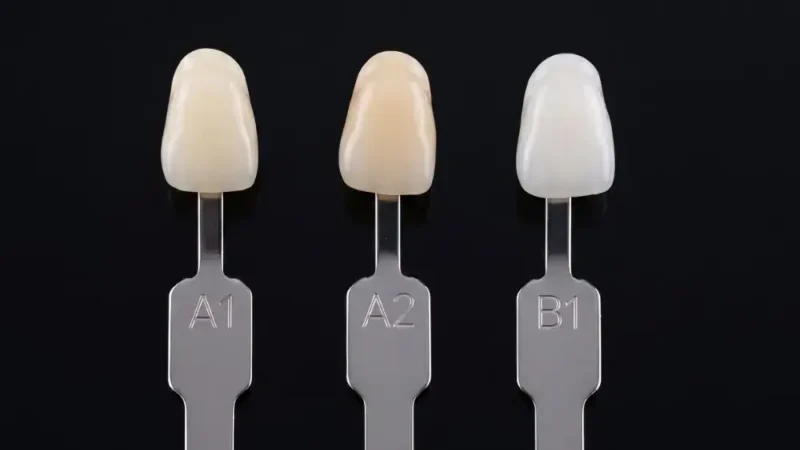
This is the most common shade comparison patients ask about. B1 is the brightest tab on the chart, sitting at position one. A1 is second. The gap between them is small, and in most lighting conditions a patient could not identify which is which.
Side by side, the difference is one of temperature: B1 leans reddish-yellow, A1 leans reddish-brown. The choice usually comes down to three considerations:
- Your existing hue: If your natural teeth are in the A family, A1 is likely to look more convincing.
- How much of the smile is being treated: When only one or two teeth are restored, matching the hue family matters far more than maximising brightness.
- Whether you will whiten later: Composite and ceramic do not respond to whitening. If natural teeth are going to be lightened around a restoration, that whitening should happen first.
A1 | B1 | |
Hue | Reddish-brown | Reddish-yellow |
Position in value order | 2 of 16 | 1 of 16 |
Visual character | Warm ivory, soft | Cool-leaning bright, crisp |
Typically chosen by | Patients with warm natural teeth wanting a natural lift | Patients wanting the brightest result still inside the natural range |
Common pitfall | Can read slightly beige against very cool skin or teeth | Can look flat if the ceramist does not build in translucency |
C1 Tooth Color
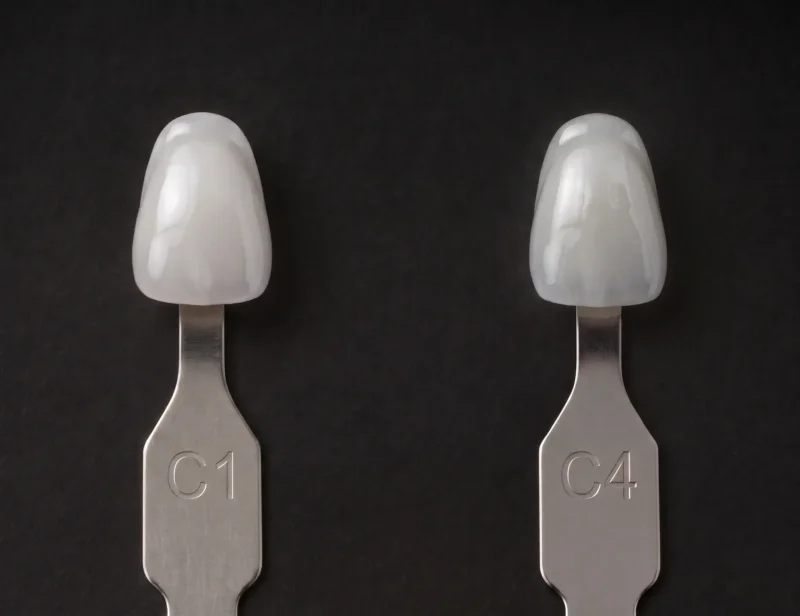
C1 is the lightest of the grey family and behaves very differently from A1 or B1 despite also being a “1”. Its brightness sits at position six, in the middle of the chart, because the grey hue absorbs more light than the warmer families.
It suits best patients whose natural teeth read cool or slightly translucent rather than yellow. This is a real and underserved group. If someone with genuinely grey-toned enamel is given a warm A-family restoration, the mismatch shows immediately at the margin.
C2 Tooth Color
Used for matching cooler dentition at a mid-range brightness. C2 was among the more frequently selected shades in Smith and Wilson’s crown data, which suggests it maps onto a real population rather than being a filler tab.
C3 Tooth Color
Used for matching darker, cooler dentition. Often recorded in older patients where greying and thinning enamel combine.
C4 Tooth Color
C4 is the darkest shade on the classical chart. Its used for matching only. A C4 baseline usually means whitening alone will not deliver a result the patient is happy with, and the discussion moves to ceramics.
D2 Tooth Color
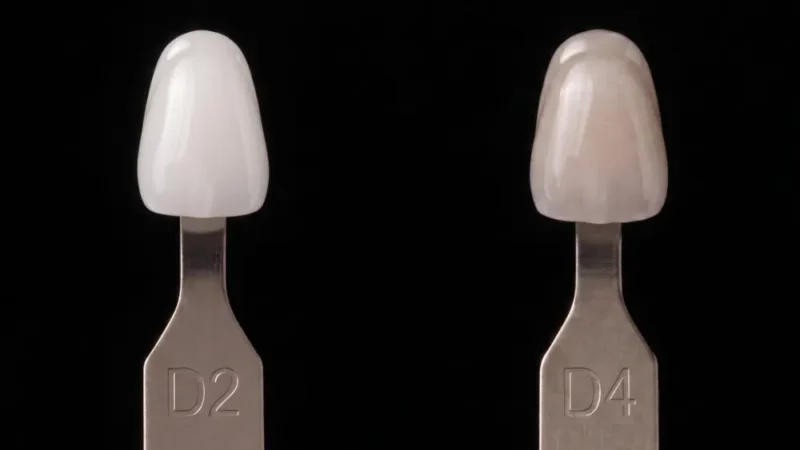
The D family starts at D2. There is no D1 tab in the classical guide. D2 suits best: patients whose teeth sit between the warm and cool families, showing neither obvious yellow nor obvious grey. D2 is bright, and it is genuinely useful for that in-between group.
D3 Tooth Color
Used for matching mixed-tone dentition at a mid-range brightness.
D4 Tooth Color
D4 is the quirk of the chart. Although it carries the highest chroma number in its family, it sits at position eight in the value order. In brightness terms, D4 is lighter than D3. It’s used for color matching, not cosmetics.
BL Bleach Shades and BL2 vs BL3 Veneers
Ivoclar responded introduced bleach shades in the 1990s originally numbered 010, 020, 030 and 040 and later renamed BL1, BL2, BL3 and BL4.
BL1 is the brightest of the four. BL4 is the least bright and sits just above B1. VITA later added its own bleached shades, 0M1, 0M2 and 0M3, to the 3D-Master system.
No one grows teeth this bright. They exist for whitened teeth and for ceramics.
BL2 vs BL3 Veneers
BL2 is brighter than BL3, but the gap is small enough that most patients cannot tell them. The difference shows up in context, against the face.
- BL2 reads as a deliberate, high-impact white. It is the shade most associated with the “Hollywood” look.
- BL3 is the softer of the two. It is still clearly brighter than any natural shade, but it retains enough warmth to blend more comfortably with surrounding features and any natural teeth left.
Which Teeth Color Suits Your Skin Tone?
The eye judges tooth colour by contrast with what surrounds it. The same shade appears brighter against deeper skin and more muted against very fair skin. The table below reflects how experienced clinicians, including One Life Dental’s doctors, tend to approach this. Use it to frame a conversation, not to pick a code.
Skin tone | How teeth read against it | Commonly chosen |
Very fair, cool or pink undertones | Low contrast, so brightness registers less | B1, A1, occasionally BL4 |
Fair, warm or golden undertones | Warmth in the skin amplifies warmth in the teeth | A1, B1, B2 |
Olive or Mediterranean | Green-yellow undertones read against warm teeth | A1, B1, and bleach shades at the softer end |
Medium brown | Moderate to high contrast, so shades read brighter than the tab suggests | A1, B1, BL3, BL4 |
Deep brown to very deep | High contrast, the strongest brightening effect of any group | B1, BL3, BL4 |
Lipstick Colors and Tooth Shade
Lipstick sits directly against the teeth, which makes it the single strongest influence on how your tooth colour is perceived. The effect is optical.
Lipstick family | Undertone | Effect on perceived tooth colour |
Blue-based red | Cool | Strongest brightening effect |
Berry, plum, raspberry | Cool | Strong brightening |
Cool pink, fuchsia, magenta | Cool | Moderate to strong brightening |
Cool nude, pink or ashy | Neutral to cool | Mildly favourable |
Warm nude, peach, beige, caramel | Warm | Makes teeth look more yellow |
Orange red, coral, brick | Warm | Makes teeth look more yellow |
Brown, chocolate | Warm | Usually unfavourable |
Pale, sheer or barely-there shades | Any | Neutral to unfavourable |
False Teeth and Denture Teeth Color Charts
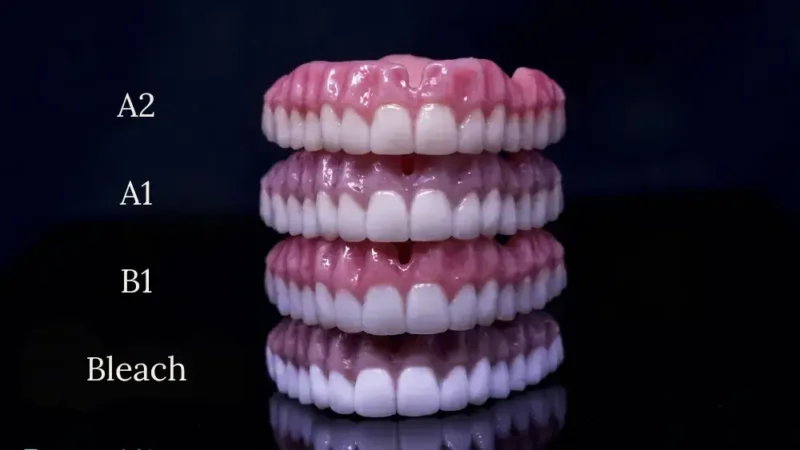
Denture tooth manufacturers supply their own shade guides matched to their specific tooth lines. VITAPAN uses the classical A1 to D4 system. Denture shade guides often include tools the natural-tooth guides do not. Ivoclar’s SR Vivodent S DCL guide, for example, has a built-in facial meter for measuring the width of the nose to help select tooth size, and a papillameter for assessing upper lip length and the lip closure line.
A few things that come up repeatedly in denture shade discussions:
- Full dentures are a free choice of shade, since there are no natural teeth left to match.
- Partial dentures must match the remaining natural teeth, which is the harder job.
- Denture teeth do not respond to whitening at all. Surface stain can be cleaned professionally, but the base colour is fixed for life.
- Bleach shades are available in some acrylic denture tooth lines but not across all materials.
Teeth Color Chart Use in Cosmetic Dentistry
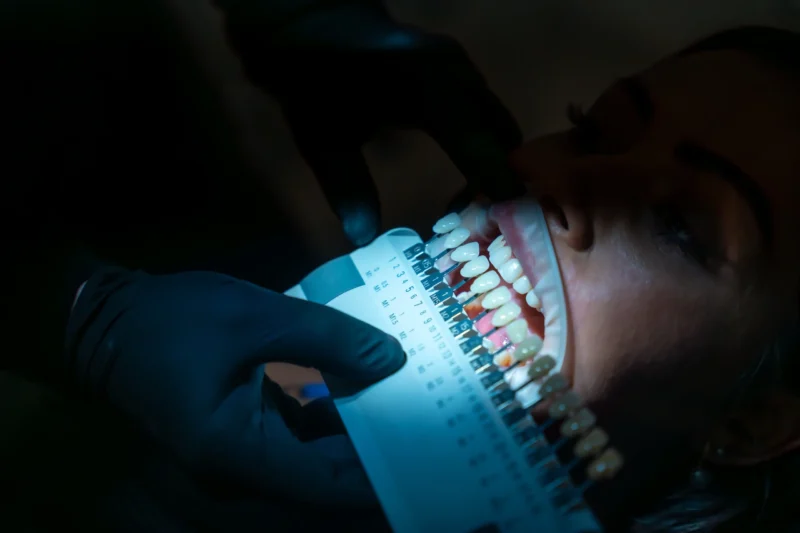
A shade guide is not a menu of whites to order from. It is a measuring instrument and a communication tool, and it is used at several distinct points in treatment. Let’s take a look at every one in detail.
1. Recording a Baseline
Before anything else, the dentist records where you are starting. That baseline is taken with a shade tab, photographs, or a digital spectrophotometer such as the VITA Easyshade, which measures colour instrumentally.
This record is the reference against which any change is measured and it forms part of your clinical record.
2. Professional Teeth Whitening
Whitening cannot guarantee a specific shade code, and it does not lighten fillings, bonding, crowns or veneers at all. Visible effects may last roughly six months to three years, influenced by coffee, tea, tobacco, oral hygiene and individual habits.
Whitening is usually most suitable for someone who likes the shape and arrangement of their natural teeth but wants a brighter colour.
3. Composite Bonding
Bonding uses a tooth-coloured resin to conceal discolouration and to improve small chips, narrow gaps, uneven edges and teeth that appear slightly short or irregular.
Composite is manufactured in VITA shades, so the chart is used to select the resin directly. Many cases need more than one shade, with a more opaque dentine layer beneath and a more translucent enamel layer over it. Composite does not respond to whitening. If both are planned, whitening comes first and the composite shade is selected afterwards.
4. Composite Veneers
Composite veneers use resin similar to bonding, but the material covers more of the visible front surface. The material is applied directly to the teeth in layers, then shaped, hardened and polished.
Composite absorbs stain and loses surface polish more readily than ceramic, so periodic polishing, maintenance or eventual replacement should be expected. Longevity depends on the material, technique, diet, oral hygiene, biting habits and grinding.
5. Porcelain Veneers
Porcelain veneers are thin ceramic shells bonded to the front surfaces of teeth. They can mask discolouration that does not respond to whitening while also modifying shape, length, proportion and irregularities.
6. Dental Crowns
A crown covers the entire visible portion of a prepared tooth, so it can completely change the tooth’s apparent colour and shape. Crowns may be appropriate when a tooth is substantially weakened, cracked, worn, heavily filled or damaged by decay.
Crowns typically last around five to fifteen years, and some remain functional for much longer.
7. Dentures, Bridges and Implant Restorations
Everything that applies to crowns applies here, with the added complication that these restorations often replace several teeth at once and sit alongside gum tissue. Gingival shade guides exist for cases where pink porcelain or an acrylic flange has to blend with natural gum.
Communicating With the Laboratory
Most of the outcome is decided by the dental technician, not the dentist. The shade code is the core of the prescription that travels to the lab, alongside the stump shade, photographs and notes on translucency, surface texture, incisal halo or white flecking.
A practice that works with a strong ceramist, like One Life Dental’s ComfyDent Laboratory, and sends detailed documentation will produce better results at any shade than a practice sending a one-word prescription.
Whitening, Bonding, Veneers, or Crowns?
Procedure | Main color effect | General appointment pattern | Approximate longevity |
Professional whitening | Lightens natural teeth | One clinical visit or a supervised course | Around 6 months to 3 years |
Composite bonding | Covers localized discoloration | Often one visit | Around 3 to 10 years |
Composite veneers | Cover a larger visible area | One or more visits | Varies; maintenance needed |
Porcelain veneers | Mask color and change visible shape | Usually at least two main appointments | Around 10 to 15 years |
Dental crowns | Cover and restore the visible tooth | Commonly two main appointments | Around 5 to 15 years |