

You’ve lost a tooth — or you’re about to — and now you’re facing a choice: dental bridge or implant? Both options can make you smile look great and let you eat normally. But they work in different ways, carry different risks, and have very different long-term costs.
This guide by Dr. Astolfi gives you the clinical facts, the honest numbers, and the practical answers — so you can walk into your consultation already informed.
First of All: Should You Replace a Missing Tooth or Just Ignore It?
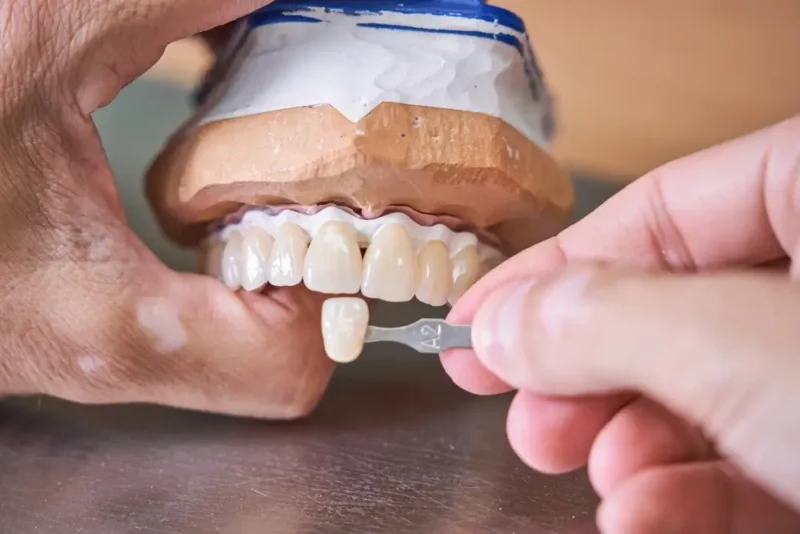
Once a tooth is gone, the jawbone beneath it starts to shrink. Within the first year alone, you can lose around 25% of the bone in that area. After three years, that figure reaches 40%.
The neighbouring teeth don’t stay put either. They will gradually tilt and drift into the gap —increasing the risk of decay and gum disease. Replacing a missing tooth protects your remaining teeth, maintains your facial structure, and keeps future treatment costs manageable. Waiting makes everything more complex — and more expensive.
What Is a Dental Bridge?
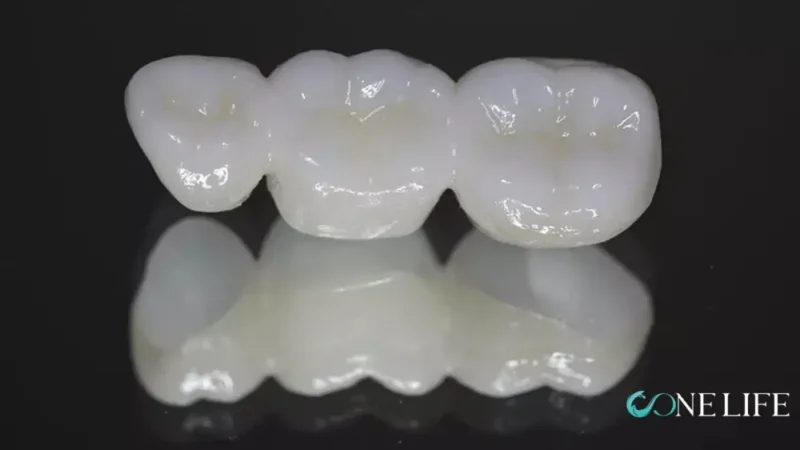
A dental bridge is a fixed prosthetic that literally bridges the gap left by one or more missing teeth. To fit a bridge, your dentist must permanently file down and reshape those neighbouring healthy teeth. The bridge is not removable by the patient.
There are several types of dental bridge:
- Traditional bridge
- Cantilever bridge
- Maryland bridge
- Implant-supported bridge
Pros & Cons of Dental Bridges
Pros:
- Fast treatment — completed in weeks
- No surgery required
- Lower upfront cost
- Widely available — covered partially by NHS in the UK (Band 3, currently £306.80) and by many insurance plans in the US, Canada and Australia
- Predictable aesthetics
Cons:
- Damages healthy neighbouring teeth
- Does not prevent bone loss
- Shorter lifespan — the average lifespan of bridges, according to the American Dental Association, is just 10.1 years
- Higher long-term cost — bridges need replacing
- Hygiene is more demanding
- Risk of cascade failure — bridge failures happen in approximately 35% of cases within 10 years
What Is a Dental Implant?
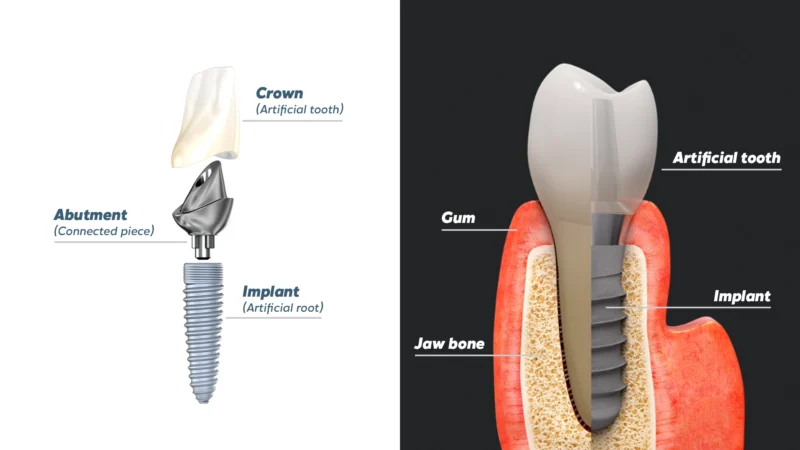
A dental implant is a small titanium post that is placed directly into the jawbone, acting as an artificial tooth root. Once in place, it gradually fuses with the jawbone over a period of 3 to 6 months. A dental crown — matched to the colour and shape of your natural teeth — is then fixed on top.
The most common implant types include:
- Single tooth implant
- Implant-supported bridge
- All-on-4 / All-on-6
- Zygomatic implants
Pros & Cons of Implant Treatment
Pros:
- Preserves jawbone
- Does not affect neighbouring teeth
- Exceptional longevity — modern dental implants show a 98.6% success rate at 5 years post-loading
- Natural appearance
- Easier to clean — brushed and flossed exactly like a natural tooth; no special tools required
- One-time investment
Cons:
- Higher upfront cost
- Requires surgery
- Longer treatment time — the full process takes several months
- Bone requirements — implants require healthy bone for success
- Not always covered by insurance — many plans in the UK, US, and Canada classify implants as cosmetic or elective, limiting reimbursement
Dental Bridge vs Implant: Key Differences
Here is a clear, at-a-glance comparison of both options across the criteria that matter most.
Dental Bridge | Dental Implant | |
Procedure type | Non-surgical | Minor surgery |
Treatment time | 3–4 weeks | 4–7 months |
Affects neighbouring teeth | Yes — filed down permanently | No |
Prevents bone loss | No | Yes |
Average lifespan | 10–15 years | 20-25+ years |
10-year success rate | 79–94% | 94–98% |
Upfront cost (UK) | £750–£2,400 | £1,800–£3,800 |
Upfront cost (US) | $2,000–$3,000 | $3,000–$6,000+ |
Long-term cost | Higher (multiple replacements) | Lower (one-time investment) |
Cleaning | Requires special tools | Normal brushing & flossing |
Bone graft needed? | Rarely | Sometimes |
NHS / insurance coverage | Partial (UK Band 3) | Limited |
Best for | Fast solution, budget-limited | Long-term health & value |
Who Is a Good Candidate for Each Option?
Neither treatment is universally right for every patient. The best choice depends on your bone health, your overall medical situation, your budget, and how long you want the result to last.
You may be a stronger candidate for a dental bridge if:
- You need a fast result
- You would need crowning regardless on the adjacent teeth
- You have insufficient bone density and prefer to avoid bone grafting
- Budget is a constraint
- You have a medical condition such as uncontrolled diabetes or cancer
You are likely a stronger candidate for a dental implant if:
- Your neighbouring teeth are healthy and intact
- You are looking for the most durable, long-term solution
- You want to prevent jawbone deterioration and maintain your facial structure
- You are in good general health with sufficient jawbone
- You want the most natural-looking and easiest-to-maintain result
Dental Bridge vs Implant Cost: UK, US, Canada, Australia & Turkey
The upfront price of dental implants or a bridge is only part of the picture. What matters equally is the total cost over time, including replacements, repairs, and any complications affecting neighbouring teeth.
Upfront Cost Comparison by Country
Bridge (3-unit) | Single Implant (post + crown) | |
United Kingdom | £750 – £2,400 | £1,800 – £3,800 |
United States | $2,000 – $3,000 | $3,000 – $6,000+ |
Canada | CAD $2,500 – $4,000 | CAD $3,000 – $6,500 |
Australia | AUD $2,500 – $4,500 | AUD $4,000 – $7,000 |
Turkey (Istanbul) | £300 – £600 | £400 – £900 |
Prices are indicative averages for 2025–2026. Costs vary by clinic, materials, and individual case complexity.
How Long Does a Dental Bridge vs Implant Last? Long-Term Cost
A bridge looks cheaper on the day you pay for it. Over a decade or two, the numbers tell a very different story. The clinical data reinforces this clearly. Dental implants show 10-year survival rates of approximately 94–98%, while dental bridges show survival rates of 72–87% over the same period. Put simply: at the 10-year mark, roughly one in five bridges has already failed.
Over 20 years, dental implants often cost less than bridges when considering replacements. A $3,000 implant lasts 20+ years, while a $1,200 bridge needs replacing every 10–15 years, totalling $5,300+ over the same period.
Factors Affecting Longevity
Several factors determine how long each option actually lasts in practice.
For dental bridges, longevity depends on:
- Condition of the abutment teeth
- Oral hygiene
- Bite forces
- Material — zirconia bridges are generally more durable than porcelain-fused-to-metal options
For dental implants, longevity depends on:
- Bone quality and quantity
- Smoking
- Systemic health
- Oral hygiene
- Implant brand and surgical precision
Maintenance, Repair & Replacement Costs
Dental bridge — ongoing costs to anticipate:
- Replacement — most bridges require full replacement every 10–15 years; each replacement costs the same as the original, and each time more tooth structure may be lost from the abutment teeth
- Abutment tooth treatment — decay or fracture in a supporting tooth may require a root canal ($800–$1,500) or even extraction, at which point the bridge is lost entirely
- Specialist cleaning tools — floss threaders, interdental brushes, or a water flosser are necessary for daily maintenance
Dental implant — ongoing costs to anticipate:
- Crown replacement — the implant post itself rarely needs replacing; the crown on top may need renewal after 15–20 years, typically costing $800–$1,500
- Regular professional hygiene — routine scale and polish appointments, ideally every 6 months
- Occasional abutment check — the connector between post and crown may need tightening or replacing over many years; a minor and inexpensive procedure
- No cascade risk — because neighbouring teeth are untouched, implant maintenance does not carry the risk of progressively more complex and costly interventions
Does a Dental Bridge Damage Neighbouring Teeth?
Yes — and this is one of the most significant drawbacks.
To place a bridge, your dentist must permanently reshape the two teeth on either side of the gap. This means filing them down — removing a substantial portion of healthy enamel and tooth structure. This process is irreversible. Once those teeth are filed down, they can never be restored to their original state.
This concern applies specifically to traditional bridges. An implant-supported bridge — where the bridge is anchored on implants rather than natural teeth — avoids this problem entirely, as no natural tooth structure is touched.
This has several important consequences:
- Permanent structural weakening
- Increased decay risk
- Root canal risk
- Tooth loss escalation
What Happens to Your Jawbone If You Choose a Bridge?
The bone begins to resorb — to break down and shrink — almost immediately. The numbers are stark:
- 25% bone volume lost in the first year after extraction
- 40% bone volume lost after three years
- Up to 60% bone volume lost after ten years
This has two major practical consequences:
- Facial changes over time: As the bone beneath the pontic shrinks, a visible indentation or dent gradually develops in the jaw. The face can take on a slightly sunken or aged appearance in that area, even with a perfectly intact bridge sitting above it.
- Compromised future options: If you choose a bridge today and later decide you want an implant, the bone loss that occurred during the years the bridge was in place may mean you no longer have enough bone to place an implant without a bone graft first.
Is There Any Alternative to Both Bridges and Implants?
Yes — though for most patients, neither alternative matches the clinical outcomes of a bridge or an implant. It is worth knowing your options, particularly if surgery is not currently possible or if budget is a genuine constraint.
- Removable partial denture: It is the most affordable option upfront and requires no surgery and no alteration of adjacent teeth.
However, the trade-offs are significant:
- It does not prevent bone loss, just like a bridge
- It can feel loose or uncomfortable, particularly when eating
- Removable partial dentures typically last between 3 to 5 years and during that time they often need to be relined as the bone continues to resorb
- Many patients find them socially uncomfortable
- Full dentures: For patients missing all or most of their teeth, full dentures are a traditional option. They are removable, relatively affordable, and widely available. However, they accelerate bone loss significantly, can slip during eating and speaking, and require adhesives for stability. Most patients who wear full dentures for several years eventually find that bone loss makes them increasingly difficult to fit.
- Implant-retained dentures: A middle-ground solution: a denture that is anchored onto two to four implants, giving it far greater stability than a conventional denture while remaining removable for cleaning. This option is particularly useful for patients who need a full arch replacement but cannot afford or are not suitable for a fixed All-on-4 solution. It also helps slow bone loss in the areas where the implants are placed.
Get a Free Consultation
Not sure which option is right for you? The answer starts with a clinical assessment.
At OONE LIFE in Istanbul, Dr. Astolfi and the specialist team offer a free consultation to international patients — including a review of your existing scans or X-rays and a clear, honest recommendation based on your bone health, your teeth, and your goals.
- Savings of up to 70% compared to UK and US private clinics
- Premium implant brands — Nobel Biocare, Straumann, and Osstem
- Specialist oral surgeons — not general dentists
- Full concierge service — transfers, accommodation, and aftercare all arranged for you
- Written guaranteeon all implant work
Book your free consultation today — send your X-rays or a few photos of your smile.