
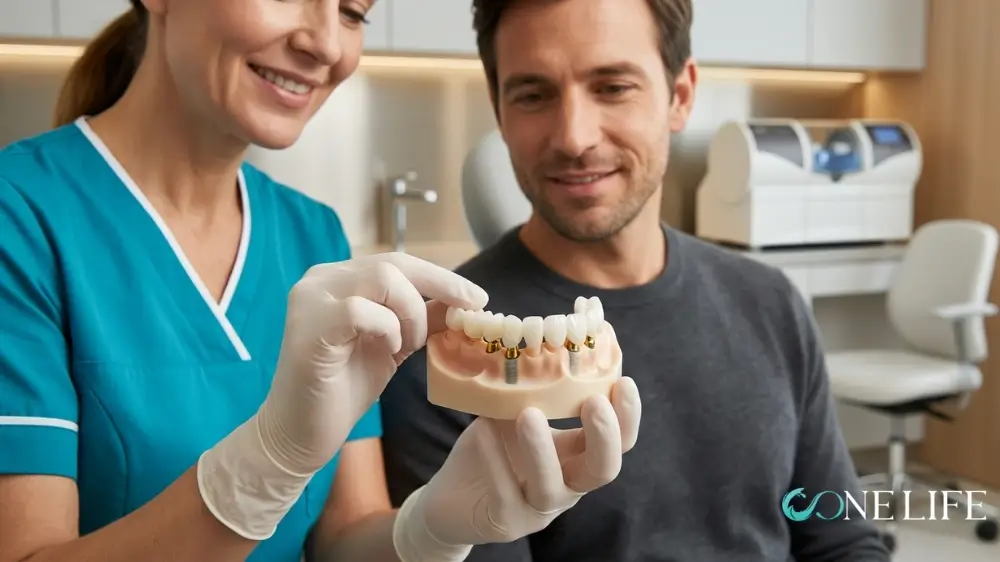
A zirconia bridge is a fixed restoration made from zirconium dioxide (ZrO₂) — a high-performance ceramic with outstanding durability and natural appearance. In 2026, dentists are increasingly recommending this material, which can reach over 1,200 MPa — more than triple the strength of natural tooth enamel.
Zirconia resists staining, looks indistinguishable from natural teeth, and is 100% metal-free. This guide covers everything you need to know about the types of zirconia bridges, how long it lasts & how much a full arch zirconia bridge costs.
What is a Zirconia Bridge?
A zirconia bridge is a metal-free prosthesis milled from a solid block of zirconium dioxide using CAD/CAM technology. It fills the gap left by one or more missing teeth, either by anchoring to the natural teeth on either side (traditional bridge) or by locking onto titanium implants placed in the jaw (implant-supported zirconia bridge).
The result is a restoration that reflects light the way natural enamel does, with no risk of a dark metal line appearing at the gumline.
Types of Zirconia Bridges
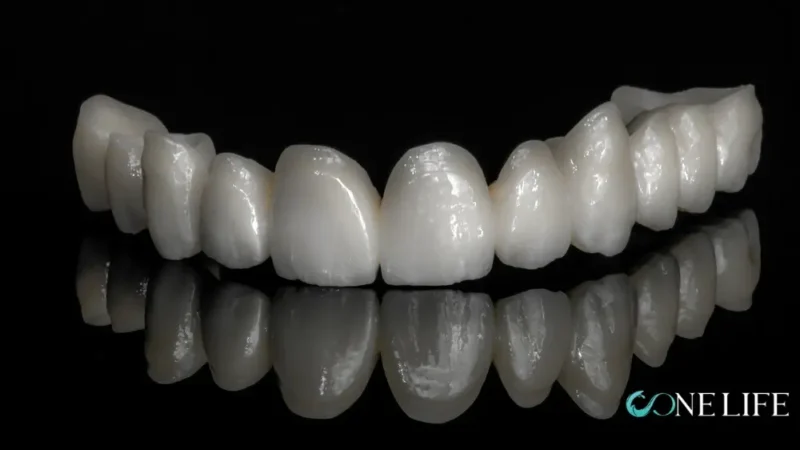
Choosing the right type of zirconia bridge depends on the location of the bridge in the mouth, the biting forces involved, and how important aesthetics are to you. Let’s look at the main types and compare them to find the best for you.
1. Tooth-Supported Zirconia Bridge
These bridges anchor to the natural teeth on either side of the gap. The adjacent teeth (called abutments) are gently reduced to accept crowns, and the false tooth — the pontic — is suspended between them. No implants are required.
There are three tooth-supported variants:
A) Traditional (fixed-fixed) Zirconia Bridge
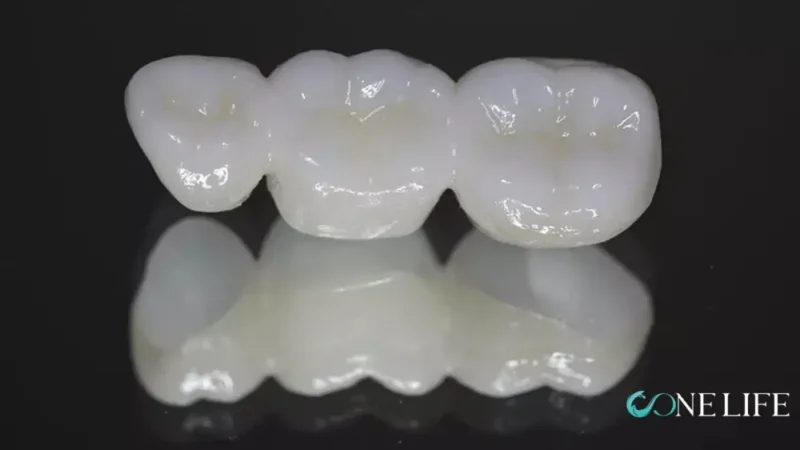
The most common design. A crown sits on each abutment tooth with the pontic locked between them. Strong and predictable, particularly when the neighbouring teeth already need crowns for other reasons.
B) Cantilever Zirconia Bridge
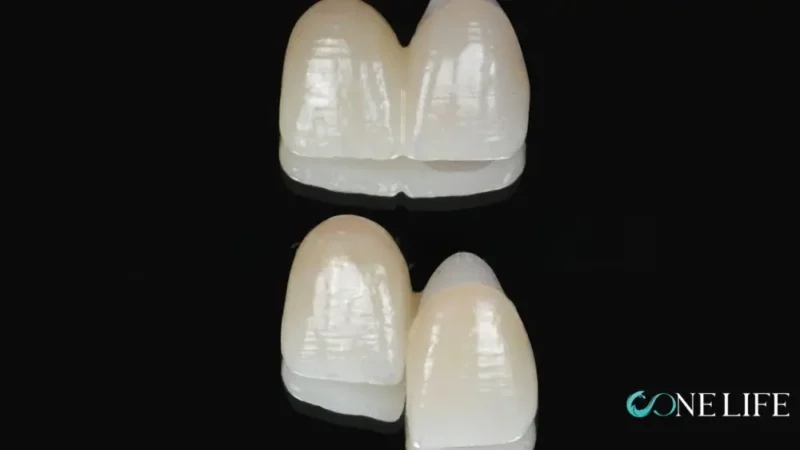
Supported on one side only, anchored to a single abutment tooth. Used when only one neighbouring tooth is available — typically in the front of the mouth for lower-bite-force situations. Not recommended in the posterior region where chewing forces are highest.
C) Maryland (resin-bonded) Zirconia Bridge
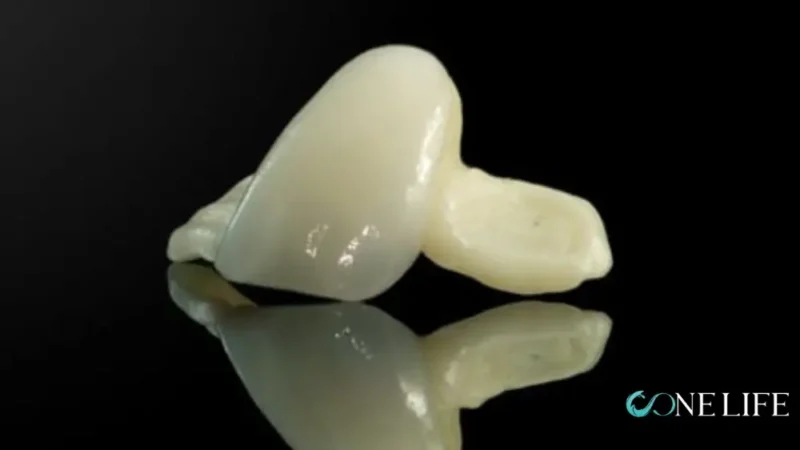
The most conservative option. Instead of full crowns, thin zirconia wings bond to the backs of the neighbouring teeth with minimal or no preparation. Ideal for replacing a single front tooth in patients who want to preserve healthy tooth structure. Not suitable for posterior or high-load.
2. Zirconia Bridge for Dental Implants
When teeth are missing and no healthy neighbours are available, the bridge anchors to dental implants placed in the jawbone. These are the most durable, longest-lasting restorations in modern dentistry, and they divide into two important subtypes:
A) Monolithic Zirconia Bridge (Full Arch)
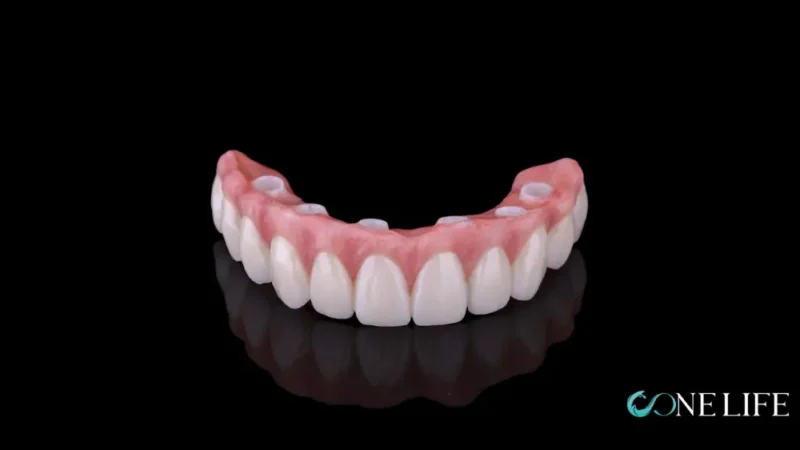
All teeth across the arch are milled from a single solid block of zirconia and screwed directly onto 4–6 implants. Because there is no substructure, the aesthetic result is clean and natural — white ceramic teeth emerging from real gum tissue, with no pink acrylic visible. Best for patients with adequate bone volume and well-positioned implants.
B) Zirconia-Over-Titanium Bar (Ti-bar Hybrid)
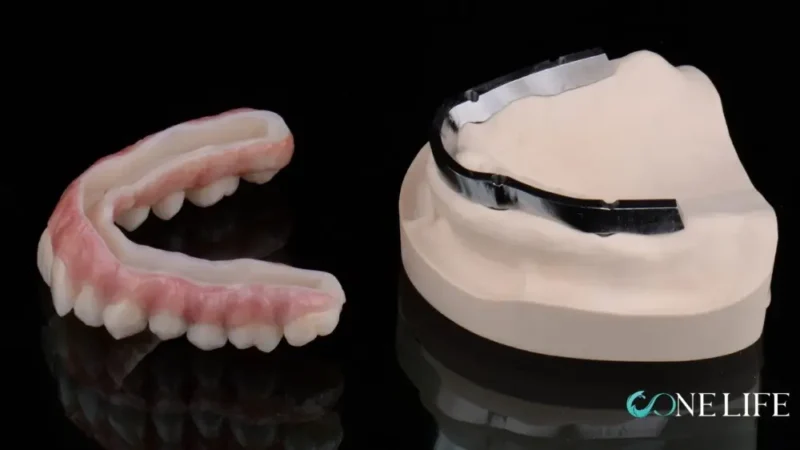
The most robust full-arch option. A precision-milled titanium bar is first fabricated to fit passively over the implants — distributing bite forces evenly across all fixation points. A zirconia superstructure is then bonded on top. These can be very natural-looking restorations with the added strength of the titanium bar underneath.
Types of Zirconia Material for Dental Bridges
The construction of the bridge determines its shape. The zirconia determines its strength and appearance. These are two separate decisions:
High-Translucency Zirconia (~720 MPa)
High-translucent zirconia has a higher flexural strength than PFM (Porcelain-Fused Metal) restorations, yet maintains a natural translucency, closely replicating the vibrancy of existing teeth. It is perfect for anterior and posterior bridges of up to 3 units. The right choice for visible front teeth where aesthetics are the priority.
Solid (monolithic) zirconia (~1,200 MPa)
Solid zirconia is monolithic and made from pure zirconia, with a high flexural strength of 1,200 MPa. It is extremely strong and ideal for patients who may have bruxism, or for posterior bridges where tooth preparations are discoloured or have been endodontically treated. Typically not recommended for front teeth.
Zirconia Type | Flexural Strength | Best Use | Bruxism-Friendly? | Anterior Aesthetics |
High-translucency | ~720 MPa | Front bridges, up to 3 units | No | ✅ Excellent |
Solid (monolithic) | ~1,200 MPa | Posterior, full arch, heavy load | Yes | ⚠️ More opaque |
Zirconia vs. Other Dental Bridges
The four main materials used for dental bridges today are porcelain-fused-to-metal (PFM), lithium disilicate (e.max), composite resin, and zirconia. Each has a specific clinical profile. The table below gives you the honest comparison across the criteria that matter most.
Material | Strength | Aesthetics | Lifespan | Cost (US, 3-unit) | Metal-free? | Best for |
Zirconia | 720–1,200 MPa | Very good – excellent | 15–20+ yrs | $2,500–$5,000 | Yes | Front & back, full arch, bruxism |
PFM | ~400 MPa | Good (metal line risk) | 10–15 yrs | $1,500–$3,500 | No | Budget, posterior teeth |
E.max (lithium disilicate) | ~400 MPa | Excellent | 10–15 yrs | $2,000–$4,500 | Yes | Front only, ≤3 units |
Composite resin | 100–200 MPa | Moderate | 5–7 yrs | $800–$2,000 | Yes | Temporary only |
How Much Does a Zirconia Bridge Cost?
The average cost of a zirconia dental bridge in the US ranges from $2,000 to $5,000 for a tooth-supported system. Clinics in areas such as New York, Los Angeles, or San Francisco will sit at the higher end.
That price typically includes:
- Initial consultation and X-rays
- Tooth preparation on both abutment teeth
- CAD/CAM lab fabrication of the bridge
- Temporary bridge while the permanent one is made
- Fitting and bite adjustment appointments
What it does not include:
- Tooth extraction, if the missing tooth is still present
- Bone grafting, sinus lifting or other preparatory procedures
- Implants, if the bridge is implant-supported (see full cost table above)
Full Arch Zirconia Bridge Cost
For patients missing most or all teeth, a full arch implant-supported zirconia bridge is the best option. Full arch zirconia bridges (zirconia arches) range from $20,000–$35,000 per arch in 2026. Both arches together (full mouth) cost $35,000–$65,000.
This price typically covers implant placement, temporaries (immediate loading), and the final zirconia bridge.
Bridge type | Units | Implants needed | Typical cost |
Tooth-supported zirconia bridge | 3 units (1 missing tooth) | None | $2,500–$5,000 |
Full arch monolithic zirconia bridge | 10–14 units | 4–6 implants | $20,000–$35,000 |
Full mouth (both arches) | 20–28 units | 8–12 implants | $35,000–$65,000 |
How Much Does a Zirconia Bridge Cost in Turkey?
A growing number of patients are travelling abroad to get full arch zirconia bridges on dental implants in Turkey. A full arch zirconia implant bridge costs in Turkey $5,000-$8,000. That is enough to cover flights, hotel, and the full treatment package and still spend up to 75% less than the US.
Don’t hesitate to contact us to receive more information on full mouth dental implants package deal in Turkey.
Treatment | US cost | Turkey cost (Istanbul) |
3-unit zirconia bridge (tooth-supported) | $2,500–$5,000 | $600–$1,200 |
Implant + zirconia crown (single tooth) | $3,000–$5,500 | $800–$1,500 |
Full arch zirconia bridge (All-on-4) | $20,000–$35,000 | $7,000–$12,000 |
Full mouth zirconia (both arches) | $35,000–$65,000 | $12,000–$20,000 |
How Long Will a Zirconia Bridge Last?
A well-maintained zirconia bridge lasts 15–20 years minimum, and in many cases, a lifetime. No other ceramic bridge comes close. The clinical evidence backs this up. A 2025 retrospective study published in Medicina (Lolos et al.) found an overall 5-year survival rate of 96.3%, with monolithic restorations reaching 100% survival.
The key longevity drivers, ranked by clinical impact, are:
Long-Term Maintenance and Care
A zirconia bridge does not require special products or complicated routines — but it does require consistency. The following protocol applies to both tooth-supported and implant-supported zirconia bridges:
Daily care:
- Brush twice daily with a soft-bristle or electric toothbrush
- Use a non-abrasive fluoride toothpaste; avoid whitening toothpastes with high RDA scores
- Clean beneath the pontic (the false tooth suspended between supports) daily using an interdental brush or water flosser
- For implant-supported bridges, floss threaders or specialised implant floss reach the areas a standard brush cannot
Professional maintenance:
- Attend a hygienist appointment every 6 months for professional cleaning
- Annual dental X-rays for tooth-supported bridges to monitor abutment tooth health and marginal fit
- For implant-supported bridges, annual periapical X-rays to monitor bone levels around each implant; any bone loss greater than 0.2 mm per year warrants clinical reviewresin100–200 MPaModerate5–7 yrs$800–$2,000✓Temporary only
How a Zirconia Bridge Works, Step by Step
Let’s go through the step-by-step process of getting a zirconia bridge at the dentist.
Step 1 — Consultation and diagnosis
Your dentist carries out a full clinical examination, including digital X-rays and, for implant cases, a 3D CBCT scan. This maps bone density, nerve positions, and implant placement sites with millimetre accuracy.
Step 2 — Treatment planning and digital design
Using CAD/CAM software, the bridge is digitally designed before a single tooth is touched. The shape, bite, and shade are planned to match your natural teeth.
Step 3 — Tooth preparation or implant placement
- For tooth-supported bridges:The abutment teeth on either side of the gap are gently reduced — typically 1.0–1.5 mm — to make room for the crowns. A digital or physical impression is taken of the prepared teeth. A temporary bridge is fitted while the permanent one is fabricated.
- For implant-supported bridges:Titanium implants are surgically placed into the jawbone under local anaesthesia. A temporary restoration is fitted the same day in most cases. An osseointegration period of 3–6 months follows, during which the implants fuse with the bone — a process called osseointegration.
Step 4 — Fabrication
The digital design file is sent to a dental laboratory, where the bridge is milled from a solid zirconia block using a precision CAD/CAM milling machine. It is then sintered (fired at high temperature to reach full density and strength), polished, and characterised to match your natural tooth shade.
Step 5 — Fitting and adjustment
The permanent bridge is seated, checked for fit, bite, and aesthetics, and then permanently cemented or screw-retained. Minor occlusal adjustments are made chairside. For implant-supported bridges, screw access holes are sealed with composite.
Step 6 — Review
A follow-up appointment at 2–4 weeks confirms the bite is comfortable and the gum tissue is healthy around the margins. For implant cases, annual X-rays monitor bone levels around the implants.
How Many Visits to the Dentist Do You Need?
The total timeline varies significantly by case type:
Bridge type | Visits to complete | Total timeline |
Tooth-supported (3-unit) | 2 visits | 2–3 weeks |
Implant-supported (single or small bridge) | 2 visits | 3–6 months |
Full arch implant bridge | 2 visits | 4–6 months |
Full arch with bone grafting | 2–3 visits | 6–12 months |
Is a Zirconia Dental Bridge Painful?
No — the procedure itself is not painful, as it is performed under local anaesthesia. You will feel pressure and movement but not pain. The more relevant question is not whether it hurts during the procedure, but what to expect in the days after.
After tooth preparation (tooth-supported bridge):
- Mild sensitivity for 1–2 weeks, particularly to cold
- Gum tenderness resolves within a few days
- Over-the-counter ibuprofen or paracetamol manages any discomfort comfortably
After implant placement (implant-supported bridge):
- Swelling and bruising peak at 48–72 hours and resolves within 7–10 days
- Discomfort is managed with over-the-counter pain relief for 3–5 days
- A soft diet is required for 6–8 weeks
- Any sharp or worsening pain after day 5 warrants contacting your clinician
Advantages & Disadvantages of Zirconia for a Dental Bridge
No restoration material is perfect. Zirconia has a genuinely strong clinical profile — but patients deserve an honest account of both sides before making a decision.
Advantages:
- Exceptional strength — at 720–1,200 MPa, zirconia is significantly stronger than natural enamel (~384 MPa) and all competing ceramic materials
- Natural aesthetics — high-translucency zirconia closely replicates the light transmission of natural enamel; no dark metal lines, no opacity, no artificial brightness
- Metal-free and biocompatible — suitable for patients with metal sensitivities; zirconia ceramics are less prone to bacterial attachment and peri-implant infection
- Stain and corrosion resistant — zirconia does not absorb pigment from coffee, tea, or red wine, and does not corrode like metal-based restorations
- Longevity — with proper care, zirconia implants and bridges are expected to last 15–25 years or longer
- Low maintenance — no adhesives, no removal, no specialist cleaning products required
Disadvantages:
- Cost — zirconia is more expensive upfront than PFM or composite
- Hardness can wear opposing teeth — solid zirconia at 1,200 MPa is harder than natural enamel; over time it can accelerate wear on the opposing teeth it bites against, particularly in bruxers
- Full arch fracture risk — in monolithic full-arch restorations, a fracture requires replacement of the entire arch
- Irreversible tooth preparation — for tooth-supported bridges, the reduction of healthy abutment teeth is permanent
- Requires skilled fabrication — CAD/CAM milling precision and sintering protocols directly affect fit and strength
- Limited repairability — chipped or fractured zirconia cannot be bonded back; significant damage typically requires full replacement of the unit
Is a Zirconia Bridge Safe?
Yes — zirconia is one of the most tested biomaterials in modern dentistry. It has been used since the early 1990s and in dental restorations at scale since the mid-2000s.
Zirconia (zirconium dioxide, ZrO₂) is an inert ceramic oxide. It does not corrode, does not leach ions into surrounding tissue, and does not trigger immune responses in the overwhelming majority of patients. It is the same class of high-performance ceramic used in orthopaedic hip and knee replacements — one of the most demanding biocompatibility standards in medicine.
Is a Zirconia Bridge Covered by Insurance?
Partially, in some cases — but do not count on full coverage. Dental insurance in the US handles zirconia bridges inconsistently,.
The core issue is how insurers classify zirconia. Most US dental insurance plans operate on a concept called “alternative benefit provision” — meaning they will pay for the least expensive clinically acceptable treatment, not necessarily the one you and your dentist choose. In practice, this means it will typically pay the equivalent of a PFM bridge (Porcelain-Fused Metal)
If you choose zirconia instead, you pay the difference between what the insurer reimburses for PFM and the actual zirconia cost out of pocket
Implant-supported bridges are frequently excluded entirely from standard dental plans, classified as elective or cosmetic rather than restorative. Dental insurance rarely covers implants, categorising them as cosmetic. Insurance sometimes covers bridges at 50–70% if deemed medically necessary rather than cosmetic.