
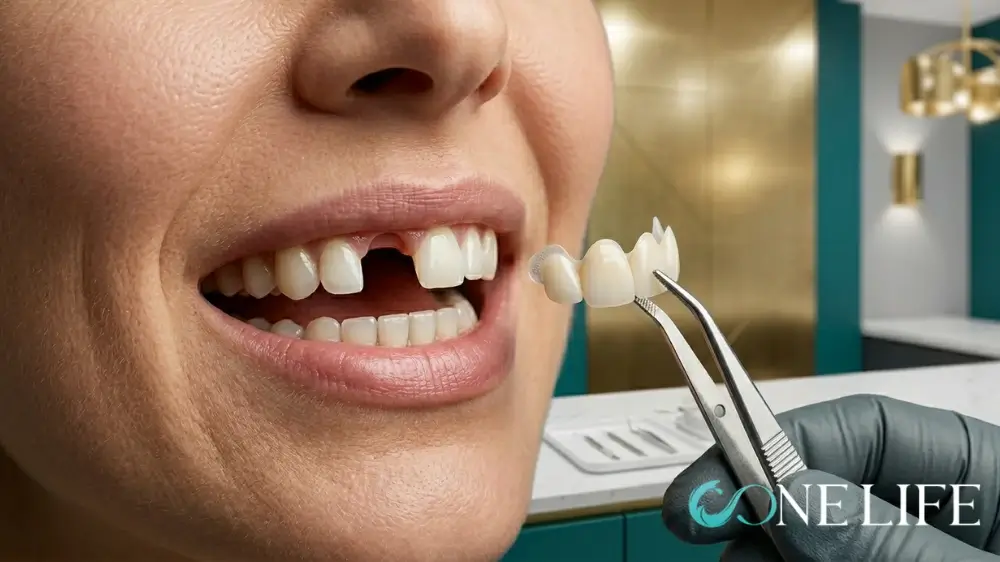
There are several ways to replace a missing tooth without major surgery. One of the most conservative and affordable is the Maryland bridge. In this guide, Dr. Astolfi walks you through everything you need to know — from how a Maryland bridge works to how long it lasts and what are the drawbacks your dentists should tell you about upfront.
What is a Maryland Bridge?
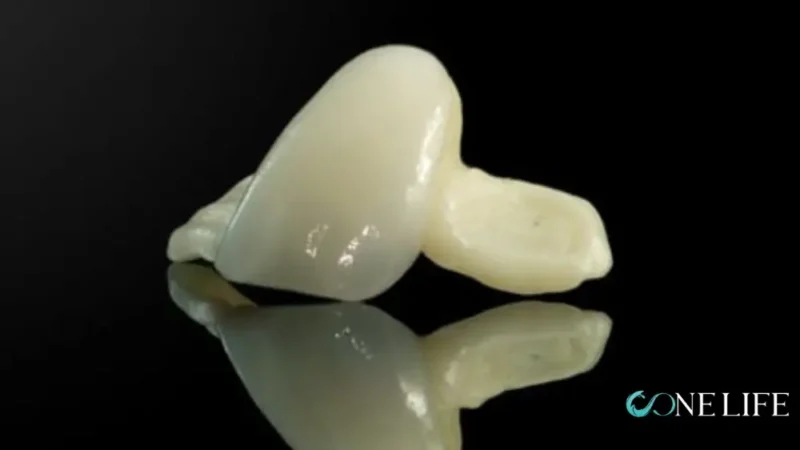
A Maryland bridge — also known as a resin-bonded bridge — is a fixed replacement for a single missing tooth which leaves adjacent teeth intact. It gets its name from the University of Maryland, where it was first developed in the 1970s.
It consists of three parts:
- A pontic: the replacement tooth, custom-made to match your natural teeth in shape and colour
- Two wings (or “flanges”): thin metal or ceramic extensions bonded to the back surfaces of the adjacent teeth
- A resin adhesive: the bonding agent that holds the wings firmly against the enamel
How Does a Maryland Bridge Work?
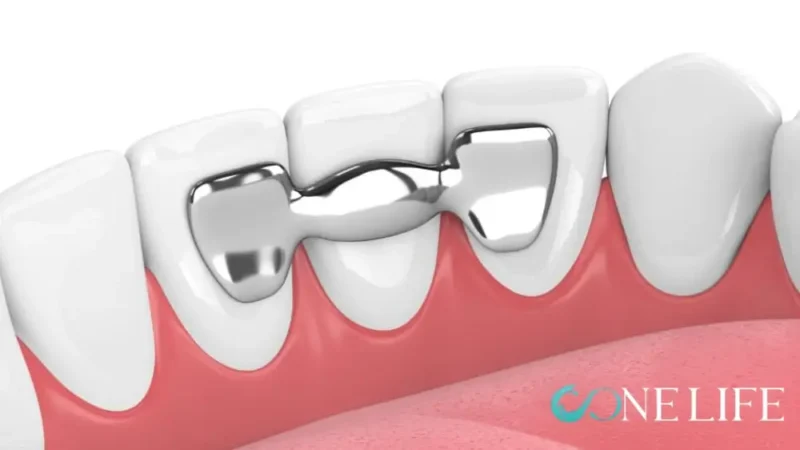
The Maryland bridge procedure is completed in two appointments. There is no surgery involved. Here is what to expect at each stage:
- Initial consultation & assessment — Your dentist evaluates your bite, the health of the adjacent teeth, and the gap size. X-rays or a CBCT scan may be taken to confirm suitability.
- Digital scan or impression — Your dentist takes a precise record of your teeth, which is sent to a dental laboratory to fabricate the custom bridge.
- Tooth preparation — A small amount of enamel is removed from the back surfaces of the two neighbouring teeth — typically less than 0.5mm.
- Temporary solution — In some cases, a temporary restoration is placed while you wait for the permanent bridge (usually 1–2 weeks).
- Bonding appointment — The finished bridge is tried in for fit and colour match, then permanently bonded to the back of the adjacent teeth using a resin adhesive.
- Final adjustments— Your dentist checks your bite and makes any minor refinements to ensure comfort and function.
Is the Process Painful?
A Maryland bridge is among the least invasive procedures in restorative dentistry. No nerves are touched and no surgical incision is made. Local anaesthesia is often not even necessary. Some patients experience mild sensitivity after the procedure — this is normal and typically resolves on its own.
Who Is the Best Candidate for a Maryland Bridge?

A Maryland bridge, when placed in the right patient, shows excellent results. When placed in the wrong one, failure is almost predictable.
You are likely a good candidate if you:
- Are missing a single tooth, particularly a front tooth (incisor or premolar)
- Have healthy, strong adjacent teeth
- Have a light to moderate bite — no heavy clenching or grinding (bruxism)
- Have good oral hygiene habits and attend regular dental check-ups
A Maryland bridge is generally not recommended if you:
- Are missing a back tooth (molar or premolar under heavy chewing force)
- Have weakened, heavily restored, or decayed adjacent teeth
- Suffer from bruxism (teeth grinding) or a deep overbite
- Are missing more than one tooth in the same area
- Have poor oral hygiene
Advantages & Disadvantages of a Maryland Bridge
Like every dental restoration, a Maryland bridge comes with genuine strengths and real limitations. Here is an honest, evidence-based breakdown of both.
Advantages
- Minimally invasive. The adjacent teeth are barely touched, you preserve healthy natural tooth structure — something no other fixed bridge option can claim.
- No surgery. Unlike dental implants, there are no incisions, no bone drilling, and no healing period of several months.
- Fast results. The entire process typically takes one to two weeks.
- Cost-effective. A Maryland bridge is significantly more affordable than a dental implant.
- Excellent aesthetics for front teeth. Modern zirconia and all-ceramic wings are virtually invisible from the front, delivering a natural-looking results
- Because so little enamel is removed, the procedure is largely reversible — a rare quality in dentalrestorations.
- If a wing debonds, it can usually be reattached without fabricating an entirely new bridge, keeping repair costs low.
Disadvantages
- Not suitable for back teeth. Chewing forces on molars and premolars are too strong for the resin bond
- Risk of debonding. The most common failure mode is the wing detaching from the adjacent tooth.
- Shorter lifespan than implants. Maryland bridges typically have a lifespan of 5 to 10 years.
- No bone preservation. Gradual bone resorption beneath the gap will occur over time.
- Wing visibility risk. Metal-framework designs can occasionally show through as a faint greyish shadow on the adjacent teeth.
- Adjacent teeth carry the load. The neighbouring teeth bear the stress of the restoration. If they are not perfectly healthy, this can accelerate wear or damage.
How Much Does a Maryland Bridge Cost?
In the United States, a Maryland bridge typically costs between $1,500 and $2,500 per tooth, depending on location, materials used, and the complexity of the case. Dental insurance may cover a portion under fixed prosthodontics benefits, though coverage varies by plan.
How Long Will a Maryland Dental Bridge Last?
With proper care, a Maryland bridge lasts between 5 and 15 years — though some have remained for over two decades. Longevity depends on a combination of clinical, biological, and behavioural factors that vary from patient to patient.
- Studies show 5-year success rates exceeding 85% with proper care and regular dental visits.
- The ten-year survival rateis around 65%.
- A study published in theAustralian Dental Journal reported an overall survival rate of 1% for anterior Maryland bridges over a follow-up period of 12 to 21 years.
- In specialist settings using modern zirconia frameworks and anterior placement, survival rates of 95–98% have been reported at five years, maintaining around 95% through 20 years (Abuzar et al.,Australian Dental Journal, 2018).
Extend Longevity: Aftercare & Good Habits
A well-placed Maryland bridge will only reach its full lifespan potential if you care for it correctly. The following habits make a difference:
- Brush twice daily with a soft-bristled toothbrush and fluoride toothpaste
- Floss daily using a floss threader or water flosser to clean beneath the pontic and around the wings
- Avoid biting hard foods directly with the bridge tooth
- Avoid sticky foods — caramels, chewing gum, and toffees can pull the wings away from the tooth surface over time
- Wear a nightguard if you grind your teeth
- Attend regular dental check-ups every six months
- Do not ignore looseness — if the bridge feels even slightly mobile or makes a clicking sound, contact your dentist promptly.
Is a Maryland Bridge Cost-Effective Long-Term?
A Maryland bridge costs less upfront, but it may need replacing after 5 to 10 years. A dental implant costs more initially but can last a lifetime. Over a 20-year horizon, the total cost of two or three Maryland bridges can approach — or exceed — the one-time investment of a well-placed implant. Your dentist should help you model this honestly based on your specific situation, age, and oral health.
What Are the Risks and Limitations of a Maryland Bridge?
A Maryland bridge is safe and well-established, but it carries specific risks that every patient should understand.
Debonding
The most frequent failure is debonding, where the wing detaches from the anchor tooth. This can often be rebonded, but repeated debonding weakens the bond over time. Debonding is more likely in patients with a deep bite, bruxism, or poor oral hygiene.
Bone Resorption Beneath the Gap
When a natural tooth is lost, the jawbone beneath it no longer receives the stimulation it needs to maintain its density. Without a root or implant in place, the bone gradually shrinks over time.
Over years, this can lead to:
- Changes in facial contour around the jaw
- A visible gap
- Complicated implant placement
Decay Risk on Adjacent Teeth
The wings of a Maryland bridge cover a portion of the back surface of the neighbouring teeth. If oral hygiene is inadequate, bacteria and food debris can accumulate beneath the wings. Over time, this creates a risk of decay developing on the abutment teeth, which may go undetected until it is clinically significant.
Not Suitable for High-Force Areas
Maryland bridges are less durable and not suitable for molars, where chewing forces are too strong for the adhesive bond.
Best Alternatives to a Maryland Bridge
A Maryland bridge is excellent for the right patient but it is not always the best solution. Always ask for second opinions and understand your alternatives before making a decision.
Dental Implants vs. Maryland Bridge
A dental implant is the closest thing modern dentistry has to a natural tooth replacement. However, implants have a higher upfront cost, require surgery and treatment takes three to six months. For patients who need a solution quickly, a Maryland bridge remains a valid alternative.
Other Types of Bridges vs. Maryland Bridge
Not every patient is a candidate for implants — and not every bridge is a Maryland bridge. Here is how the main alternatives compare.
Conventional Fixed Bridge
A traditional bridge replaces a missing tooth by crowning the two adjacent teeth and suspending a pontic between them. It is strong, durable, and suitable for both front and back teeth.
- Lifespan: Studies report 10-year survival rates between 79% and 94% for fixed dental bridges. Dentaris
- Drawback: Requires significant removal of healthy tooth structure from the neighbouring teeth — irreversible and potentially damaging to otherwise healthy teeth.
- Best for: Patients with adjacent teeth that are already crowned or heavily restored, or cases where a Maryland bridge is not biomechanically suitable.
Cantilever Bridge
A cantilever bridge is anchored to just one adjacent tooth rather than two. It is used when there is only one healthy neighbour available on one side of the gap.
- Less common than traditional bridges due to the increased mechanical stress on the single anchor tooth
- Generally not recommended for back teeth where biting forces are high
- Best for: Specific clinical situations where anatomy or tooth availability limits other options
Partial Denture (Removable)
A partial denture is a removable appliance that fills the gap left by a missing tooth. It is the most affordable option of all, but also the least preferred by most patients.
- No tooth preparation required
- Removable — must be taken out for cleaning and at night
- Less stable and less comfortable than fixed restorations
- Can accelerate bone loss in the gap area
- Best for: Patients who are not candidates for any fixed restoration, or as a very short-term temporary solution
Orthodontic Space Closure
In some younger patients — particularly those missing a lateral incisor — orthodontic treatment can close the gap entirely by moving adjacent teeth into the space. This eliminates the need for any prosthetic restoration.
- Requires careful planning with an orthodontist and restorative dentist working together
- Not suitable for all gap sizes or tooth positions
- Best for: Younger patients with good alignment candidates and sufficient space management potential
Which Option Is Right for You?
It depends on your bone volume, the health of your teeth, your bite, your age, your budget, and your timeline. A consultation is the only reliable way to determine which restoration will serve you best.
At OONE LIFE, Dr. Astolfi ––a Columbia University Scholar––, offers free online consultations to assess your case, explain your options clearly, and give you an honest recommendation — with no pressure and no obligation.