
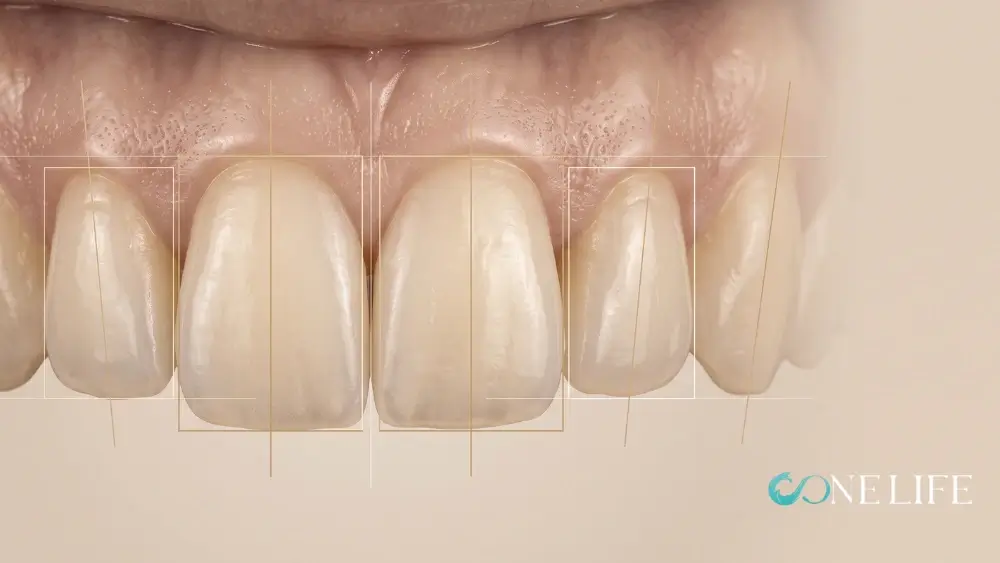
You have seen tiny, pointed teeth on social media (“shark teeth”), and you may think all dental veneers and crowns require aggressive teeth shaving. Fortunately, that is not true. The amount of enamel removed can range from a fraction of a millimetre to 2mm+ for a full crown.
Nevertheless, filing down teeth is permanent and should never be treated as a casual decision. In this article, extracted from One Life Dental’s practice, we discuss how much tooth enamel should be removed for veneers vs crowns and the best alternatives for each case.
Key takeaways:
- The realistic tooth filing range is 0.1 mm to 2.5 mm at most.
- Conventional veneers sit around3–0.7 mm
- Full crowns sit around 1–2.5 mm.
Why Shave Down Teeth?
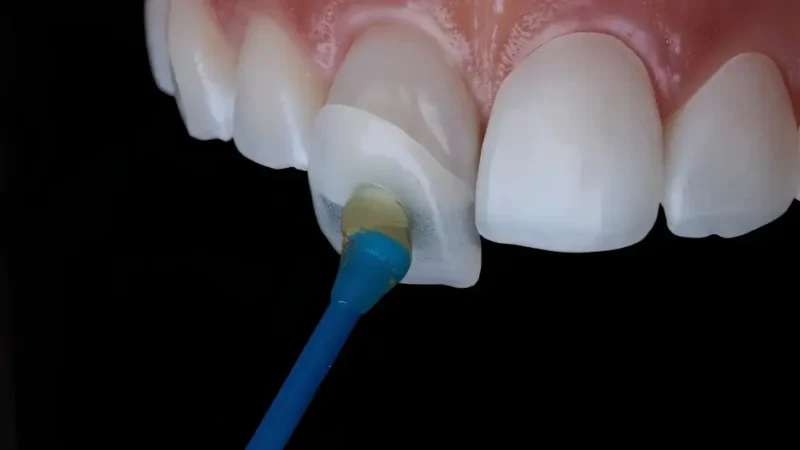
There are several reasons a patient might want to get their teeth filed down. Depending on your purpose, dentists may call it enamel reduction, tooth preparation, enameloplasty, odontoplasty, dental contouring or teeth filing.
A dentist may recommend filing down teeth for cosmetic or functional reasons:
- Making Room for Veneers
- Preparing Teeth for Crowns
- Reshaping Minor Imperfections
- Creating Orthodontic Space
- Adjusting the Bite
How Are Teeth Measured and Prepared?
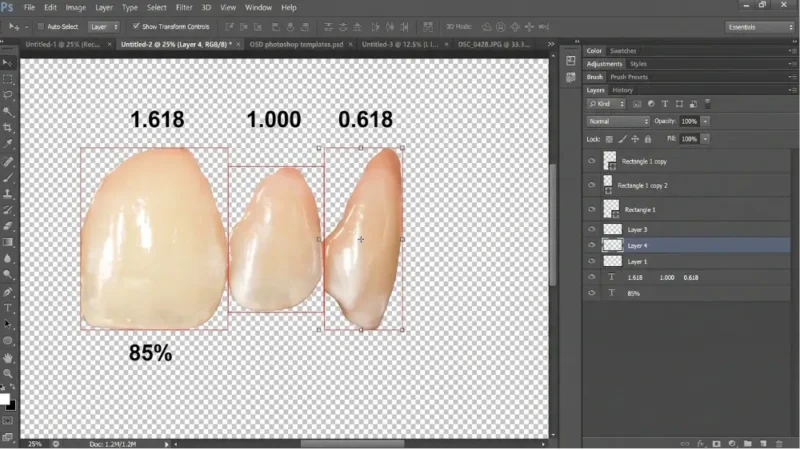
Successful treatment begins before any tooth is filed.
1. Examination and treatment planning
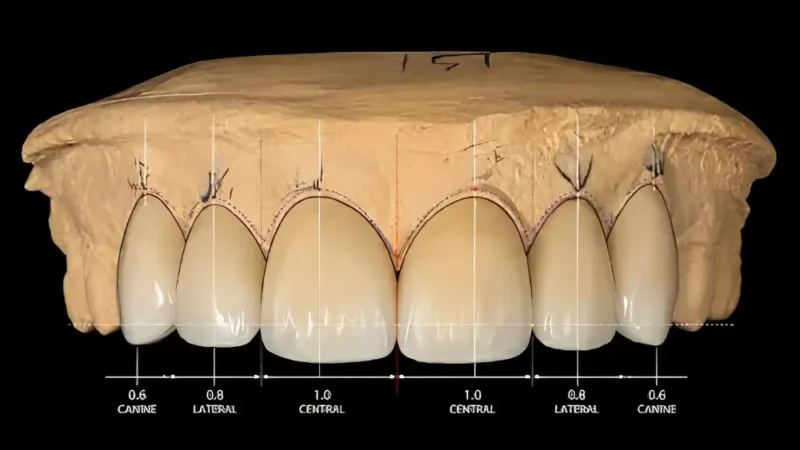
The dentist evaluates the teeth, gums, bite and overall oral health. A digital smile design, diagnostic model or temporary mock-up may help preview possible changes before irreversible preparation begins.
2. Photographs, impressions and digital scans
Photographs record tooth colour, shape, facial proportions and smile line. 3D scans create a detailed three-dimensional model of the mouth. This information helps the dentist and laboratory plan the restoration’s thickness, contours, contact points and relationship with the opposing teeth.
3. Controlled tooth preparation
Local anaesthesia may be used, particularly for crown preparation. The dentist removes a planned amount with precision instruments and repeatedly checks the available space.
4. Impressions and temporary restorations
Once preparation is complete, another impression or digital scan records the final shape of the teeth. Shade information and other instructions are sent to the laboratory. Temporary veneers or crowns may be placed while the definitive restorations are produced.
5. Laboratory production
The dental laboratory manufactures the restorations according to the scans, measurements, material selection and design instructions. Digital manufacturing, milling, pressing, layering and finishing methods may be used depending on the material.
6. Trial fitting
Before final placement, the dentist checks:
- Fit at the edges
- Contact with neighbouring teeth
- Bite
- Shape and proportions
- Shade and translucency
- Gum response
- Patient approval
- Adjustments may be made before the restorations are secured
Teeth Shaving Before and After
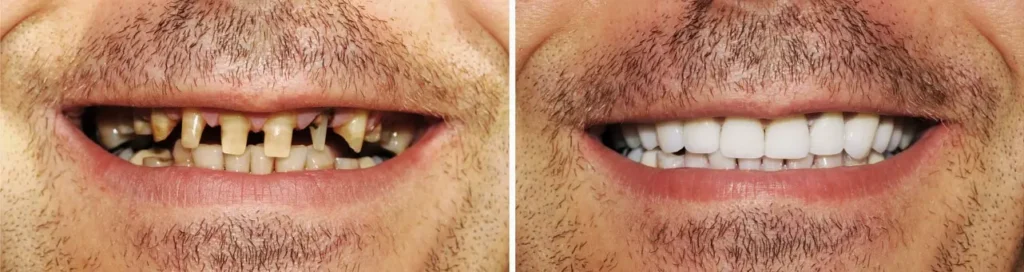
Teeth shaving before-and-after photos are purposefully impressive. However, they do not reveal how much natural structure remains under the veneers/crowns. They cannot show sensitivity either, bite comfort or future maintenance. Appearance should always be considered together with health and function.
Factors affecting the preparation include:
- Tooth shape, size and position
- Enamel thickness
- Tooth decay, cracks or fillings
- The patient’s bite
- Whether veneers, crowns, zirconia or emax are considered
- Whether a tooth is prominent, crowded or rotated
Shaved Teeth for Veneers: How Much Is Removed?
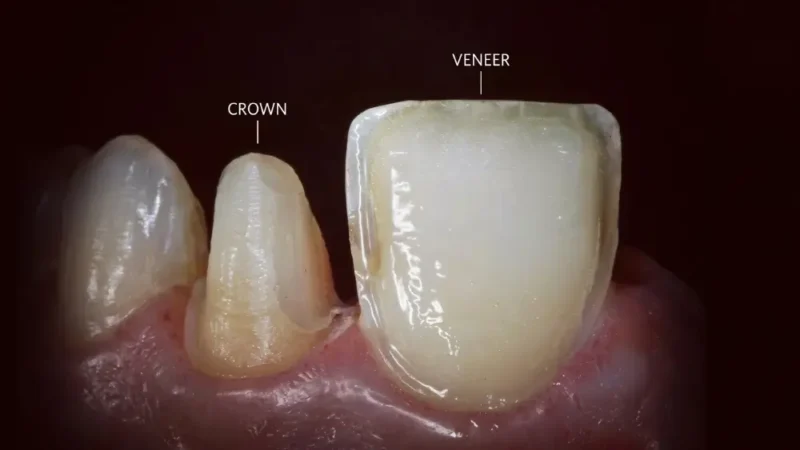
Because a veneer mainly covers the front of a tooth, the preparation is usually more conservative than for a crown.
Veneer type | Approximate preparation | Important considerations |
No-prep veneer | 0–0.1 mm in selected cases | Suitable only for certain teeth; may look bulky on large or prominent teeth |
Minimal-prep veneer | About 0.2–0.5 mm | Preserves more enamel while creating space for a thin restoration |
Conventional porcelain veneer | About 0.3–0.7 mm | Used to improve colour, size, shape or proportions |
E-max/lithium-disilicate veneer | Commonly around 0.3–0.7 mm | Known for translucency and natural-looking aesthetics |
Zirconia veneer | Case-dependent | Used selectively; greater opacity may help mask some underlying colours |
Composite veneer | Often little or no reduction in suitable cases | Easier to repair, but may stain or wear sooner than ceramic |
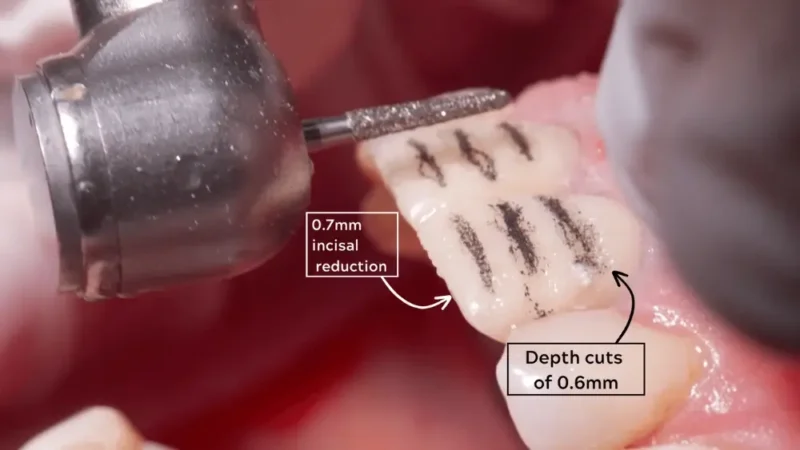
Shaving Teeth for Crowns: How Do Materials Compare?
A crown surrounds the visible portion of the tooth, so preparation involves more surfaces. The dentist must create sufficient space for the material while preserving as much healthy structure as reasonably possible.
Crown material | Approximate preparation | Characteristics and considerations |
Zirconia | Often approximately 1–2 mm, depending on the surface | Strong, metal-free and available in different levels of translucency |
E-max/lithium-disilicate | Often approximately 1–2 mm | Offers natural translucency but requires adequate thickness for strength |
Porcelain fused to metal | Commonly approximately 1.5–2 mm | Requires room for both the metal substructure and porcelain covering |
Gold or metal alloy | Often approximately 0.5–1.5 mm, depending on the surface | Can function at a lower thickness than some ceramics in selected cases |
Full crowns overall | Commonly approximately 1–2.5 mm | The exact amount varies between the sides, gum-line area and biting surface |
A crown may be appropriate when a tooth:
- Has lost substantial structure through decay or fracture
- Contains a large filling
- Has undergone root canal treatment
- Is severely worn or weakened
- Requires full coverage for functional protection
- Cannot be predictably restored with a conservative alternative
- No crown material is universally best. Selection depends on tooth position, remaining structure, bite forces, aesthetic expectations and other individual factors
Is Teeth Shaving Permanent?
Yes. This does not mean every form of teeth shaving is harmful. Carefully limited preparation may be appropriate. However, a tooth prepared for a veneer or crown cannot be returned to its untouched condition.
Veneers and crowns can provide long-lasting results, but they are not lifetime devices, either. They require monitoring and may eventually need repair or replacement. Replacement can sometimes involve additional tooth preparation, meaning younger patients may experience several restorative cycles during their lifetime.
How Are Veneers and Crowns Attached?
People often call every method “gluing,” but dental placement involves bonding or cementation systems. The correct method depends on the restoration material, remaining enamel and dentine, design, moisture control and available retention.
1. Adhesive Bonding
Adhesive bonding creates a strong connection between the tooth and restoration. The tooth and inner restoration surface are treated according to the material, and a resin cement is used to secure them.
This method is commonly associated with ceramic veneers because veneers depend heavily on adhesion for retention and strength.
2. Conventional Cementation
Traditional dental cement fills the microscopic space between the prepared tooth and crown. Retention depends significantly on the shape and height of the crown preparation.
This method may be suitable for certain metal, PFM or zirconia crowns when the preparation provides adequate mechanical retention.
3. Self-Adhesive or Hybrid Resin Cementation
Self-adhesive resin cements combine characteristics of resin bonding and conventional cementation while reducing the number of separate application stages. They may be used for selected crowns and other restorations.
Benefits and Possible Risks of Filing Down Teeth
Potential benefits | Possible risks and trade-offs |
Improved tooth colour, shape and proportions | Permanent loss of natural structure |
Space for well-contoured restorations | Temporary or persistent sensitivity |
Protection of weakened teeth with crowns | Cracks, decay or pulp irritation in some cases |
Smoother, more balanced tooth edges | Gum irritation or recession around margins |
Controlled orthodontic space | Bite discomfort if contacts are incorrect |
Faster cosmetic changes than orthodontics in selected cases | Future maintenance, repair and replacement |
The outcome depends on much more than a millimetre measurement. Tooth health, preparation technique, restoration quality, bonding, bite forces and oral hygiene all influence the long-term result.
Could a More Conservative Treatment Work?
A patient-centred plan should consider whether the desired result can be achieved while preserving more natural tooth structure.
Teeth Whitening
Professional whitening may improve colour without altering tooth shape. It may reduce the need to cover healthy teeth solely because of staining.
Composite Bonding
Composite resin can repair small chips, close modest gaps and change selected contours, sometimes with little or no enamel removal. However, it may stain, chip or require maintenance.
Orthodontics
Braces or clear aligners move teeth instead of disguising their position. Treatment takes longer, but it may preserve substantially more healthy structure when crowding, rotation or protrusion is the main concern.
Inlays and Onlays
Inlays and onlays restore damaged portions of back teeth without necessarily covering the entire tooth. They may be more conservative than full crowns when the remaining structure is sufficiently healthy.
They are restorative alternatives for suitable back teeth—not substitutes for cosmetic veneers on front teeth.
No Treatment
Natural teeth are rarely perfectly identical. If the concern is minor and the teeth are healthy, monitoring the situation or deciding against cosmetic treatment is also reasonable.