
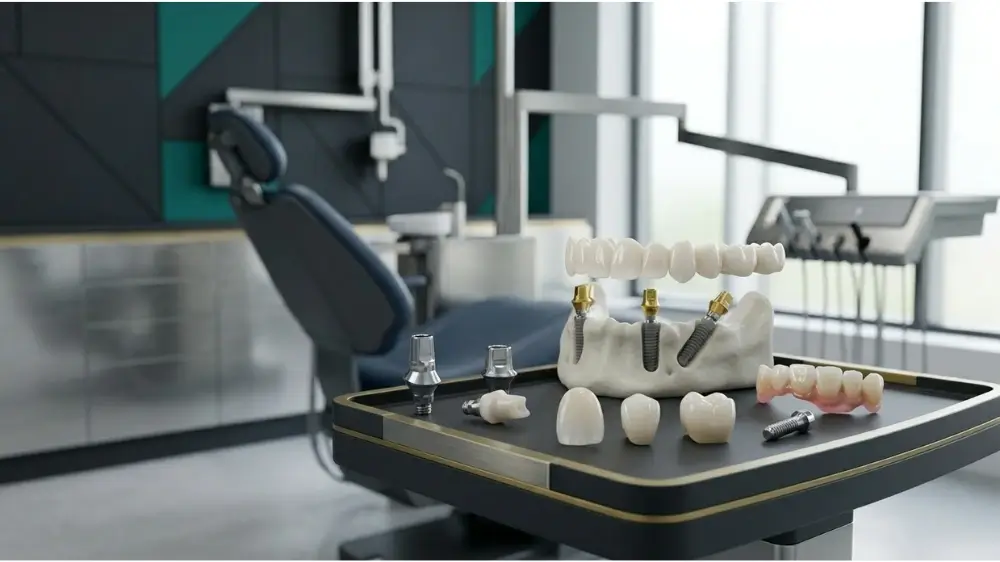
While results are life-changing, the cost of full mouth dental implants remains a barrier for most patients. However, with +75% savings in Turkey for Swiss Straumann® implants placed by maxillofacial surgeons, many now see “Turkey Teeth” as the obvious choice. But is it truly worth it?
Below, we provide all the information you need to secure the best product for your budget, breaking down costs and showing you how to verify authentic Swiss implants with REF codes.
Key Takeaways:
- The average cost of full mouth dental implants in theUK is £32,000
- The average cost of full mouth implants inTurkey is £7,200
- Always ask for the REF codes to ensure you get authentic Swiss implants
- Verify clinic credentials and certifications for legal compliance
- Make sure you are operated by a certified oral & maxillofacial surgeon or an expert periodontist
How Much Is a Full Set of Dental Implants in the UK?
In 2026, the average full mouth dental implants cost in the UK for a single arch ranges between £12,000 and £18,000. For a complete restoration (both jaws), British patients can expect to pay between £25,000 and £35,000.
While the National Health Service (NHS) provides exceptional care for many conditions, complete mouth dental implants are almost exclusively categorized as “cosmetic” or “elective.” Unless tooth loss is the result of mouth cancer or severe trauma, the NHS rarely covers this procedure.
Full Mouth Dental Implants Cost: UK vs. Turkey
The following table breaks down the typical investment for different implant systems in 2026. Note that Turkey pricing often includes “Full Package” perks like luxury accommodation and VIP transfers. Don’t hesitate to contact us to receive your personalized full mouth dental implants Turkey package price.
Treatment Type | UK Private Practice (Per Arch) | Turkey | Potential Savings |
All-on-4 (Acrylic/Composite) | £12,500 – £15,000 | £2,500 – £4,000 | ~70% |
All-on-6 (Premium Zirconia) | £16,000 – £22,000 | £4,500 – £6,500 | ~72% |
All-on-8 / 3-on-6 System | £22,000 – £28,000 | £7,000 – £9,500 | ~68% |
Why are Dental Implants so Cheap in Turkey?
Turkey has significantly lower operational costs (rent, laboratory labor, salaries) compared to the UK. Additionally, the Turkish government heavily subsidizes health tourism. Another important factor is the favorable exchange rate for the British Pound (GBP). All of these combined explain why the best Swiss dental implants are so cheap in Turkey.
Are They Authentic Swiss Implants in Turkey?
Every dental implant must be accompanied by a Reference (REF) Code and a Lot Number. For British patients, verifying these codes is the only way to ensure they are receiving genuine Grade 5 Medical Titanium or Monolithic Zirconia rather than generic imitations.
Verification with REF Codes
A REF Code is a unique identifier used by global manufacturers like Straumann, Nobel Biocare, or Megagen. It allows both the dentist and the patient to track the specifications of the implant:
- Dimensions:Exact length and diameter of the post.
- Surface Treatment:Verification of the “SLA” or “active” surface coating that promotes bone growth.
- Compatibility:Ensures that any dentist in the UK can identify the correct components for future maintenance.
Are There Any Hidden Expenses?
British dentists rarely offer all-inclusive packages, making it essential to inquire about surprise fees. When researching full teeth implants cost in the UK, there are many extras that can add a significant cost to the quote, including:
- Bone Grafting & Sinus Lifts: If you have suffered from long-term tooth loss, your jawbone may have atrophied. Rebuilding this bone can add £1,500–£3,000 to a UK bill, whereas in Turkey, it typically costs between £250 and £500.
- Tooth Extractions: Removing “terminal” teeth before implant placement is sometimes charged per tooth.
- Temporary Teeth: You cannot leave the clinic without teeth. The “Temporary Fixed Bridge” worn during the 3-6 month healing phase is a separate laboratory cost in many UK clinics.
- Aftercare & Maintenance: Special cleaning kits, water flossers, and follow-up scans are necessary to protect your investment.
What Expenses Are There Outside Surgery Costs?
When calculating the full mouth dental implants cost, the budget must include logistics, medication, hygiene technology and others.
- Transportation: Since full-mouth reconstruction requirestwo-visits, you must factor in travel for both the surgical phase and the final fitting (usually 3–6 months apart).
- Antibiotic:Mandatory to prevent early-stage infection during the first 7 days of osseointegration.
- Corticosteroids & Analgesics:Professional-grade anti-inflammatories are required to manage swelling and ensure a painless recovery.
- Chlorhexidine Rinses:Specialized antiseptic mouthwashes are vital for the first 14 days to keep the surgical sites sterile while stitches are in place.
- Water Flossers (e.g., Waterpik):Mandatory for full-arch bridges. You cannot use traditional floss under a fixed prosthesis. Budget: £60 – £120.
- Night Guards (Occlusal Splints):If you have a history of bruxism, a lab-made night guard is essential to prevent the zirconia from chipping or the implant screws from loosening.
- Specialized Proxi-brushes:Non-metallic interdental brushes are required to clean around the titanium abutments without scratching the surface.
What Determines the Final Cost of Full Mouth Dental Implants?
Honest dentists will always give you several options to choose from: costlier and more affordable. The final decision is always the patient’s, but we strongly suggest following professional advice and asking for second opinions. The dental implant cost for a whole mouth is calculated based on your biological needs and is mostly determined by the following:
- Number of Implants: While All-on-4 in Turkey uses four posts, an All-on-6 or All-on-8 requires more hardware and surgical time. More implants generally provide higher stability but increase the initial cost.
- Prosthetic Material: A Fixed Prosthesis made of Monolithic Zirconia is the premium standard for dental implants in Turkey. It is more expensive than acrylic or composite but offers superior durability and a more natural light reflection.
- Technology & Diagnostics: High-end clinics use CBCT scans and 3D intraoral scanners to create a “Digital Twin” of your jaw. This precision reduces surgical risk but is factored into the clinical fee.
- Brand of Implants: Premium brands like Straumann or Nobel Biocare carry higher manufacturing costs and come with global lifetime warranties, whereas generic brands are cheaper but may lack long-term data.
Is Getting Dental Implants in Turkey Safe?
Is Turkey safe for dental implants? This is often misunderstood. The reason for the lower cost of full mouth dental implants in Turkey is lower overheads. Many international patients are deeply surprised when they realise that Turkey actually has some of the best hospital and private clinics in Europe. In 2026, standards and safety have only been enhanced with recent Health Türkiye regulations. To ensure safety, always choose clinics verified by the Turkish Ministry of Health.
- Compulsory Insurance:As of January 2026, the Turkish Ministry of Health requires licensed health tourism clinics to provide complication insurance for international patients, ensuring that any necessary corrective care is covered.
- Identical Global Technology:High-end clinics like OONE LIFE Dental utilize the same CAD/CAM milling machines (e.g., Ivoclar, Amann Girrbach) and Swiss-made titanium implants (Straumann/Nobel Biocare) found in the UK. The material traceability is identical; only the labor and property overheads differ.
- GCR & ISO Accreditation:Top-tier clinics hold Global Clinic Rating (GCR) scores above 4.0 and ISO 9001:2015certifications, meaning their sterilization protocols and patient success rates are audited by independent international bodies.
Are You an Eligible Candidate?
Eligibility for a complete mouth dental implant restoration is determined by your dentist upon consultation. While 95% of patients can be treated, certain systemic factors require a specialized approach:
Status | Patient Profile | Clinical Implication |
Eligible | Total tooth loss, terminal dentition (failing teeth), or sufficient bone density. | Candidates for Immediate Loading (Smile in a Day). |
Conditional | Controlled Diabetics (HbA1c < 8.0), stable smokers, or those with moderate bone atrophy. | May require Bone Augmentation (Sinus Lifts) or a longer 4–6 month healing period. |
High Risk | Heavy smokers (>15/day) or patients with active gum disease. | Must undergo a pre-surgical detox/hygiene phaseto prevent early implant rejection. |
Ineligible | Active IV Bisphosphonates, radiation therapy to the jaw, or Uncontrolled Diabetes. | High risk of bone necrosis; alternative prosthetics (Overdentures) are recommended. |
Maintenance for Longevity: Tips by Dr. Astolfi
While titanium posts can last a lifetime, the fixed prosthesis requires diligent maintenance to prevent peri-implantitis (infection).
- The Water Flosser Rule: Traditional floss cannot reach the space between the bridge and the gums. Use a Waterpik daily to flush out bacteria.
- Non-Abrasive Cleaning: Use specialized, low-abrasive gels to clean your zirconia teeth to maintain their high-gloss finish.
- Professional Hygiene: Visit a dental hygienist twice a year. Even though implants cannot get cavities, the surrounding gum tissue remains susceptible to disease.
FAQs
Can I have all my teeth removed and replaced with implants on the same day?
Yes. This protocol, commonly known as “Same-Day Teeth” or “Smile in a Day,” allows the surgeon to extract failing teeth, place 4 to 6 implants, and attach a temporary fixed bridge all in a single appointment. However, if the bone is too soft, the surgeon may recommend a healing period of 3–6 months before loading the implants.
Are full mouth dental implants worth it?
Yes. While the initial investment is high, they are the only restoration that prevents jawbone resorption (bone loss). Unlike dentures, implants provide a lifetime solution with nearly 100% natural bite force.
What is the downside of dental implants?
The primary downsides are the upfront cost and the surgical nature of the treatment. There is a recovery period involving swelling and bruising, and a small risk (2-5%) of implant failure or infection (peri-implantitis) if oral hygiene is not strictly maintained.
Can I have all my teeth removed and replaced with implants?
Yes. This is the standard procedure for patients with terminal dentition, where the remaining teeth are loose, decayed, or structurally unsound. Replacing a full arch with a bridge (All-on-4 or All-on-6) is often better than trying to save multiple failing teeth with individual crowns or root canals.
How painful is a full dental implant?
The surgery itself is painless as it is performed under local anaesthesia or IV sedation. Discomfort typically peaks at 48 hours and is easily managed with over-the-counter painkillers like Ibuprofen.
Who cannot have dental implants?
Individuals with uncontrolled diabetes (HbA1c > 9.0), active substance abuse issues, or those undergoing IV bisphosphonate therapy for bone cancer are generally ineligible due to high failure risks. Additionally, heavy smokers who refuse to quit during the healing phase are considered high-risk candidates.