
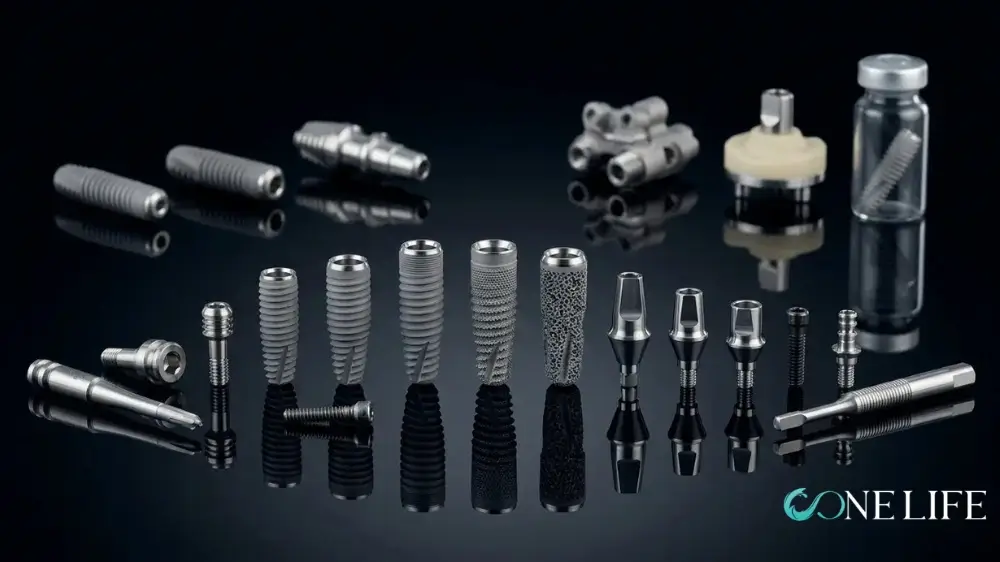
If you’ve been quoted Zimmer dental implants by your dental clinic, this guide covers everything you need to know: the brand’s best products, what the real costs are and how Zimmer compares to household names like Straumann and Nobel Biocare.
What Are Zimmer Dental Implants?
Zimmer dental implants are medical-grade titanium fixtures surgically placed into the jawbone to replace the root of a missing tooth. What sets Zimmer apart is the depth of its engineering heritage. The brand brings decades of expertise originally developed in orthopaedic medicine — hip and knee replacements — and applies those same biomaterial principles to dentistry.
Best Types of Zimmer Dental Implants
ZimVie offers several implant systems, but two stand out: the Tapered Screw-Vent (TSV) for standard cases, and the Trabecular Metal Implant for complex and high-risk patients.
Tapered Screw-Vent (TSV)
The Tapered Screw-Vent — TSV — is ZimVie’s standard implant system and the one most patients will receive. Its name describes its design: a tapered (narrowing) body with a screw-vent thread pattern for bone compression during insertion.
The TSV has been studied in a prospective dataset of over 1,553 TSV MTX implants with a mean follow-up of 36 months, making it one of the most documented mid-tier implant systems available today.
Key engineering features of the TSV include:
- MTX Microtextured Surface— a proprietary surface treatment documented to achieve high levels of bone-to-implant contact, accelerating the fusion between jawbone and fixture.
- MP-1 HA Coating— a hydroxyapatite coating with up to 97% crystalline HA content, significantly higher than most commercial HA coatings on the market, further supporting bone growth onto the implant surface.
- Internal Hex Connection with Friction-Fit— a 1.5mm deep internal hex that distributes bite force deep into the implant body, shielding the critical crestal bone (the bone at the top of the jaw) from concentrated pressure. This is a key factor in long-term bone preservation.
- Platform Plus Technology— the proprietary connection geometry creates favourable conditions for crestal bone-level maintenance, reducing the risk of bone recession around the implant neck over time.
Trabecular Metal Implants
The Trabecular Metal Implant is Zimmer’s most advanced system. Rather than standard titanium, the mid-section incorporates elemental tantalum (atomic number 73): a rare, stable metal with a highly porous, three-dimensional structure that mimics the microscopic architecture of human cancellous bone.
The clinical implications of this material are significant:
- Its80% volumetric porosity allows bone cells and blood vessels to grow directly into the implant structure — a process ZimVie calls osseoincorporation, as opposed to standard osseointegration where bone fuses only onto the surface.
- Itsmodulus of elasticity closely matches that of cancellous bone, meaning forces distribute more naturally through the jaw, reducing stress at the bone-implant interface.
- It triggers what ZimVie’s clinical literature calls theBioBoost Effect: a measurable multiplication of bone growth factors, accelerating healing.
Trabecular Metal implants support 2-week final loading — meaning a permanent restoration can be attached in as little as two weeks, compared to the standard 3–6 month osseointegration wait. This protocol has been documented across multiple clinical studies with a 97–100% survival rate at up to five years of follow-up.
Feature | Tapered Screw-Vent (TSV) | Trabecular Metal Implant |
Primary material | Medical-grade titanium alloy | Titanium body + elemental tantalum mid-section |
Surface technology | MTX Microtexture + MP-1 HA coating | Trabecular porous structure (osseoincorporation) |
Standard healing time | 3–6 months | As little as 2 weeks (appropriate cases) |
Documented survival rate | >95% (standard population) | 97–100% (up to 5 years, including high-risk patients) |
Best suited for | Standard single-tooth & full-arch cases | Complex, high-risk, or revision cases |
Key advantage | Crestal bone preservation via Friction-Fit | BioBoost Effect — accelerated bone formation |
How Much Do Zimmer Dental Implants Cost?
A single Zimmer dental implant in the US costs between $3,000 and $6,000 per tooth all-inclusive. For full-arch All-on-4/6 implants, costs run $18,000–$35,000 per arch. Insurance rarely covers it fully — most dental insurance plans have an annual maximum of $1,000–$2,000, meaning many patients still pay $1,500–$3,000 per tooth out of pocket even with coverage.
Treatment | UK Private Cost (2026) |
Single implant (fixture + abutment + crown) | $3,000 – $6,000 |
All-on-4 per arch | $18,000 – $24,000 |
All-on-6 per arch | $24,000 – $35,000 |
Full mouth (upper + lower) | $36,000 – $70,000+ |
Zimmer Dental Implants From $550 in Turkey
The implant fixture manufactured by ZimVie is identical worldwide. What changes between the US and Turkey is the cost of the infrastructure around it: surgeon salaries, clinic overhead, laboratory fees, taxation, and government policy on medical tourism.
At OONE LIFE Dental, Zimmer implant packages start from $550 per implant and full-arch solutions from $3,800 per jaw— all-inclusive, with hotel accommodation, airport transfers, and a 10-year guarantee.
Treatment | OONE LIFE Dental (Turkey) |
Single Zimmer implant | From $550 |
All-on-4 per arch | From $3,800 |
All-on-6 per arch | From $4,900 |
Full mouth restoration | From $7,600 |
Longevity & Success Rates of Zimmer Implants
Zimmer dental implants are designed to last a lifetime. The titanium fixture, once successfully osseointegrated, is permanent. The crown attached to it will typically need replacing after 10–15 years due to normal wear — but the implant root itself should not require intervention if maintained correctly.
The headline clinical figures are well supported by independent research:
- TheTapered Screw-Vent (TSV) system carries a >95% long-term success rate in standard healthy patients — consistent with the broader implantology evidence base and with the performance of comparable premium systems.
- TheTrabecular Metal Implant has been documented at 97–100% survival at five-year follow-up in both standard and high-risk populations, including patients with diabetes, rheumatoid arthritis, prior infection, and post-cancer treatment.
- Clinical data across 30 publications documents immediate and long-term success in rapid recovery, high-risk, and revision therapy cases — including a two-week final loading protocol with a 97–100% survival rate at up to five years of follow-up.
- In post-ablative cancer patients, clinical data shows 100% survival after one year, and 97.2% survival after three years in patients with systemic disease.
The factors that most reliably determine whether your implant succeeds long-term are:
- Oral hygiene— brushing, flossing, and professional cleaning around the implant. Neglect leads to peri-implantitis (infection and bone loss around the fixture), the leading cause of late implant failure.
- Smoking— significantly increases failure risk by impairing healing and bone density.
- Systemic health— uncontrolled diabetes or untreated gum disease must be managed before treatment.
- Surgical precision— computer-guided placement eliminates the technique variability that causes early failure.
Do Zimmer Implants Have Guarantee?
Yes — but the guarantee you receive depends on where and with whom you have the procedure.
ZimVie, the manufacturer, provides quality assurance on the material itself: every implant is manufactured to ISO and CE standards and arrives in tamper-evident, traceable packaging. The company does not, however, issue clinical outcome guarantees directly to patients — that is the responsibility of the treating clinic.
At OONE LIFE Dental, every Zimmer implant procedure is backed by a signed 10-Year Guarantee on both the fixture and the restoration. This covers:
- Implant fixture failure or rejection
- Crown or bridge structural failure
- Material defects
Zimmer vs. Straumann & Nobel Dental Implants
All three — Zimmer (ZimVie), Straumann, and Nobel Biocare — are premium-tier brands with decades of clinical evidence and globally standardised manufacturing.
Straumann and Nobel Biocare occupy the premium tier, offering the strongest clinical documentation, most innovative surface technologies, and most comprehensive global support networks — excelling particularly in complex cases and challenging clinical conditions.
Zimmer Biomet sits in the high-quality tier alongside brands like Bego and BioHorizons: excellent clinical outcomes, slightly fewer advanced features than the top two, but often representing better value without significant compromise.
Feature | Zimmer (ZimVie) | Straumann | Nobel Biocare |
Country of origin | USA (founded) | Switzerland 🇨🇭 | Switzerland / Sweden 🇸🇪 |
Standard success rate | >95% (TSV); 97–100% (Trabecular Metal) | >96% at 10 years | >95% at 10 years |
Signature technology | Trabecular Metal (tantalum); MTX surface | SLActive® hydrophilic surface; Roxolid® alloy | TiUnite® surface; All-on-4® protocol |
Standout strength | High-risk & complex cases; bone integration | Fastest osseointegration; challenging anatomy | Full-arch (All-on-4); aesthetic outcomes |
Global clinical documentation | Extensive — 4+ decades across orthopaedics + dental | Among the strongest in implantology | Among the strongest in implantology |
Typical cost in UK | £1,800 – £4,000 | £2,500 – £4,500 | £2,200 – £4,500 |
FAQs
Which country made Zimmer implants?
The United States. Zimmer implants were developed from American orthopaedic and dental companies. Today they are manufactured by ZimVie, a US-headquartered company spun off from Zimmer Biomet in 2022, with production facilities across the US and Europe. All implants meet ISO and CE certification standards.
What implant systems are compatible with Zimmer?
Most major third-party prosthetic components are compatible. ZimVie uses a proprietary internal hex (Friction-Fit) connection. Compatible parts — abutments, scan bodies, impression copings, Locator attachments — are widely available from third-party manufacturers across the TSV’s 3.5mm, 4.5mm, and 5.7mm platforms. Always confirm compatibility with your surgeon.
What is the difference between Zimmer and Straumann?
Both are premium brands with >95% success rates — the key difference is their technology. Straumann’s SLActive® surface accelerates standard osseointegration. Zimmer’s Trabecular Metal enables bone to grow into the implant and supports loading in as little as two weeks. Zimmer leads in high-risk cases; Straumann leads in speed for healthy patients.
Are Zimmer dental implants good?
Yes — they are a clinically serious, premium-quality choice. The TSV system carries a >95% success rate across 1,500+ documented implants. The Trabecular Metal system is backed by 30+ publications with 97–100% survival rates, including in diabetic and post-cancer patients. Among implant surgeons, ZimVie is a well-respected, proven system.
Which dental implant brand is the best?
There is no single best brand — it depends on your case. Straumann leads on healing speed. Nobel Biocare leads on full-arch (All-on-4) outcomes. Zimmer leads on high-risk and revision cases. All three are top-tier globally. What matters most is surgeon expertise, authentic materials, and proper aftercare — not the logo on the box.