
“It took humanity 2,000 years and a microscope to answer this question correctly.” Here is the definitive answer — and the remarkable science behind it.
Teeth are not bones. They look similar, feel similar, and sit inside the same jaw. But they are fundamentally different structures with different origins, different biology, and very different consequences when lost. As Dr. Serkan, maxillofacial specialist at OONE LIFE, explains to patients: “Teeth and bones are neighbours — not relatives.”
No, Teeth Are Not Bones — Here’s the Short Answer
Teeth are not counted among the 206 bones of the human skeleton. They do not contain bone marrow. They cannot heal themselves. And they develop from a completely different embryonic layer.
Feature | Teeth | Bones |
Embryonic origin | Ectoderm (oral epithelium) | Mesoderm |
Mineral content | ~96% hydroxyapatite (enamel) | ~65–70% hydroxyapatite |
Living cells in mature tissue | No (enamel is acellular) | Yes (osteoblasts, osteoclasts) |
Self-repair ability | No | Yes |
Covered by skin/gum | Yes | No |
Part of the skeleton | No | Yes |
Contains bone marrow | No | Yes |
Enamel is composed of approximately 96% hydroxyapatite — compared to around 65–70% in bone — making it harder, but far more brittle and impossible to regenerate once damaged. Biology Insights
Why Do So Many People Think Teeth Are Bones?
The myth is logical. Both teeth and bones are hard, white, and mineralised. They share the same jaw. When you look at a skull, teeth appear to be part of the bone structure itself. Three reasons the confusion persists:
- Appearance: Both are white, dense, and rigid
- Composition: Both contain calcium phosphate (hydroxyapatite). This mineral is the fundamental building block that gives them their structure, rigidity, and hardness
- Proximity: Teeth are anchored directly into the alveolar bone of the jaw
What Is a Tooth Made Of? The 4 Key Layers
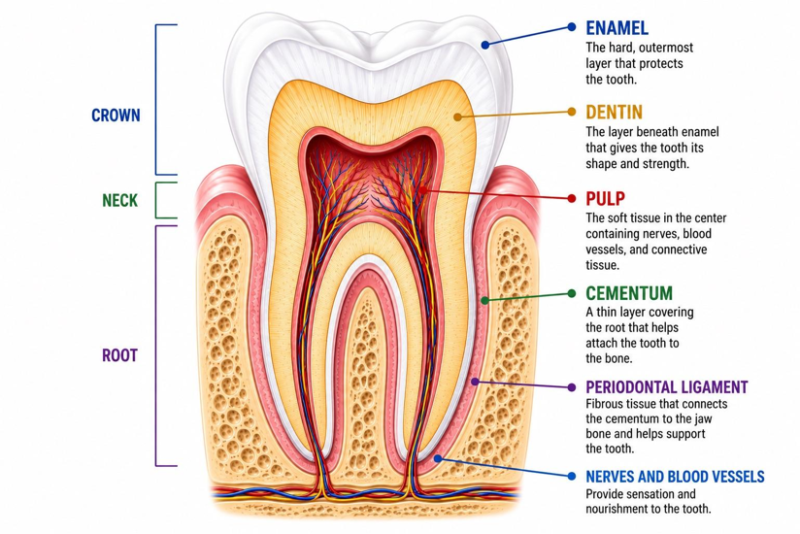
Now that we know where teeth came from, let’s look at what they are made of today.
Layer | Location | Living Cells? | Key Function |
Enamel | Outer crown | No | Protection |
Dentin | Beneath enamel | Yes (odontoblasts) | Structural support |
Pulp | Inner core | Yes | Nutrition, sensation |
Cementum | Root surface | Limited | Anchors tooth to jaw |
- Mature enamel is acellular — it contains no living cells and cannot regenerate or be replaced once damaged.
- Dentin contains millions of microscopic tubules connecting to the pulp, transmitting sensations such as heat and cold — which is why sensitivity increases when enamel wears away.
- The pulp consists of cells, blood vessels, and a nerve, communicating with the body’s systems through openings at the root tip.
- Cementum is similar in structure to bone but less hard than dentin, serving as the attachment point for the periodontal ligament that holds the tooth within the jaw.
Teeth vs Bones: Key Differences at a Glance
Property | Teeth (Enamel) | Bone |
Hydroxyapatite content | ~96% | ~65–70% |
Collagen | None (in enamel) | High |
Self-repair | No | Yes |
Cellular remodelling | No | Continuous |
Response to fracture | Permanent damage | Heals over time |
Bones continuously remodel via osteoblasts, osteoclasts and osteocytes — allowing fractures to heal and bone to adapt to stress throughout life.
Once enamel is damaged, it cannot grow back — which is why preventive dental care is so critical.
What Hippocrates, Aristotle and Galen Got Wrong — and Why It Stuck for 1,500 Years
The belief that teeth are bones is not just a modern misconception. It was official medical doctrine for over fifteen centuries — endorsed by the greatest minds of the ancient world.
Hippocrates (c. 460–370 BC), widely regarded as the father of medicine, still propagated the idea that teeth arise from a “glutinous increment from the bones of the head and jaw” in his treatise On Dentition — classifying them as a direct extension of bone tissue.
Aristotle (384–322 BC), one of the first systematic naturalists, wrote extensively on tooth anatomy in his Historia Animalium — yet despite making novel observations on tooth shapes across many animal species, he too made incorrect assumptions about dental biology that went unchallenged for centuries.
It was Galen of Pergamon (c. 130–216 AD) whose authority proved the most enduring. Galen described teeth as “the only sensitive bones” — acknowledging their nerve supply, but still classifying them firmly within the category of bone. His views on dental anatomy were accepted without serious question for over 1,000 years, until Andreas Vesalius— who published his landmark De Humani Corporis Fabrica in 1543, the same year Copernicus overturned the geocentric model of the universe.
Where Do Teeth Really Come From? 500 Million Years of Evolution
Teeth and bones did not just develop differently in the embryo. They have entirely independent evolutionary origins— and understanding this makes the distinction between them definitive.
The Origin of Teeth: Scales That Moved Into the Mouth
While bone was evolving as external armour, teeth were on a completely different path.
Fossil and genetic evidence indicates that enamel did not originate in teeth but in the scales of ancient fish that lived more than 400 million years ago — and only later became a key component of teeth. The key fossil evidence:
- Andreolepis — 425 million years ago, Sweden: enamel on its scales, not its teeth
- Psarolepis — 418 million years ago, China: enamel on its scales and skull, not its teeth
Two Separate Origins — One Shared Confusion
| Teeth | Bones |
Evolutionary origin | Ectodermal scales on skin surface | Exoskeletal armour; later internalised |
First appeared | ~425 million years ago | ~480–500 million years ago |
Embryonic layer | Ectoderm | Mesoderm |
Developmental pathway | Odontogenesis | Osteogenesis |
Key early function | Armour → feeding | External armour → structural support |
Self-repair today | No | Yes |
According to research led by the University of Bristol and published in Nature, teeth and bones appear to have evolved independently, later converging in the same body. ScienceDaily
What Happens When a Tooth Is Lost?
Losing a tooth is not just a cosmetic issue. It triggers a chain of biological consequences — beginning with the jawbone.
Population | Statistic |
Americans missing at least one tooth | ~178 million |
Adults 60+ with complete tooth loss globally | ~23% |
Global adults 20+ with complete tooth loss (WHO, 2025) | ~7% |
People worldwide with severe tooth loss (60+) | 349 million |
The leading causes of tooth loss include dental decay, trauma — and most significantly, periodontitis (advanced gum disease), which destroys the bone and soft tissue supporting the tooth root.
According to WHO data published in March 2025, approximately 7% of adults aged 20 and above and around 23% of those aged 60 and above experience complete tooth loss. Grand View Research