
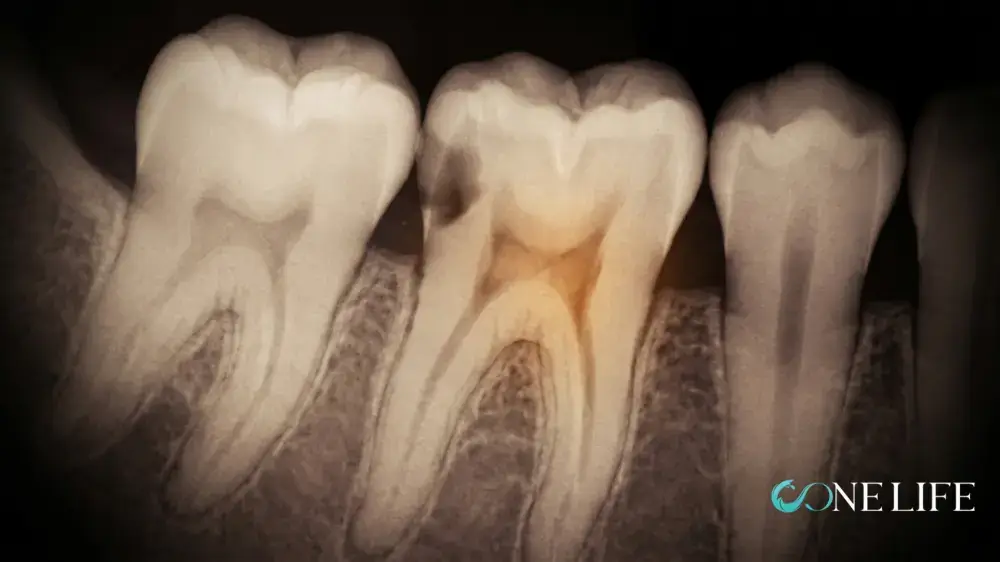
Tooth pain is a warning sign that may be indicative of a cavity or tooth decay. If ignored, it can degenerate into inflammation, infection or tooth loss. Dentists rely on X-rays, cold tests, and a patient’s symptoms to decide between teeth filling vs root canal. If you find yourself in late stage tooth decay, the good news is root canal treatment succeeds in saving the tooth in 85% to 97% of cases. This guide won’t replace your dentist, but it’ll tell you what to expect before you get there.
The Different Stages of Tooth Decay
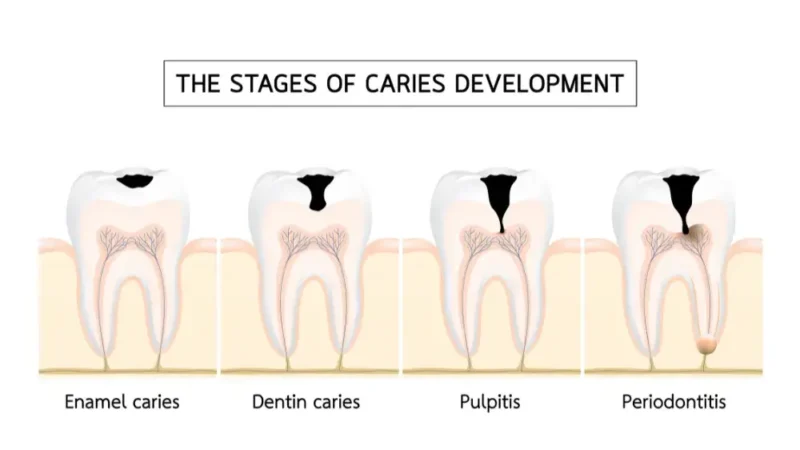
Tooth decay doesn’t jump from healthy to root canal treatment overnight. It moves through the tooth in stagesillustrated in the picture above. Let’s discuss their main symptoms, what is going on in each of them and the usual treatments to resolve each:
- Early demineralization: Acid weakens the enamel’s mineral structure. No cavity yet, no pain. Usually treated with fluoride or remineralizing toothpaste.
- Enamel cavity: The weakened enamel breaks down into an actual hole. Still outside the tooth’s living tissue. Usually painless or mildly sensitive. A standard filling is the usual treatment here.
- Dentin decay: Decay pushes past the enamel into the dentin, the softer layer underneath. Sensitivity to sweets, hot, and cold typically starts here. A pulpotomy (especially in children), removes the affected dentin and solves it.
- Pulp involvement: Decay reaches the nerve and blood vessels at the tooth’s core. This is where pain becomes persistent, throbbing, or triggered by pressure. Root canal is now required.
- Abscess: Untreated infection spreads beyond the root, causing swelling, a possible gum bump, and risk of the infection reaching the jaw or bloodstream. Tooth extraction is now necessary, followed by a dental implant or bridg
Signs You Only Need a Filling
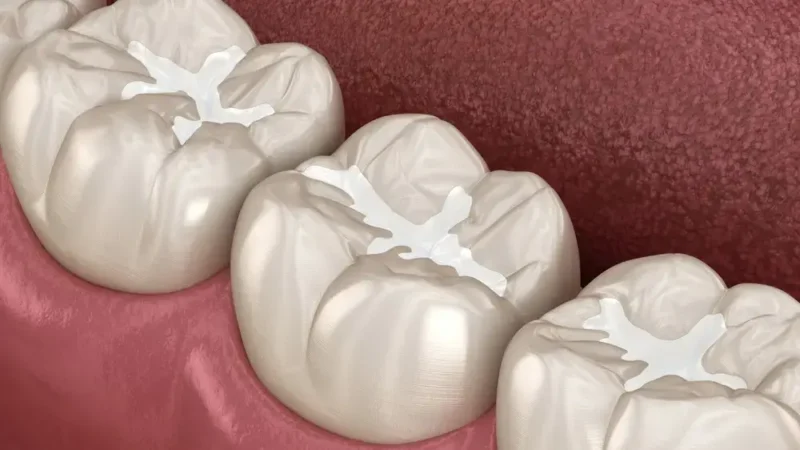
A filling is usually enough when symptoms are mild and short-lived:
- A brief, sharp twinge when eating something sweet, hot, or cold
- A dull ache that comes and goes, or pain only when biting down
- A visible dark spot, rough patch, or small hole on the tooth
- No swelling, no throbbing, no pain that wakes you up at night
Signs You Likely Need a Root Canal
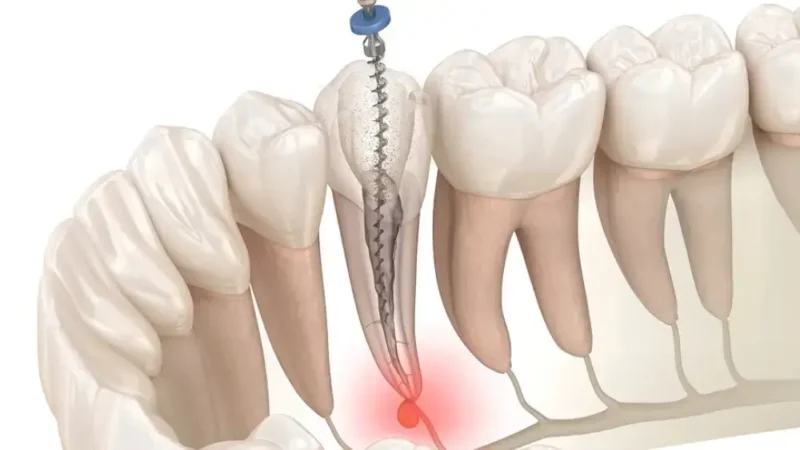
The line between the two treatments is whether the pulp is involved. If pain lingers after the trigger is gone, wakes you up at night, or comes with swelling, a root canal is more likely than a filling. Watch for:
- Persistent, throbbing pain that doesn’t settle with painkillers
- Sensitivity to hot or cold that lingers for more than 30 seconds
- Swelling, tenderness, or a pimple-like bump on the gum near the tooth
- Pain when chewing or applying pressure
- Visible darkening or discoloration of the tooth
Filling vs Root Canal: At a Glance
Filling | Root Canal | |
Decay depth | Enamel/dentin only | Reaches the pulp/nerve |
Appointments | 1 visit, 30–60 min | 1–2 visits, 60–90 min each |
Anesthesia | Local | Local |
Follow-up | None usually needed | Crown often required |
Recovery | Same day | 2–3 days of mild soreness |
Tooth vitality | Nerve preserved | Nerve removed (“dead” tooth) |
How Do Dentists Decide Between the Two?
Dentists rely on visual exams, digital X-rays, and diagnostic such as cold testing and percussion. Relying purely on visual diagnosis is tricky, because some deep infections cause little pain until they spread. X-rays show exactly how far decay has progressed and whether the pulp is compromised. If the pulp tests healthy, a filling resolves the problem. If it’s inflamed or infected, only a root canal will stop it.
What Happens During Each Procedure
Let’s now look at what goes on exactly during teeth filling vs root canal treatment, while on the dental chair.
Filling Procedure Step by Step
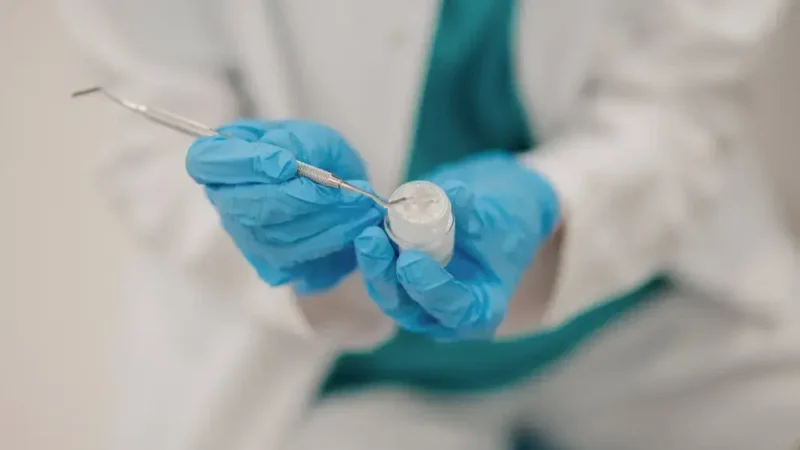
Most fillings are finished 30–60 minutes, and you can eat once the numbness wears off, a few hours after the procedure.
- Local anesthesia numbs the tooth and surrounding gum.
- The dentist removes the decayed tissue with a drill or laser.
- The cavity is cleaned and, if close to the pulp, lined with a protective base.
- The filling material (composite, amalgam, or ceramic) is placed in layers and, for composite, hardened with a curing light.
- The bite is checked and adjusted so the filling doesn’t sit too high.
Root Canal Treatment
Root canals take one or two visits of 60–90 minutes, depending on the tooth’s number of canals. The treatment unfolds as follows:
- Local anesthesia numbs the tooth; a rubber dam isolates it to keep the area dry and bacteria-free.
- The dentist creates a small access opening in the crown of the tooth.
- Infected pulp is removed from the canals using fine instruments.
- The canals are cleaned, shaped, and disinfected.
- The cleaned canals are filled and sealed with gutta-percha, a biocompatible material, to prevent reinfection.
- A temporary filling closes the access hole until a permanent restoration (usually a dental crown) is placed a few weeks later.
Is a Root Canal More Painful Than a Filling?
No. Modern anesthesia and rotary instruments mean the procedure itself feels similar to getting a filling. What patients remember as “root canal pain” is almost always the pain of the infected tooth before treatment, not the procedure itself. Removing the infected pulp typically relieves pain rather than causing it.
Risks and Possible Complications
Below, we show the most common risks of a tooth filling vs root canal. Both procedures are routine; these risks are the exceptions, and most are preventable with good aftercare.
Risks of fillings
- Temporary sensitivity to hot, cold, or pressure, usually resolving within a few weeks
- Secondary decay forming at the edge of an aging filling
- Cracking or wear over time
- Rarely, an allergic reaction to filling materials
Risks of root canal treatment
- Reinfection if bacteria remain in a missed or curved canal
- Instrument separation inside a canal during cleaning, in complex cases
- A weakened tooth structure that fractures if a crown isn’t placed afterward
- In a small percentage of cases, retreatment or an apicoectomy (removing the root tip) if the first treatment doesn’t fully resolve the infection
Recovery and Healing: Teeth Filling vs Root Canal
Rest assured, both fillings and root canals are safe, routine procedures, with very low-risks. Let’s explain what you will feel right after the procedure and how healing unfolds.
Healing After a Filling
Recovery is truly minimal in the case of tooth filling. Numbness wears off within a few hours, and sensitivity to hot, cold, or biting can linger for a few days to a couple of weeks at most. This settles on its own.
Healing After a Root Canal
Soreness in the tooth and surrounding gum is normal for two to three days and responds well to painkillers like ibuprofen. Most patients return to normal eating and activity within 24 to 48 hours. Until the permanent crown is placed, just avoid chewing on that side of the mouth. The temporary filling and the tooth itself are more vulnerable to fracture in this window.
How Much Does a Filling Cost?
In the US, a composite (tooth-coloured) filling averages $150–$300, an amalgam (silver) filling costs $75–$150, and a ceramic filling runs $250–$500, with the national average for composite sitting around $191.
In the UK, an NHS filling costs a flat £76.60 in England under Band 2, regardless of which tooth or material is used. Aprivate filling typically runs £80–£250 depending on size and material.
Material | NHS (England) | Private UK | US (no insurance) | Typical Lifespan |
Amalgam (silver) | £76.60 (Band 2) | £80–£250 | $75–$150 | 10–15 years |
Composite (tooth-coloured) | £76.60 (Band 2) | £80–£250 | $150–$300 (avg. ~$191) | 5–10 years |
Ceramic/porcelain | £76.60 (Band 2) | £80–£250 | $250–$500 | 10–15 years |
Material also determines how long the filling lasts: amalgam fillings typically hold up for 10–15 years, while composite fillings last 5–10 years, depending on oral hygiene, diet, and whether you grind your teeth.
How Much Does a Root Canal Cost?
In the US, a root canal alone costs roughly $620–$1,100 for a front tooth, $720–$1,300 for a premolar, and $890–$1,500 for a molar, with the crown that most back teeth need afterward adding another $800–$3,000.
Region | Front tooth | Premolar | Molar |
NHS (England) | £76.60 (Band 2) | £76.60 (Band 2) | £76.60 (Band 2) |
Private UK | £400–£700 | £500–£800 | £900–£1,500 |
US, no insurance | $620–$1,100 | $720–$1,300 | $890–$1,500 |
In England, NHS root canal treatment falls under Band 2, a fixed charge covering all appointments needed to complete the procedure — but if a crown is fitted straight after, the course moves to Band 3, priced at £332.10. Privately in the UK, front teeth typically cost £400–£700, while premolars range from £500–£800, and molars, which have the most canals, run £900–£1,500.
What Happens If You Ignore the Symptoms?
Delaying treatment rarely makes the problem smaller. Untreated decay keeps advancing toward the pulp, and once it gets there, a filling is no longer enough — a root canal, and sometimes extraction, becomes the only option. Left further untreated, infection can form an abscess and spread beyond the tooth, turning a dental issue into a medical emergency requiring antibiotics or surgery. In short: the earlier the treatment, the smaller the procedure and the lower the cost.
How Long Do the Results Last?
To be sure, the longevity of both tooth fillings and root canal treatments depend on the patient’s hygiene and life habits. The dentist’s experience and technique are also determinant factors. Both treatments have strong, well-documented outcomes when done correctly:
- Fillings: Composite fillings on chewing surfaces wear faster than amalgam, but both routinely last 5–15 years with good hygiene.
- Root canals: Success rates range between 85% and 97%, with front teeth performing at the higher end due to simpler root anatomy. Patient factors matter too — non-smokers show roughly 20% better long-term outcomes than smokers.
Long-Term Care: Making the Result Last
Whether it’s a filling or a root canal, the same habits protect the result for years. With this care, fillings routinely last 5–15 years and root canal-treated teeth with a crown can last a lifetime.
- Brush twice daily and floss around the restoration, where new decay most often starts
- See your dentist for regular check-ups and X-rays — small problems caught early stay small
- Avoid chewing ice, hard sweets, or using your teeth as tools, which can crack fillings or crowns
- Address teeth grinding (bruxism) with a night guard if recommended, since grinding is a leading cause of both filling and crown failure
- Get the permanent crown fitted promptly after a root canal — delaying it is one of the most common, avoidable reasons treatment fails
Filling vs Root Canal vs Extraction
It’s worth remembering that a root canal is almost always the more conservative — and cheaper — option compared to losing the tooth altogether. Replacing an extracted tooth with an implant typically costs £2,000–£3,000, while a bridge runs £800–£1,500 — both considerably more than saving the natural tooth with a root canal and crown.
Remember: you can always contact One Life Dental to inquire about dental implants in Turkey. We also offer full mouth dental implant packages in Turkey for more severe cases.