
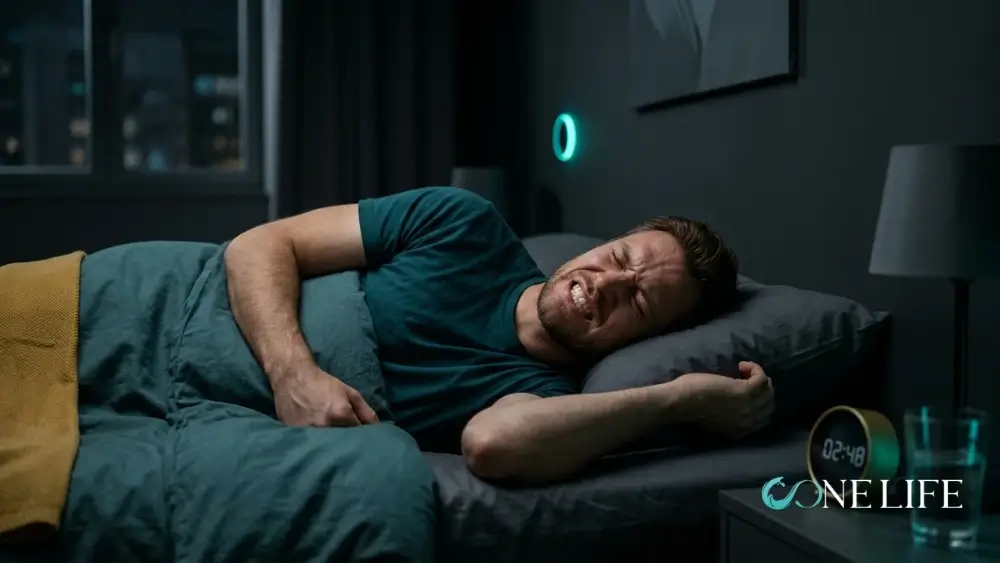
Sleep bruxism is the involuntary clenching, gnashing, or grinding of teeth during sleep. It’s classified as a sleep-related movement disorder and is considered a parafunctional activity — meaning it’s unrelated to normal functions like chewing or talking. It happens when the muscles in your jaw tense up and move on their own while you’re asleep — something you have no control over and aren’t aware of. It’s fairly common: about 8% of middle-aged adults grind their teeth during sleep, and around 3% of older adults do.
Because it happens during sleep, most people don’t realize they grind their teeth until a partner hears it, a dentist spots worn enamel, or they wake with revealing symptoms. Left unaddressed, chronic grinding can lead to tooth wear, jaw-muscle fatigue, morning headaches, and temporomandibular (TMJ) disorders. The earlier you spot the signs, the easier it is to manage.
Common Signs and Symptoms of Teeth Grinding at Night
You can’t watch yourself sleep, but your body leaves clues. Watch for these common warning signs of nighttime teeth grinding:
- Worn, flattened, chipped, or increasingly sensitive teeth
- Dull morning headaches, often centered around the temples
- Jaw, face, or neck soreness, or a tight, tired jaw on waking
- Clicking, popping, or locking of the jaw joint (TMJ)
- A sleep partner hearing grinding or clenching sounds at night
- Disrupted sleep or earache-like pain with no underlying ear problem
What Causes You to Grind Your Teeth in Your Sleep?
Sleep bruxism rarely has a single cause. For most people, it’s a mix of psychological, lifestyle, and sleep-related factors that put the jaw on high alert at night.
Understanding your personal triggers is the first step toward stopping the grinding naturally — because the most effective remedies target the root cause, not just the symptoms.
By far the most common driver is stress and anxiety. According to dental and sleep experts, stress is the single most common cause of bruxism. When you are tense, your body stays in a “fight-or-flight” state, and that muscle tension carries into sleep — your jaw simply doesn’t switch off. But stress isn’t the only factor. Here are the most common culprits behind nighttime teeth grinding:
- Stress, anxiety, and unresolved tension — the leading trigger for most adults.
- Sleep apnea and disordered breathing — there’s a strong link between bruxism and obstructive sleep apnea, which is estimated to affect a meaningful share of grinders. Sleep apnea is one of the most frequent risk factors for grinding in adults.
- Caffeine and alcohol — both are well-documented triggers. Caffeine keeps your nervous system active past bedtime, and alcohol fragments sleep and increases muscle activity.
- Smoking and recreational stimulants — nicotine and similar substances heighten nervous-system activity.
- Certain medications — some antidepressants and stimulants can increase grinding.
- Lifestyle and personality factors — a “go-go-go” routine, poor sleep, and high-pressure work all contribute.
How to Stop Grinding Teeth in Sleep Naturally: 9 Evidence-Based Methods
Here’s the encouraging part: most cases of mild-to-moderate bruxism respond well to natural, at-home strategies. The key is consistency. These habits work best when combined and done nightly. Below are nine proven ways to stop grinding your teeth naturally, recommended by Dr. Astolfi.
Lower Stress and Calm Your Nervous System Before Bed
Since stress is the number-one trigger, calming your mind is the most powerful natural remedy you have. The goal is to switch your body out of “alert mode” before you go to sleep, so your jaw can finally relax.
- Practice relaxation techniques like deep breathing, meditation, or gentle yoga in the evening.
- Build a wind-down routine — a warm bath, reading, or calming music signals your body that it’s time to rest.
- Consider cognitive behavioral therapy (CBT), which helps identify and change the thoughts and behaviors that contribute to grinding.
Support Your Jaw Muscles with Magnesium and Smart Nutrition
Nutrition plays a role in nighttime muscle behavior. Magnesium is a key mineral: it helps relax muscles and contributes to calmer sleep.
- Eat magnesium-rich foods like leafy greens, nuts, seeds, legumes, and dark chocolate.
- Ask your doctor about a magnesium supplement — many adults take around 400 milligrams before bed to support muscle relaxation and sleep. (Always check first if you take medication or have kidney issues.)
- Stay hydrated, since dehydration can contribute to muscle cramping, including in the jaw.
Relax Your Jaw with Targeted Exercises and Massage
Releasing built-up tension in the jaw muscles eases soreness and helps retrain them to stay relaxed. A few minutes before bed can make a real difference.
Practice the “lips together, teeth apart” resting position. This is the natural, relaxed position your jaw should hold whenever you’re not eating or speaking — and consciously training it during the day helps reduce clenching at night. The principle is simple: your teeth should never be touching at rest. Here’s how to do it:
- Close your lips gently, keeping them softly together.
- Let your upper and lower teeth come apart, leaving a small space (a few millimeters) between them — they should not touch.
- Rest the tip of your tongue against the roof of your mouth, just behind your front teeth, without pushing hard.
- Relax your jaw, cheeks, and facial muscles, letting any tension melt away.
Hold this position whenever you remember throughout the day — at your desk, in the car, watching TV. Over time, it retrains your jaw to default to a relaxed state instead of a clenched one. A helpful cue is to place a sticky note where you’ll see it often as a reminder to check your jaw. The more naturally your jaw rests open during the day, the less likely the muscles are to tense and grind at night.

Other supporting actions:
- Gently massage the jaw muscles and temples in slow, circular motions.
- Apply a warm compress to the jaw to loosen tight muscles and improve blood flow.
Improve Sleep Hygiene and Evening Habits
As grinding happens during sleep, better sleep quality means less grinding. Small evening tweaks often produce noticeable jaw relief within just a few nights.
- Keep a consistent sleep schedule and a cool, dark, quiet bedroom.
- Avoid caffeine, alcohol, and heavy screen time in the hours before bed.
- Skip gum and chewy snacks at night, which can overwork and “train” the jaw to clench.
Here’s a quick-reference summary of all nine natural remedies:
Natural Remedy | How It Helps | When You May Notice Results |
Stress reduction & relaxation | Calms the nervous system so the jaw relaxes | 1–3 weeks |
Cognitive behavioral therapy (CBT) | Reframes stress-driven clenching habits | Several weeks |
Magnesium (food or supplement) | Relaxes muscles and supports sleep | 1–4 weeks |
Hydration & balanced nutrition | Reduces muscle cramping | 1–2 weeks |
Jaw exercises & resting position | Releases and retrains jaw muscles | Days to weeks |
Jaw massage & warm compress | Loosens tight muscles, eases soreness | Same day relief |
Better sleep hygiene | Improves sleep quality, reduces grinding | A few nights |
Cutting caffeine & alcohol | Removes major nighttime triggers | 3–7 nights |
Evening wind-down routine | Lowers pre-sleep tension | A few nights |
Natural Remedies vs. Dental Treatments for Bruxism: What the Evidence Says
Natural strategies are powerful for tackling the causes of grinding, but they don’t physically protect your teeth in the meantime. That’s where professional dental care comes in. The most effective approach often combines both: natural habits to reduce grinding, plus a custom guard to shield your enamel while you work on the root cause.
Factor | Natural Remedies | Dental / Professional Treatment |
What it targets | The root causes (stress, sleep, lifestyle) | Tooth protection & symptom control |
Tooth protection | None directly | Custom night guard shields enamel |
Cost | Low / minimal | Moderate to higher |
Best for | Mild-to-moderate grinding | Moderate-to-severe grinding, worn teeth |
Speed of relief | Days to weeks | Immediate physical protection |
Addresses the cause? | Yes | Partially — mainly manages symptoms |
A custom-fitted night guard from a dentist is the gold standard for protecting teeth, and it can help prevent dental damage and chronic pain. Unlike one-size-fits-all drugstore versions, a professionally made guard fits precisely and lasts far longer.
When Natural Methods Aren’t Enough: Signs You Should See a Professional
Natural remedies work well for most mild cases, but some situations call for expert care. Book a dental evaluation if you notice any of the following:
- Visibly worn, cracked, chipped, or loose teeth
- Persistent jaw pain, facial pain, or frequent morning headaches
- Jaw locking, clicking, or limited movement (possible TMJ disorder)
- Grinding that continues despite weeks of consistent natural strategies
- Loud grinding noticed by a partner, especially with pauses in breathing — a possible sign of sleep apnea that needs evaluation
A professional can confirm whether you’re grinding, assess any damage, rule out underlying conditions like sleep apnea, and fit you with the right protection. Early intervention prevents small problems from becoming costly ones.
Book Your Free Bruxism Consultation
You don’t have to figure this out alone. If you suspect you’re grinding your teeth at night, book a free consultation at ONELIFE today — our specialists will assess your symptoms, identify your triggers, and build a personalized plan to protect your smile and help you sleep better. Reach out now to get started.