
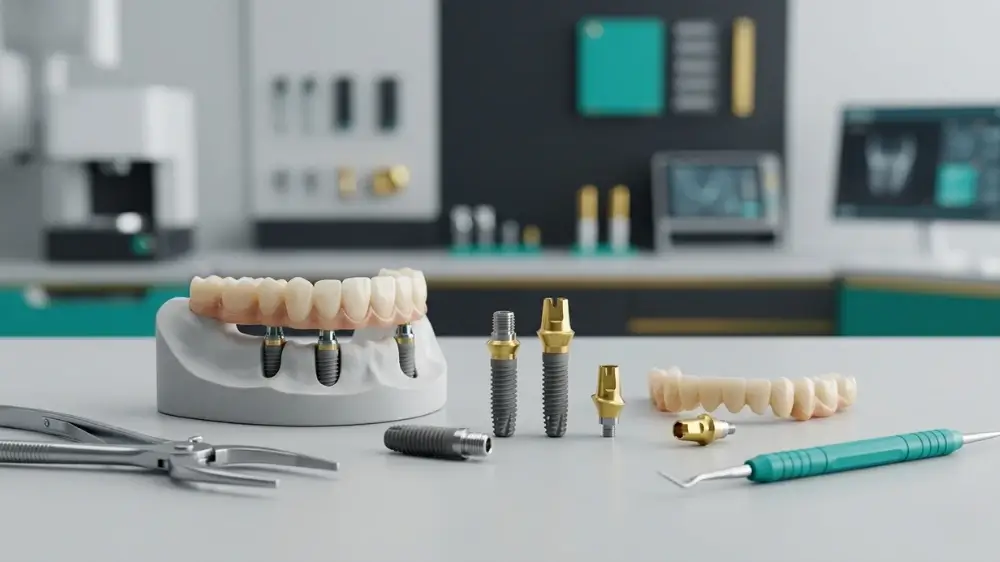
Modern times are so fast-paced that it’s becoming increasingly common for people to need full mouth dental implants as early as their 40s. Thankfully, the success rate for full mouth restorations is 95-98%, thanks to advanced 3D imaging and robotic-guided surgery. Dr. Astolfi gives you all information about the types of bridges, titanium and zirconia posts, along with the cost of the procedure (including hidden expenses), right below.
Types of Full Mouth Dental Implants
Choosing the right system for full mouth dental implants depends on your jawbone density and budget. While the “All-on-4” is the most famous, modern dentistry offers many different types of dental implants for increased stability and a more natural feel.
The All-on-4 System
The All-on-4 system uses four titanium implants per arch, with the two posterior implants tilted at a 45-degree angle. This clever engineering avoids the need for bone grafts in patients with moderate bone loss. It is the most cost-effective solution.
All-on-6 Full Mouth Implants
The All-on-6 system adds two extra implants for increased support. This is often recommended for the upper jaw, where the bone is naturally softer and more porous. By distributing the bite force across six points, the longevity increases significantly, reducing the stress on each implant.
All-on-8
For patients seeking the absolute highest level of stability, the All-on-8 configuration uses eight implants to support a full arch. This is typically reserved for patients with very strong bone structures who want a restoration that feels exactly like individual natural teeth.
3-on-6 Bridge System
The 3-on-6 is a newer, innovative alternative. Instead of one large bridge, the arch is divided into three separate bridges supported by six implants.
- Benefit 1: It feels more natural as it follows the jaw’s anatomy.
- Benefit 2: It eliminates the artificial gum (pink acrylic) used in All-on-4, as the bridges sit directly on your natural gum line.
- Benefit 3: If one part of the bridge chips, you only replace that segment, not the entire arch.
Zygomatic Implants for Severe Bone Loss
Zygomatic implants are an advanced surgical solution for patients who have been told they don’t have enough bone for standard implants. These extra-long implants are anchored in the zygomatic bone (cheekbone) rather than the jawbone. This allows for a full mouth restoration without the need for 6-12 months of painful bone grafting.
The Fixed Prosthesis
The Fixed Prosthesis (the actual teeth you see and use) is critical for your long-term satisfaction. The prosthesis is the bridge that connects to the implants, and its material determines how long your new smile will stay white and chip-free.
There are three main tiers for the fixed prosthesis:
- Acrylic (PMMA): Often used for temporary or immediate loading. It is lightweight but porous, meaning it can stain over time and eventually wear down.
- Composite over Metal: A metal frame coated with a high-grade composite resin. It is durable and repairable, though not as translucent as ceramic.
- Monolithic Zirconia: The premium choice. Zirconia fixed prostheses are virtually indestructible, highly resistant to staining, and offer the best light-reflection properties, making them look identical to natural enamel.
*Dr. Astolfi often notes that the precision of the CAD/CAM milling of the prosthesis is what prevents food traps and gum inflammation. A poorly designed prosthesis can lead to peri-implantitis (infection around the implant), regardless of how well the surgery went.
How Much Do Full Mouth Implants Cost?
The cost of full mouth dental implants is an average £12,000 to £16,000 per jaw, influenced by the number of implants, material and the location of the clinic. Prices for full mouth dental implants in the USA currently stand at an average $15,000 to $30,000 per jaw, with wide variation depending on method, materials, doctor and clinic.
Below is a detailed comparison of the average cost for a full arch (one jaw):
Full Mouth Implants Price Comparison
Country | All-on-4 (Acrylic) | All-on-6 (Zirconia) | All-on-8 / 3-on-6 |
United Kingdom | £12,000 – £15,000 | £16,000 – £22,000 | £24,000+ |
USA | $15,000 – $20,000 | $22,000 – $30,000 | $35,000+ |
Turkey | £2,500 – £4,500 | £5,000 – £7,500 | £8,000 – £10,000 |
Are There Any Hidden Expenses?
When budgeting for full mouth dental implants cost, many patients look at the headline price exclusively. However, a medical plan must account for pre-surgical and post-operative needs. The most common hidden costs that can shift your budget by 10% to 20% include:
- Bone Grafting & Sinus Lifts: If you have been missing teeth for a long time, your jawbone may have atrophied. A sinus lift (essential for upper jaw implants) costs approximately £250–£600 in Turkey, compared to £1,500+ in the UK.
- Extractions: If you still have failing natural teeth, these must be removed. Some clinics charge per tooth, while others include it in a Full Mouth Package.
- Sedation Fees: While local anesthesia is standard, IV Sedation or General Anesthesia for anxious patients is usually an add-on cost, ranging from £200 to £500.
- Maintenance Kits: Specialized Waterpiks, interdental brushes, and specific antibacterial rinses recommended by Astolfi for the first 3 months of healing.
- Travel & Accommodation: For international patients, factor in 2 trips (one for surgery, one for the final prosthesis 3–6 months later).
The Procedure Step by Step
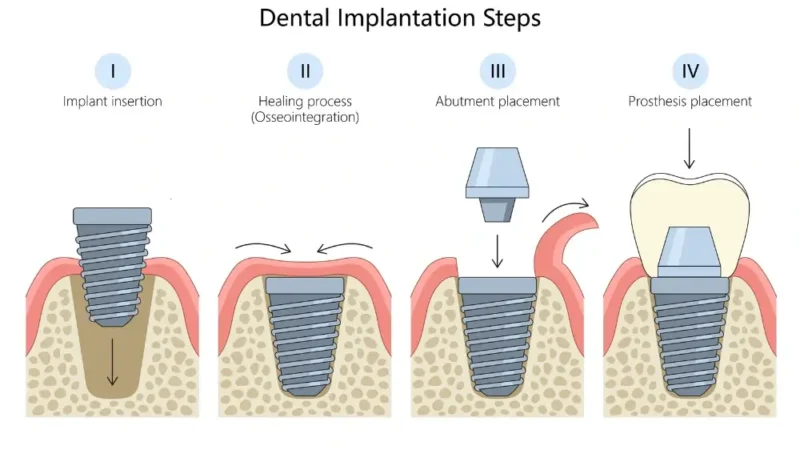
The modern complete mouth dental implants protocol is a marvel of digital precision. Thanks to Guided Surgery, the process is faster and less invasive than ever before.
- Digital Blueprint (Day 1): We perform a CBCT Scan and 3D intraoral mapping. This allows the surgeon to visualize your bone density and nerve pathways in 3D, ensuring the implants are placed with sub-millimeter accuracy.
- Surgical Phase & Extractions (Day 2): Under sedation, any remaining “terminal” teeth are extracted. The implants (4, 6, or 8) are then placed into the jawbone.
- Immediate Loading (The Smile in a Day): If the implants achieve a stability torque of 35-45 Ncm, a fixed temporary prosthesis is attached. You leave the clinic with functional, aesthetic teeth on the same day.
- Osseointegration (3–6 Months): This is the biological “waiting period” where your bone fuses with the titanium posts. You will wear your temporary teeth and follow a soft-food diet.
- The Final Reveal (Second Visit): Once healing is confirmed, the temporary bridge is replaced with your permanent, high-strength Zirconia Fixed Prosthesis.
Lifestyle Benefits of Full Mouth Restorations
Full mouth dental implants restore up to 90% of natural chewing force and prevent facial collapse by halting jawbone resorption, offering a permanent advantage over traditional dentures, which only provide 20-30% efficiency.
Restoring Chewing Force and Digestive Health
The most immediate benefit is the restoration of the biting force. Dentures rest on the gums, leading to sores and limited diet. In contrast, complete mouth dental implants are anchored into the bone, allowing for a bite pressure of 500 to 700 Newtons, nearly identical to natural teeth.
- Nutritional Impact: Patients can return to a high-fiber diet (raw vegetables, nuts, proteins)
- Proprioception: The rigid fixation provides a sense of security that eliminates the cognitive load of worrying about teeth slipping during a meal.
Prevention of Alveolar Bone Resorption (Facial Collapse)
When teeth are lost, the alveolar bone (the part of the jaw that holds teeth) no longer receives stimulation and begins to dissolve. This leads to the sunken facial appearance.
- Wolff’s Law of Bone Transformation: Implants act as artificial tooth roots. Through the process of chewing, they transmit mechanical stress to the bone, signaling the body to keep the bone density intact.
- Aesthetic Preservation: By maintaining the bone, implants preserve the Vertical Dimension of Occlusion (VDO), naturally supporting the lips and cheeks and reducing the formation of “marionette lines” without the need for dermal fillers.
Before & After Results
Full mouth reconstruction results in a smile makeover and a functional recovery in 6-months, moving from initial surgery to final Zirconia prosthesis.
The 24-Hour Transformation
With Immediate Loading (often called “Teeth in a Day”), the most striking change occurs within the first 24 hours.
- Soft Tissue Contouring: Surgeons use the temporary prosthesis to train the gum tissue. This ensures that when the final Zirconia bridge is placed, the gums look pink, healthy, and naturally scalloped.
- Psychological Shift: A 2024 study in the Journal of Prosthodontics found that 92% of full-arch patients reported a “significant increase in self-worth” within one week of the procedure.
Long-term Functional Success Rates (10-Year Data)
Feature | Traditional Dentures | Full Mouth Implants |
10-Year Survival Rate | 30% (Require frequent relining) | 95.4% – 98% |
Bone Loss | 1.5mm to 4mm per year | Negligible (Stable) |
Taste Perception | Reduced (Palate is covered) | 100% (Open Palate Design) |
How Long Do Complete Mouth Implants Last?
The longevity of dental implants depends on several factors. While the titanium or zirconia posts are engineered to last 25+ years to a lifetime, the prosthetic bridge (the teeth) is a functional component subject to wear and tear, requiring maintenance or replacement every 12 to 18 years.
Factors Influencing Implant Survival
- Osseointegration Quality: This is the initial “fusion” of bone to metal. Factors like Vitamin D levels and blood supply (impacted by smoking) are the primary predictors of success in the first 2 years.
- Mechanical Stress (The Bruxism Factor): Patients who grind their teeth (bruxism) put immense pressure on the screw joints. This is why Astolfi insists on a custom-milled night guard for every full-mouth patient.
- Bio-Film Management: The Achilles heel of implants is Peri-implantitis. This is a localized infection caused by bacteria buildup. Unlike natural teeth, implants don’t have the same immune response in the surrounding tissue, making professional hygiene non-negotiable.
Maintenance for Maximum Longevity: Tips by Dr. Astolfi
Do you want full mouth implants to last +25 years? Proper hygiene and care are needed. The maintenance of a full-arch bridge is similar to natural teeth, yet it requires specialized tools to clean the “transition zone” where the prosthesis meets the gum tissue.
- Water Flossing (Mandatory): A standard toothbrush cannot reach the “underside” of a fixed bridge. A Waterpik or high-pressure oral irrigator is essential to flush out food debris from the abutments.
- Interproximal Brushing: Use rubber-coated “proxy brushes” to clean between the implant posts. Avoid metal-core brushes, as they can scratch the titanium surface and create breeding grounds for bacteria.
- The Non-Abrasive Rule: Only use low-abrasive toothpastes. High-whitening pastes often contain silica, which can micro-scratch the Zirconia or Acrylic surface, leading to loss of luster over time.
Are You Eligible for Complete Teeth Implants?
While approximately 95% of adults are candidates for some form of full-arch restoration, success is predicated on the “Medical Triad”: adequate bone volume (or the ability to graft), stable systemic health (controlled blood sugar), and a commitment to post-operative hygiene.
Ideal Candidates
These patients typically see a 98% long-term success rate and are the best fit for Immediate Loading (Teeth in a Day).
- Terminal Dentition Patients: Those with multiple failing teeth, advanced decay, or loose bridges that can no longer be repaired.
- Total Edentulism: Patients currently wearing full dentures who are experiencing “denture fatigue,” speech issues, or clicking.
- Severe Periodontal Survivors: Patients whose gum disease has been stabilized but has left them with insufficient natural tooth support.
- High Bone Volume Profiles: Patients with at least 10mm of vertical bone height and 5mm of width, allowing for straightforward implant placement without grafting.
- Healthy Seniors: Age is not a barrier; a healthy 80-year-old with stable vitals is a better candidate than a 40-year-old with uncontrolled chronic illness.
High-Risk (Conditional) Candidates
These patients can still receive complete mouth dental implants, but they require specialized surgical techniques.
- Managed Diabetics: Patients with an HbA1c level between 7.0 and 8.0. They require a longer healing period (osseointegration) and often a prophylactic antibiotic course.
- Controlled Smokers: Those willing to cease smoking 2 weeks before and 8 weeks after surgery to ensure blood flow to the surgical site.
- Severe Atrophy Cases: Patients with paper-thin jawbones. They are ineligible for standard implants but are prime candidates for Zygomatic or Pterygoid implants, which bypass the jawbone to anchor in the cheekbone or skull base.
- Bruxism (Grinders): Patients who clench their jaw. They are eligible but must commit to a high-strength Monolithic Zirconia prosthesis and a mandatory night guard to prevent mechanical fracture.
Contraindicated Patients (Non-Eligible)
These patients should not undergo this procedure due to high failure risks or life-threatening complications.
Condition | Reason for Ineligibility | Clinical Implication |
Uncontrolled Diabetes | HbA1c > 9.0 | Extreme risk of total implant failure due to poor healing. |
Active IV Bisphosphonates | Risk of MRONJ | Medications for bone cancer/severe osteoporosis can cause the jawbone to die after surgery. |
Recent Cardiac Event | Surgical Stress | Patients who have suffered a heart attack or stroke within the last 6 months must wait for medical clearance. |
Active Radiation Therapy | Osteoradionecrosis | Radiation to the head/neck area significantly compromises bone vitality and blood supply. |
Heavy Substance Abuse | Compliance Risk | Alcoholism or drug dependency interferes with the patient’s ability to follow critical aftercare and hygiene protocols. |
Unchecked Autoimmune Disease | Systemic Inflammation | Conditions like active Lupus or severe Rheumatoid Arthritis can cause the body to attack the tissue around the implant. |
The Diagnosis at OONE LIFE Dental
Our eligibility check uses CBCT (Cone Beam Computed Tomography) and digital bone density analysis to ensure we never place an implant that isn’t biologically destined to succeed.
- 3D Bone Mapping: We measure the Hounsfield Units (HU) of your bone. This tells us exactly how “hard” or “soft” your jaw is, determining if we can give you teeth on the same day.
- Medical History Scrub: We review every medication you are taking. If you are on blood thinners, we coordinate with your GP to manage your dosage for the 48 hours surrounding surgery.
- Virtual Surgical Planning:Before you even arrive in Turkey, your surgery has been “performed” virtually on a digital twin of your jaw. This eliminates surprises and ensures we only proceed if you are a safe candidate.
Best Alternatives to Full Mouth Implants
If a fixed full-mouth restoration is not financially or clinically viable, Implant-Supported Overdentures (Snap-ons) offer a superior alternative to traditional dentures by providing mechanical retention with fewer implants.
- Implant-Supported Overdentures (2-4 Implants): The “snap-on” option. It provides better stability than a regular denture but is still removable. It is an excellent choice for patients with extreme bone loss in the posterior (back) jaw.
- Partial “All-on-X” Segments: If you have 6-8 healthy teeth remaining, we can perform “Segmented Bridges,” replacing only the missing sections. This preserves your natural proprioception.