
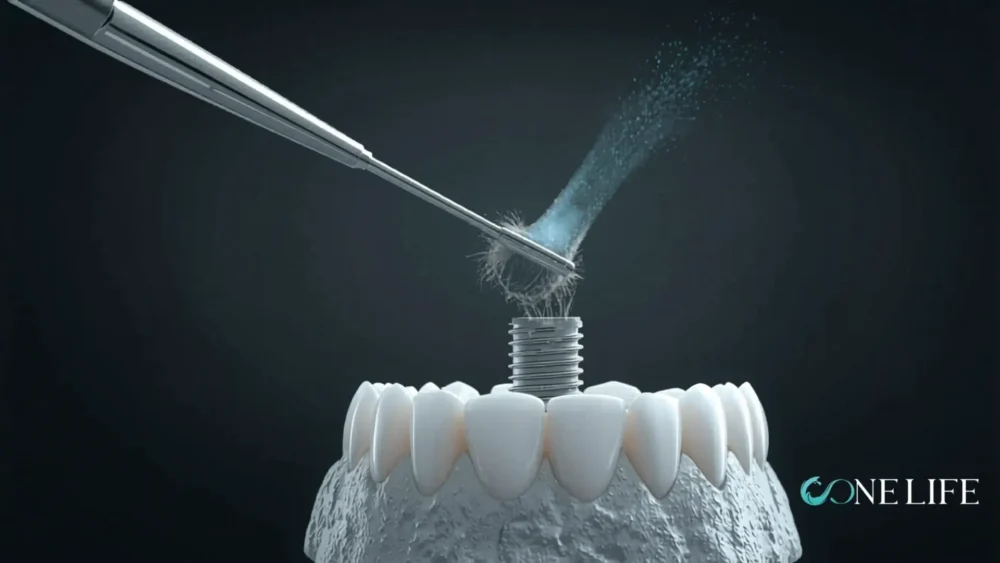
Dental implants can last for 25+ years with the right care. Whether you have a single implant or a full-arch restoration, the daily habits and care routines you build will determine whether your implants last a decade or a lifetime.
This guide covers everything you need to know about dental implant maintenance: from cleaning techniques to check-up schedules, warning signs to watch for, and advice for All-on-4 patients.
Why Dental Implant Maintenance Is Important
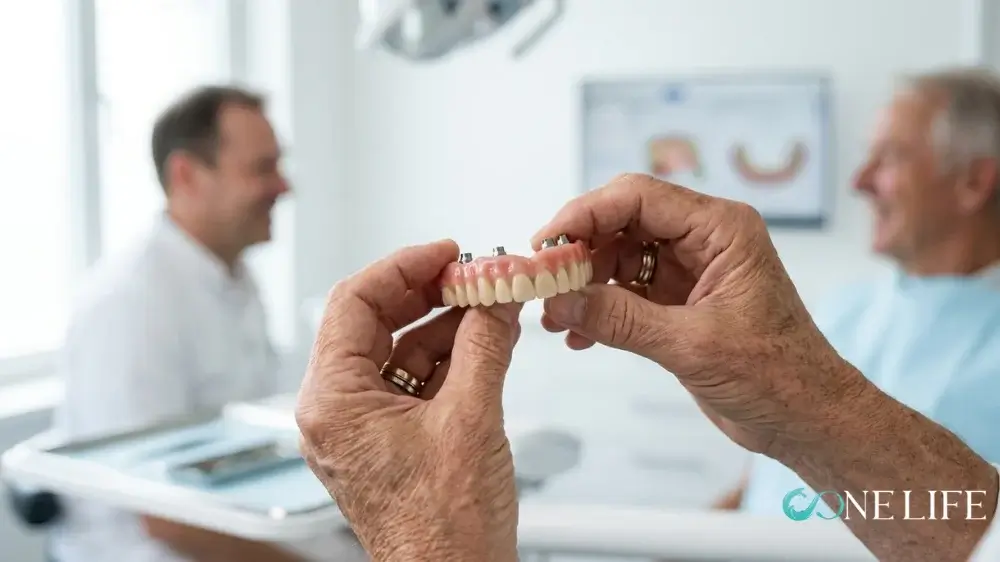
Dental implants are designed to be permanent, but that does not mean they are maintenance-free. The titanium post is highly durable, yet the surrounding gum tissue and bone remain vulnerable to bacterial infection and inflammation if hygiene is neglected.
Neglected implants are the leading cause of peri-implantitis, an inflammatory condition that destroys the bone supporting your implant. Research published in BMC Oral Health found that peri-implantitis affects nearly 1 in 5 patients (19.53%). Left untreated, it leads to implant failure.
9 Essential Tips to Take Good Care of Your Dental Implants

Caring for dental implants is straightforward once you build the right routine. The following 9 tips cover everything from brushing to monitoring, and together they are the foundation of long-term implant success.
Tip 1: Brush Twice Daily with a Soft-Bristle Toothbrush
Brush your implants at least twice a day with a soft-bristle or implant-specific toothbrush. Hard bristles scratch the implant surface and irritate the surrounding gum tissue. Use gentle, circular motions and make sure to reach the gumline where plaque tends to build up.
Avoid electric brushes with aggressive settings. A standard soft manual brush or a low-vibration electric model works well for cleaning dental implants without causing damage.
Tip 2: Floss Around Implants Every Day
Flossing is non-negotiable. Food debris and plaque that collect between implants and gums are the primary triggers of infection. Use implant-specific floss or unwaxed tape and guide it gently beneath the gumline in a C-shape motion around each implant.
If traditional flossing feels awkward around your restoration, floss threaders are a practical alternative that makes the process easier and more consistent.
Tip 3: Use an Interdental Brush for Deeper Cleaning
An interdental brush is a small, cone-shaped brush designed to fit between teeth and implants. It removes plaque from areas a standard toothbrush cannot reach. This is particularly useful for patients with implant-supported bridges or full-arch restorations.
Choose a size that fits snugly without forcing. Used once daily, interdental brushes significantly reduce the bacterial load around your implants and lower the risk of peri-implant disease.
Tip 4: Rinse with an Antibacterial Mouthwash
A daily rinse with a chlorhexidine-free antibacterial mouthwash helps control bacterial growth in areas that brushing and flossing may miss. Look for alcohol-free formulas; alcohol-based rinses dry out the oral mucosa and irritate gum tissue over time.
Rinse for 30 seconds after brushing, ideally before bed, when saliva production drops and bacterial activity increases.
Tip 5: Avoid Abrasive Toothpastes
Not all toothpastes are safe for dental implants. Whitening toothpastes and baking-soda formulas often contain micro-abrasive particles that scratch the implant crown’s surface, making it more susceptible to plaque buildup over time.
Choose a low-abrasion, implant-safe toothpaste. When in doubt, a plain fluoride toothpaste with no added whitening agents is a safe choice. Your dentist can recommend a specific brand.
Tip 6: Use a Water Flosser for Hard-to-Reach Areas
A water flosser uses a pressurized stream of water to flush debris and bacteria from around implants and beneath the gumline. It is especially effective for patients with All-on-4 implants or implant-supported bridges where traditional flossing is difficult.
Use it at medium pressure once daily, directing the tip at a 45-degree angle toward the gumline. Studies show that water flossers reduce plaque around implants more effectively than string floss alone when used consistently.
Tip 7: Avoid Hard and Sticky Foods
Chewing on hard foods such as ice, hard candies, crusty bread, or nuts puts excessive force on the implant crown and the abutment beneath it. Over time, this can cause micro-fractures or loosen the connection between components.
Sticky foods like caramel or chewing gum can pull at the crown and dislodge temporary restorations. These are small but meaningful dietary adjustments that need to be permanent, not just observed during the healing phase.
Tip 8: Schedule Professional Cleanings Every 3 to 6 Months
Home hygiene alone is not enough. Research recommends professional maintenance visits every three months to protect your implant investment. Your dental hygienist uses specialised tools, including non-metal scalers and air-polishing devices, to remove calculus from around implants without damaging the surface.
During these visits, your dentist will also assess gum pocket depths, check for early signs of inflammation, and evaluate the stability of the restoration. Early detection changes everything.
Tip 9: Get Annual X-Rays to Monitor Bone Levels
Even when everything looks fine clinically, bone loss can occur silently beneath the surface. Annual dental X-rays allow your dentist to monitor marginal bone levels around each implant and detect early-stage peri-implantitis before it becomes irreversible.
A large-scale cohort study tracking 10,871 implants over 22 years found cumulative survival rates of 98.9% at 3 years, dropping to 94% at 15 years. Long-term monitoring is what keeps those numbers high.
How to Care for All-on-4 Dental Implants: What’s Different
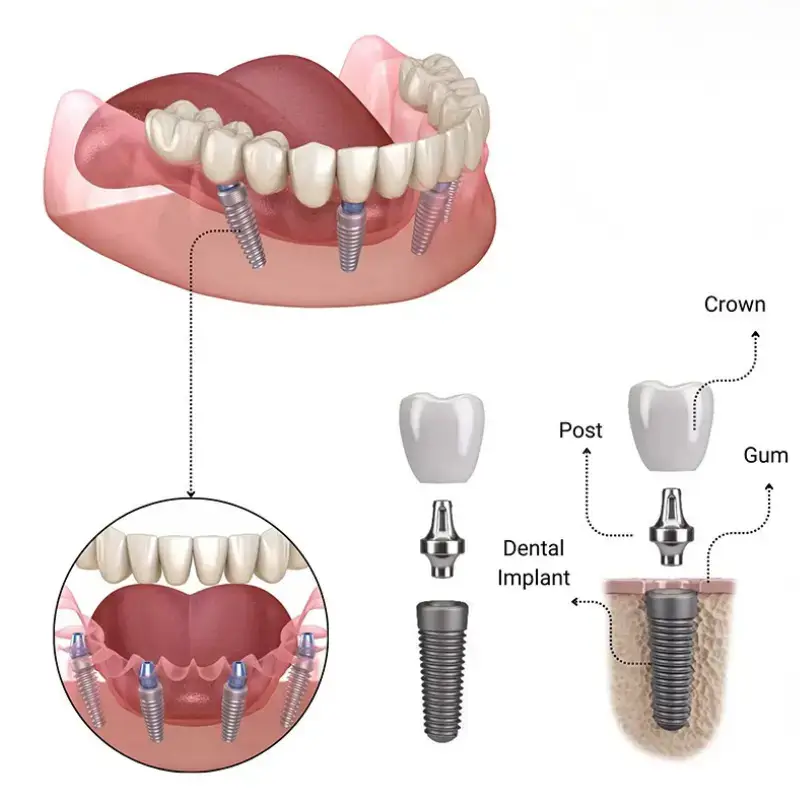
All-on-4 restorations replace an entire arch of teeth using just four implants. Because the prosthesis is fixed, it does not come out at night, which means cleaning requires a more deliberate approach than caring for a single implant.
The biggest risk with All-on-4 is debris and bacteria accumulating beneath the bridge, in the gap between the prosthesis and the gum tissue. This area is invisible but highly vulnerable to peri-implant disease if left unattended.
Water flosser first, always. String floss cannot reach beneath a full-arch bridge. A water flosser directed at a 45-degree angle under the prosthesis is your primary tool for clearing this zone.
After water flossing, pass implant-specific floss or a bridge threader beneath the bridge along each implant site to clear any remaining film.
A soft-tip interdental brush clears what the flosser and threader leave behind. Use it along the gumline at every implant site.
Do not attempt to remove or adjust the bridge at home. All-on-4 bridges are fixed restorations and should only be professionally removed and cleaned by your dentist. DIY attempts risk damaging the abutments or loosening the implant connection.
For All-on-4 patients specifically, three-month professional cleaning intervals are strongly recommended rather than the standard six. Your hygienist uses instruments calibrated for implant-safe cleaning, and your dentist will check the torque of each screw connection and assess the gumline beneath the bridge.
Signs of Peri-Implantitis
Peri-implantitis is the most serious threat to a functioning dental implant. It is a bacterial infection that progressively destroys the bone and soft tissue surrounding the implant. It is largely silent in its early stages; patients often feel nothing until meaningful bone loss has already occurred.
Warning signs to watch for:
– Bleeding or tenderness around the implant when brushing or flossing
– Redness or swelling of the gum tissue at the implant site
– A visible gap appearing between the gum and the implant crown
– Pus or discharge at the gumline
– A dull ache, pressure, or sensitivity that was not there before
– The implant feeling loose or slightly mobile
Any one of these signs warrants an appointment. Peri-implantitis caught early can be managed with professional debridement and antimicrobial therapy. In advanced cases, surgical bone grafting may be required, and in severe cases, the implant must be removed entirely.
Do not wait and watch. Unlike natural teeth, implants have no periodontal ligament to cushion impact or act as an early warning system. By the time discomfort becomes obvious, bone loss is often already significant.
Signs of Dental Implant Failure
Implant failure is distinct from peri-implantitis, though the two can overlap. Failure refers to the loss of osseointegration (the bond between the titanium post and the jawbone) or to mechanical failure of the implant components.
Signs that warrant urgent assessment:
– The implant feels loose, shifts, or rotates when you apply pressure to it
– The crown feels different when you bite: higher, lower, or unstable
– Persistent deep pain or throbbing at the implant site
– Swelling that does not resolve within a few days
– A cracking or clicking sensation when chewing
– Noticeable bone recession visible on an X-ray
Some implant failures occur early, within the first few months during the osseointegration phase, and are unrelated to hygiene. Others develop years later and are almost always linked to infection, bone loss, or mechanical overload from bruxism or dietary habits.
When to Call Your Dentist Immediately
Call the same day if you experience:
– A loose or mobile implant at any stage after the healing period
– Sudden, unexplained pain that does not improve within 24 hours
– Visible swelling accompanied by fever or a bad taste in the mouth
– Any trauma to the face or mouth involving an implant
Early intervention almost always changes the outcome.
Long-Term Dental Implant Care: Maintenance Schedule
Frequency | Task |
Twice daily | Brush with a soft-bristle toothbrush using gentle circular motions |
Once daily | Floss around each implant using implant floss or a threader |
Once daily | Use an interdental brush at each implant site |
Once daily | Rinse with an alcohol-free antibacterial mouthwash |
Once daily | Water flosser (essential for All-on-4 and bridge patients) |
Every 3 to 6 months | Professional cleaning with implant-safe instruments |
Every 3 months | Recommended interval for All-on-4 patients |
Annually | Dental X-rays to monitor marginal bone levels |
Annually | Full clinical assessment: pocket depths, restoration stability, occlusion check |
As needed | Contact your dentist at the first sign of bleeding, pain, or mobility |
Book Your Free Implant Consultation
Whether you are considering dental implants or already have them and want to ensure they last, we offer free consultations with no obligation. Book yours at One Life Dental.