
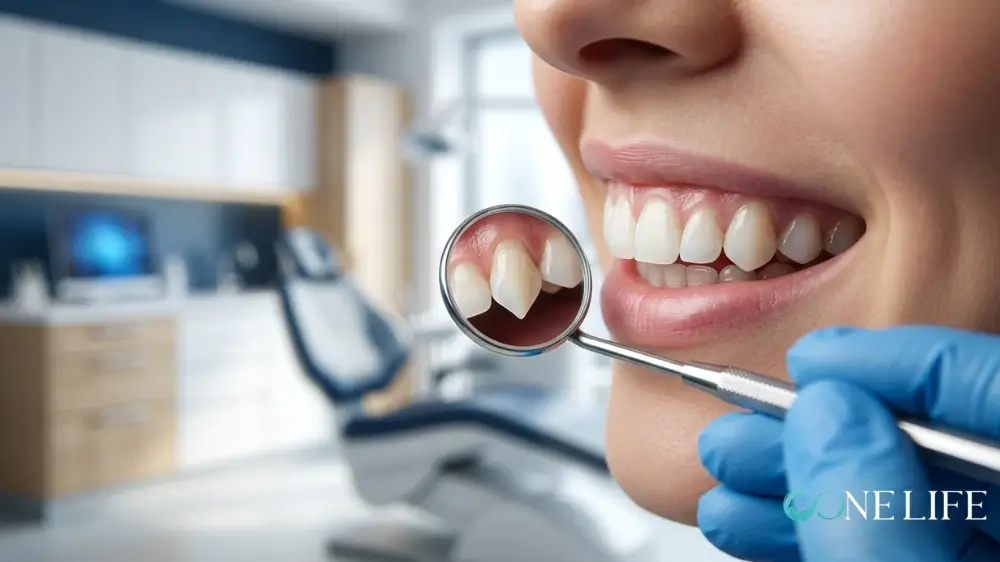
Vampires have them. Wolves kill with them. Some fighters sharpen them into fangs. No other tooth in the human body carries this much mythology –– and so much power. Canine teeth tear your food and carry the genetic memory of omnivore meat eaters. They hold the shape of your face together and have the longest root of any tooth in your mouth, built to last a lifetime. Here is everything to know about them.
What Are Canine Teeth?
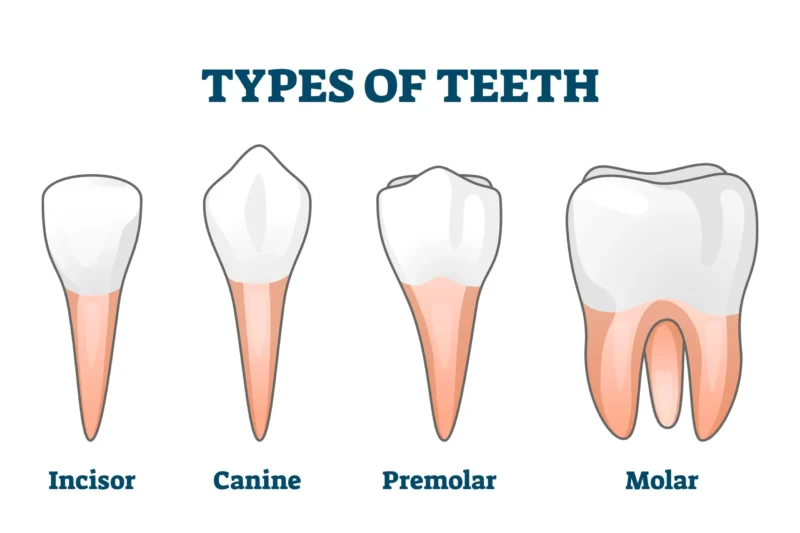
Your canine teeth are four pointed teeth — two on top, two on the bottom — sitting at the corners of your dental arch. They are the sharpest, most deeply rooted teeth in your mouth, and despite being just 4 out of 32 adult teeth, they carry a disproportionate amount of responsibility: tearing food, guiding your bite, protecting your back teeth from damage, and giving your face its structural contour.
Anatomy of a Canine Tooth
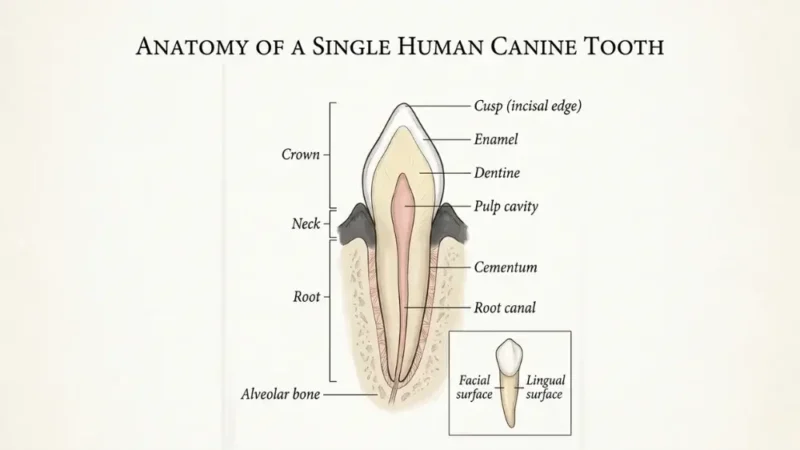
Like all permanent teeth, canines have a crown, a neck, and a root. What sets them apart is root depth: the upper canine root can measure up to 27 mm— nearly the length of a matchstick — which is why these teeth are so stable and so difficult to extract.
Where Are Your Canine Teeth Located?
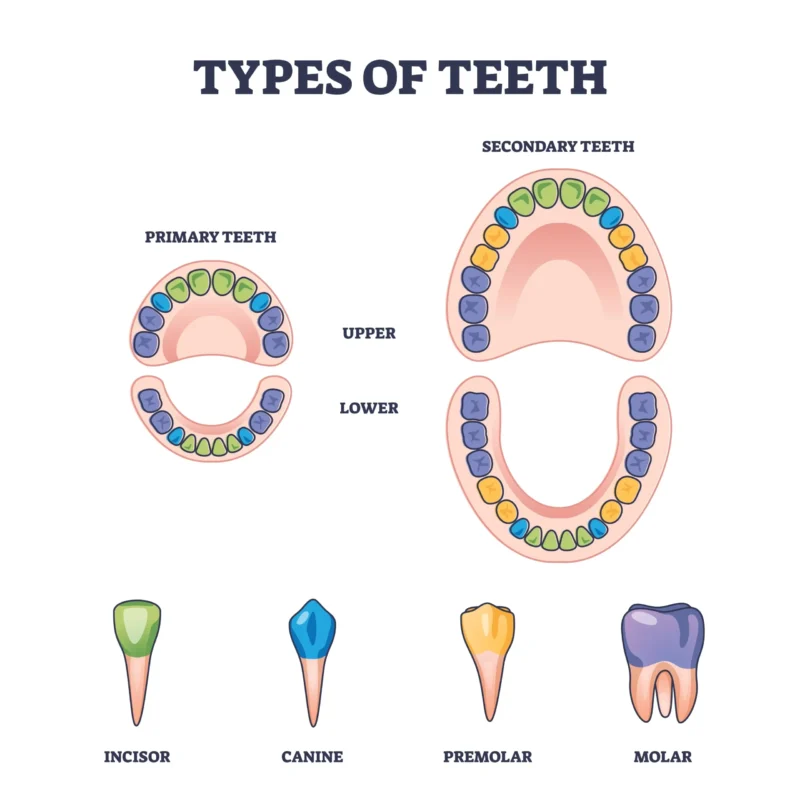
Your human canine teeth sit at the four corners of your smile: upper-left, upper-right, lower-left, lower-right. In dental notation, they are teeth #6, #11, #22 and #27 (Universal system) or teeth 13, 23, 33 and 43 (FDI/ISO system used across the UK and Europe).
A simple way to find them: starting from the centre of your mouth, count along — central incisor, lateral incisor, and then the pointed tooth at the corner. That is your canine. They sit immediately before your premolars and are visually distinct from every other tooth type due to their single, sharp cusp.
How Many Canine Teeth Do Humans Have?
Humans have four canine teeth: two maxillary (upper) and two mandibular (lower), one on each side of both jaws. Children develop four primary canine teeth (milk canines) first, later replaced. Both sets follow the same position and function.
Set | Number of Canines | When They Appear |
Primary (milk) | 4 | 16–23 months |
Permanent | 4 | 9–12 years |
What Do Canine Teeth Do? 4 Key Functions of Your Cuspids
Canine teeth add definition to a smile. Their anatomy gives them a unique role that no other tooth can replicate. Theirfour core functions are:
- Tearing and piercing food. The canine is a sharp tooth with a single cusp, designed to tear or pierce food — essential for anything fibrous: meat, raw vegetables, crusty bread.
- Guiding your bite. When your jaw moves sideways, your canines are the teeth doing the steering. This is known as canine guidance (covered in detail below).
- Supporting facial structure. The roots of your upper canines sit directly beneath the corners of your nose, providing the scaffolding that holds lip and cheek tissue in position.
- Anchoring the dental arch. Canines provide support to the lips and help in the alignment of other teeth, acting as a stabilising point.
How Your Canines Protect the Rest of Your Teeth
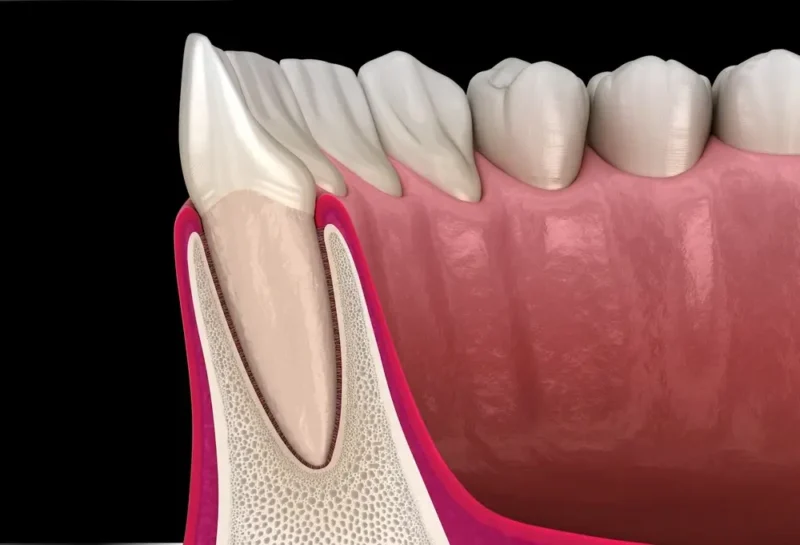
Every time your jaw moves sideways — when chewing, grinding, or clenching — your upper and lower canines make contact first and lift the back teeth slightly off each other.
Canines absorb up to 70% more lateral forces than premolars, reducing wear on posterior teeth. Without this protection, those lateral forces hit your molars and premolars directly — teeth that are built for vertical crushing, not sideways stress.
This is why, when a canine tooth is lost or severely worn, dentists work hard to restore it precisely — because restoring canine guidance is structural.
Canines and Facial Structure
When you look in the mirror and flash a smile, the most prominent teeth often grabbing your attention are the sharp, pointed ones at the corners of your dental arch. Their visual role is real, but their structural role runs deeper.
When canine teeth are lost, the corners of the mouth begin to drop, and the lip and lower face develop a sunken appearance. This is why we consider canine replacement a facial health issue, not merely a dental one.
Human Canine Teeth vs. Animal Canines
The word canine comes from the Latin canis — dog. And if you have ever seen a wolf, a lion, or even a domestic cat yawn, you understand why the comparison stuck. A lion’s canine can reach 7 cm in length. A wolf’s can exert bite forces exceeding 150 kg per square centimetre.
Human canines tell a different story.
In humans, canine teeth reflect our dietary evolution toward softer foods and the development of language and social interaction. They are shorter, more symmetrical, and far less pronounced. And yet the underlying architecture is preserved: single cusp, deep root, corner position.
What changed most is function. In apex predators, canines are offensive tools. In humans, they became protective ones — less about attacking food and more about managing the forces of a speech-capable jaw that moves in multiple planes.
One thing worth noting: humans are among the very few primates where male and female canines are nearly identical in size. In most other primates — gorillas, baboons, chimpanzees — males have dramatically larger canines.
Timeline by Age: When Do Canine Teeth Erupt?
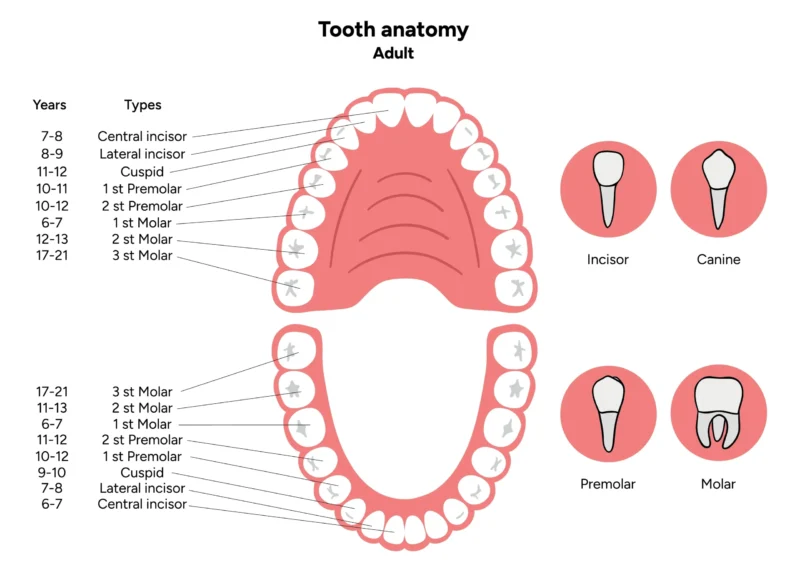
Canine tooth eruption in children follows a predictable sequence, though timing varies. Here is the usual timeline for canines specifically:
Primary (milk) canines:
- Upper canines:typically erupt between 16 and 22 months
- Lower canines:typically erupt between 17 and 23 months
Permanent canines:
- Lower canines:typically erupt between 9 and 10 years
- Upper canines:typically erupt between 11 and 12 years
What if a canine has not appeared by age 14?
A canine that has not erupted by the mid-teens is likely impacted — meaning it is stuck beneath the gum or bone and will not emerge on its own. This requires professional assessment, and in most cases, intervention.
Left untreated, an impacted canine can damage the roots of adjacent teeth, cause cysts, and create significant orthodontic problems.
The key takeaway: if a child’s upper canines have not visibly begun to erupt by age 10 to 11, a dental X-ray is warranted. Early intervention is almost always simpler, shorter, and less costly than treating the consequences later.
What Can Go Wrong with Your Canine Teeth?
Despite being the most structurally robust teeth in your mouth, human canine teeth are not immune to problems. The issues range from developmental to mechanical and pathological. Here is what to watch for.
Impacted Canine Teeth
An impacted canine fails to erupt, remaining trapped beneath the gum, within the bone, or angled against an adjacent tooth. It is the most common canine problem dentists encounter, and it is far more prevalent in the upper jaw than the lower.
Impacted upper canines affect approximately 2% of the population and are twice as common in females as in males. While those percentages may sound small, they translate to millions of people globally — and the consequences of leaving an impacted canine untreated are serious.
Treatment almost always involves orthodontics: a brace that slowly guides the tooth into its correct position over several months. When caught early, outcomes are excellent. When left too long, extraction and replacement may become the only option.
Why do canines become impacted?
- Insufficient space in the dental arch (crowding)
- Abnormal eruption path — the tooth angles toward the roof of the mouth (palatal impaction) or toward the lip (labial impaction)
- Retained milk canine that did not fall out naturally
- Genetic factors influencing tooth position
- Multifactorial causes involving both genetic and environmental influences, with artificial intelligence-based prediction models now being developed to improve early detection
Worn, Chipped or Broken Canine Teeth
If your canine tips look flat rather than pointed, mention it at your next dental check. It is one of the earliest and most actionable warning signs in dentistry.
Because canine teeth bear significant lateral bite forces — absorbing up to 70% more lateral force than premolars — they are vulnerable to wear and fracture, particularly in people who grind their teeth (bruxism) or clench under stress.
Common causes of canine damage include:
- Bruxism— nocturnal grinding that gradually flattens the cusp tip, reducing the tooth’s ability to provide canine guidance
- Trauma— a fall, sports impact, or accident that chips or fractures the crown
- Acid erosion— from diet (citrus, fizzy drinks) or acid reflux, which softens enamel and accelerates wear
- Parafunctional habits— nail biting, pen chewing, or using teeth as tools
Canine Tooth Loss
Losing a canine tooth is more significant than losing most other teeth. Most common causes of canine tooth loss in adults include:
- Periodontal (gum) disease— the leading cause of adult tooth loss globally, responsible for progressive bone loss that eventually destabilises even the deepest roots
- Severe trauma— road accidents, sports injuries, falls
- Advanced untreated decay— decay that reaches the root and makes the tooth unrestorable
- Failed previous treatment— a root canal or crown that breaks down over time
What happens after a canine is lost?
The consequences are immediate and progressive:
- Bite shift:adjacent teeth begin to drift and tilt into the gap within weeks
- Bone resorption:the jawbone in the empty socket begins to shrink — studies show up to 25% of bone width can be lost in the first year alone
- Loss of canine guidance:lateral bite forces are redistributed to teeth not designed to handle them
- Facial changes:the canine eminence — the bony ridge beneath the corner of your lip — begins to flatten as the underlying bone recedes, visibly ageing the lower face
- Increased wear on remaining teeth:without canine protection, molars and premolars wear faster
Can You Replace a Missing Canine Tooth?
Yes — and in most cases, a dental implant is the best solution. A missing canine tooth is not something to leave untreated or manage with a temporary fix. Given everything a canine does — bite guidance, facial support, arch stability — the replacement needs to perform.
There are three main replacement options available:
Option | Preserves Bone? | Restores Canine Guidance? | Longevity |
Dental implant | ✅ Yes | ✅ Yes (when correctly placed) | 20–25+ years |
Dental bridge | ❌ No | Partially | 10–15 years |
Removable partial denture | ❌ No | ❌ Limited | 5–10 years |
Why Canine Teeth Are Harder to Replace Than Other Teeth
Research shows the canine area has one of the highest implant failure rates among all positions — 6.8% — and the shortest average survival time compared to other sites. This is not a reason to avoid implants; it is a reason to choose an experienced specialist.
Here is why:
- Root depth.The canine has the longest root of any tooth. Placing an implant that replicates this depth and angulation requires precision planning and advanced imaging.
- Aesthetic demand.Canines sit at the visible corners of the smile. The crown must match the natural tooth in shape, colour, translucency, and cusp profile — a higher aesthetic bar than a molar replacement.
- Canine guidance restoration.The implant crown must be designed to re-establish lateral bite guidance. This requires collaboration between the implant surgeon and the prosthetist.
- Bone availability.If the tooth has been missing for some time, bone resorption may mean a bone graft is required before implant placement.
Dental Implants for Canine Teeth
Dental implant success rates range from 95% to 98% when placed by an experienced specialist using premium-grade materials — which is precisely why the choice of provider is as important as the choice of treatment.
What does it cost?
The cost of dental implants vary significantly by country and clinic, with dental implants in Turkey having some of the most competitive prices in the world:
Country | Approximate single implant cost |
🇬🇧 UK | £2,000 – £3,500 per implant |
🇺🇸 USA | $2,000 – $4,500 per implant |
🇨🇦 Canada | CAD $2,500 – $4,500 per implant |
🇦🇺 Australia | AUD $3,000 – $6,000 per implant |
🇹🇷 Turkey | $450-850 for Swiss verified implants |
Canine Teeth Cleaning: How to Care for Your K9 Tooth Daily
K9 teeth are exposed to plaque accumulation on the front face, the back face, and both sides. The gumline around canines is also a common site for early recession, particularly in people who brush too hard.
Daily care essentials:
- Brush at a 45-degree angle to the gumline, using gentle circular motions. Scrubbing horizontally accelerates wear.
- Floss daily, paying particular attention to both contact points of each canine
- Use a fluoride toothpaste to maintain enamel strength. If you consume acidic food or drink regularly, a remineralising toothpaste adds an extra layer of protection.
- Wear a night guard if you grind. Bruxism is the single fastest way to destroy canine guidance
- Do not use your canines as tools. Opening packaging, biting nails, tearing tape — all of these are forbidden