A qualified Turkish implant dentist must hold a Turkish Ministry of Health licence, active TDB membership, and ideally international credentials such as JCI clinic accreditation, ITI or EAO membership, and certified use of traceable premium implant brands. If any of these are missing or unverifiable, walk away.
Turkey receives over 500,000 international dental patients every year, and its clinics serve a growing volume of international patients seeking treatments ranging from routine care to complex oral surgeries. The savings are real — a single dental implant in Turkey typically costs a fraction of UK/US prices, with many patients saving 60–70% on the treatment. But those savings only make sense when the dentist performing your surgery is properly qualified, independently verified, and working within an accredited facility.
Who Actually Places Your Implants in Turkey? The Reality in Dental Clinics
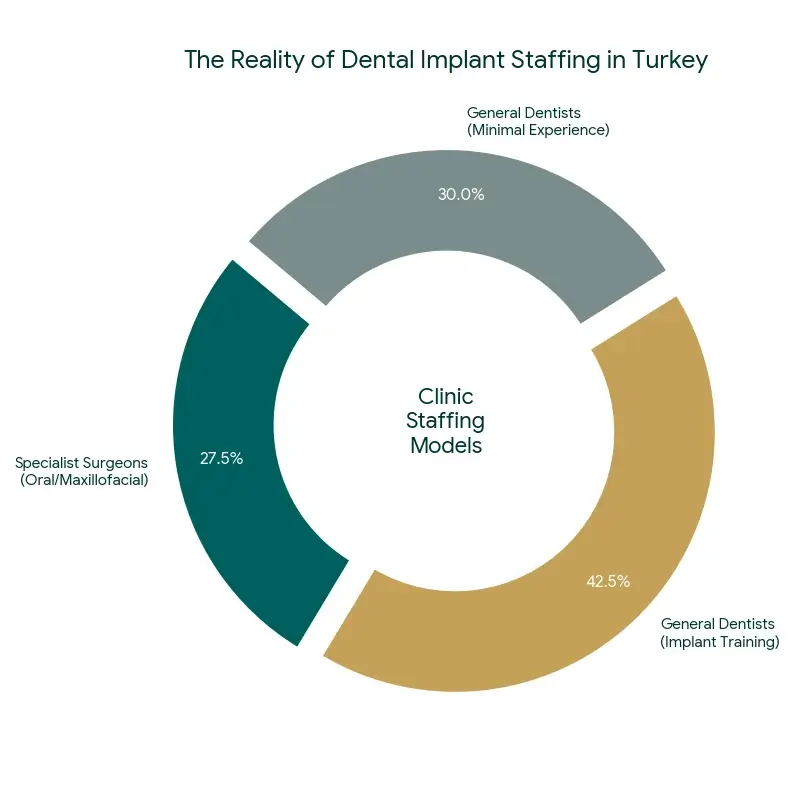
Most patients travelling for Turkey dental implants get treated in licensed clinics. But Turkey is a medical powerhouse that welcomed 2 million health tourists in 2024 alone. That enormous scale for a 85 million people countryhas created a wide spectrum of clinical staffing models, from fully specialist-led teams to high-volume “dental mills” where the surgeon’s role is minimal.
Here is what the staffing landscape actually looks like:
Who Performs Your Implant Surgery | Share of Turkish Clinics (est.) | What This Means for You |
Specialist oral surgeon or maxillofacial surgeon — performs all surgical steps personally | ~25–30% of clinics | Gold standard. This is what you must verify explicitly. |
General dentist with implant training— licensed, but no postgraduate surgical specialisation | ~40–45% of clinics | Adequate for straightforward single implants; higher risk in complex cases requiring bone grafts or sinus lifts. |
General dentist with minimal implant experience — a weekend course, high patient volume | ~25–30% of clinics | Significant risk. Data shows a major experience gap between general dentists and dedicated implant specialists in Turkey. |
Estimates based on Turkish Dental Tourism Association data, Bookimed clinical database analysis, and independent industry reporting (2024).
The Essential List of Certificates and Accreditations for Dental Implants in Turkey
The critical distinction is between a general dentist and a specialist oral surgeon. A dentist with a PhD-level specialisation in oral surgery has 9 to 11 years of university education, compared to a general dentist who may have completed only a few weekend courses on implants. For a single straightforward implant, an experienced general dentist may be perfectly adequate. For complex cases — bone grafts, sinus lifts, full-arch All-on-4 or All-on-6, or zygomatic implants — a specialist oral surgeon is not optional.
The importance of certificates and accreditations extends to the dental clinic in Turkey, not just the dentist! Below, we will look at each and every one of these in detail.
The Non-Negotiable: Turkish Ministry of Health Licence
Every legitimate dental clinic in Turkey must be licensed by the Turkish Ministry of Health (Sağlık Bakanlığı). This is the baseline.
Licensing involves inspections of facilities, equipment, staffing, sterilisation, and safety standards. A clinic without this licence is operating illegally. You can verify a clinic’s licence through the Ministry of Health’s online registry. The clinic should be able to provide their licence number and registration details on request.
What Is the TDB — and Why Your Dentist Must Be a Member?
The TDB (Türk Tabipleri Birliği Diş Hekimleri Kolu, or Turkish Dental Association) is the professional regulatory body for all practising dentists in Turkey.
The Turkish Dental Association (TDB) maintains a registry of licensed practitioners. If your dentist is not on that register, they should not be performing implant surgery on you.
Verifying TDB membership takes minutes. Ask the clinic for the dentist’s full name and registration number, then cross-reference against the TDB’s public database. Any reputable clinic will provide this without hesitation. Beyond registration, many Turkish dentists also hold memberships in international organisations such as the International Congress of Oral Implantologists (ICOI), the European Association for Osseointegration (EAO), or the International Academy of Cosmetic Dentistry.
Which International Accreditations Should the Clinic Hold?
International accreditations confirm the dental clinic in Turkey it is excellent.
Some clinics pursue voluntary international accreditations that indicate higher standards of care. These are not legally required, but tell you a great deal about how seriously a clinic takes patient safety, clinical governance, and long-term outcomes.
The three most important are JCI accreditation, ISO 9001 certification, and the International Health Tourism Authorisation Certificate.
JCI Accreditation
JCI (Joint Commission International) is the most widely recognised healthcare accreditation body in the world.
JCI evaluates patient safety, infection control, staff qualifications, clinical outcomes, and organisational management. Achieving JCI accreditation requires extensive preparation and ongoing compliance. It demands documented processes, regular audits, and measurable clinical standards.
Patients should check JCI accreditation directly on the Joint Commission International website rather than relying on clinic claims alone. The official JCI directory lists every currently accredited organisation.
ISO 9001 & ISO 9001:2015
ISO 9001 is an international quality management standard. It means the clinic operates consistent, documented processes from surgery to sterilisation to aftercare.
ISO certification does not evaluate clinical outcomes directly, but it does confirm that the clinic has formal systems for quality control, complaint management, and continuous improvement. Some Turkish clinics hold multiple ISO standards simultaneously.
International Health Tourism Authorisation Certificate
This certificate, issued by the Turkish Ministry of Health, is specifically required for clinics and organisations serving international patients.
The Ministry of Health requires an International Health Tourism Authorisation Certificate for facilities and intermediary organisations offering international medical tourism services. If you are travelling for dental implants in Turkey, ask for it in writing before you book.
What Professional Memberships Should Your Implant Surgeon Hold?
Professional memberships signal that your surgeon actively engages with the latest research, techniques, and clinical standards in implantology.
The three organisations most relevant to dental implant surgery are the ITI, the EAO, and the ICOI. Each requires demonstrated expertise and ongoing professional development.
- ITI (International Team for Implantology): Surgeons certified by the ITI have demonstrated competency in implant placement, bone grafting, and complex reconstructive cases.
- EAO (European Association for Osseointegration):Membership of the EAO provides reassurance that the dentist adheres to the highest standards of practice in osseointegration. EAO members are required to engage in peer-reviewed education and evidence-based practice.
- ICOI (International Congress of Oral Implantologists): ICOI fellows and diplomates have passed formal examinations and case-submission requirements — it is not simply an honorary title.
Implant Brand Certification: Avoid Counterfeiting
Many Turkish clinics use the same premium implant brands available in Europe, including Straumann, Nobel Biocare, and Zimmer Biomet. At OONE LIFE, we provide the REF and LOT stickers directly from the implant packaging. These are traceable, verifiable, and something no reputable clinic will refuse to supply.
Patients should also receive an implant passport with the brand, model, and lot number for future reference. This document is essential for any follow-up care you receive back home. Your UK, Irish, or Australian dentist will need it.
Does Turkey Have Enough Specialists to Handle Dental Implant Demand?
Turkey’s dental workforce has grown impressively. According to data from the Turkish Ministry of Health, the number of dentists in Turkey increased from 16,371 in 2002 to 45,718 as of 2023 —, bringing the ratio to 57 dentists per 100,000 people and ranking Turkey 6th among OECD countries.
The numbers, laid out plainly:
Metric | Figure | Source |
Total registered dentists in Turkey (2023) | ~45,700 | Turkish Ministry of Health |
Turkish domestic population | ~85 million | Turkish Statistical Institute |
International health tourists (2024) | ~1.5 million | Turkish Ministry of Health / industry data |
Of those, dental patients (est. ~15%) | ~225,000+ | Dental services represent approximately 15% of all medical tourism procedures in Turkey |
Dental implant market share of dental tourism | ~42% | Dental implants were the largest revenue-generating service in Turkey’s dental tourism sector in 2024 |
UK patients travelling to Turkey for dentistry annually | ~150,000–200,000 | TDA reports and industry data |
Why this Matters for Implant Patients
Turkey has a large and growing dental workforce, but the number of specialist implant surgeons is smaller than the headline dentist figures suggest. As international demand continues to surge — particularly for complex procedures like full mouth dental implants in Turkey — the pressure on specialist oral & maxilofacial surgeonsincreases.
What this means practically for you as a foreign patient:
- High-volume “dental mill” clinics exist precisely because demand outpaces specialist supply. They are a market response to overcrowding at the top tier.
- Industry estimates suggest 60–70% of Turkey’s dental tourism patients receive treatment in licensed, properly staffed clinics. The remaining 30–40%, concentrated in the cheapest segment, account for the documented failures.
- The credentials checklist in this guide is your mechanism for ensuring you land in the 60–70%, not the 30–40%.
- Book early, communicate thoroughly before you travel, and never choose a clinic solely on price or package attractiveness.
The Accreditation Checklist Table
Use this table to evaluate any Turkish clinic before booking. Every item in the Essential column is non-negotiable. Items in the Strongly Recommended column significantly reduce your risk.
Credential | Issued By | Type | How to Verify |
Ministry of Health Licence | Turkish Ministry of Health | Essential | Ministry’s online healthcare facility registry |
TDB Membership | Turkish Dental Association | Essential | TDB public practitioner database |
Int’l Health Tourism Auth. Certificate | Turkish Ministry of Health | Essential | Request directly from clinic in writing |
JCI Accreditation | Joint Commission International | Strongly Recommended | Official JCI-accredited organisations directory |
ISO 9001 Certification | International Organisation for Standardisation | Strongly Recommended | Request certificate number; verify with issuing body |
ITI Membership | International Team for Implantology | Strongly Recommended | ITI member directory (itinerary.iti.org) |
EAO Membership | European Association for Osseointegration | Strongly Recommended | EAO member directory |
ICOI Membership / Fellowship | Int’l Congress of Oral Implantologists | Strongly Recommended | ICOI member directory |
Implant Brand Traceability | Manufacturer (e.g. Straumann, Nobel Biocare) | Essential | REF/LOT stickers + written implant passport |
CE-Marked Materials | European Conformity | Essential | Request written confirmation from clinic |
Why Choose OONE LIFE for Your Dental Implants in Turkey?
Reading this guide, you now know exactly what to look for in a Turkish implant clinic. OONE LIFE Dental was built around precisely those criteria.
A European Agency Operating in Turkey — a Structural Difference
OONE LIFE is a European-managed agency operating within Turkey’s dental system — with its own clinics, dentists, partners and laboratory.
That structure means European standards of transparency, patient communication, and clinical governance are applied from the first consultation to post-treatment aftercare. It means you have a point of contact who understands both the Turkish healthcare environment and the expectations — and legal frameworks — of British, Irish, American, Australian, and Canadian patients.
Oral & Maxillofacial Surgeon for Dental Implants
At OONE LIFE, implant surgery is performed by Dr. Serkan, a fully qualified Oral & Maxillofacial Surgeon.
Oral and maxillofacial surgery is the highest level of surgical qualification in dentistry. It requires postgraduate hospital-based training covering the full spectrum of surgical intervention — from complex bone grafting and sinus lifts to full-arch reconstruction and zygomatic implants.
Periodontal Expertise: US-Trained at Columbia University
OONE LIFE includes Dr. Astolfi, a periodontist trained at Columbia University — one of the world’s leading dental schools — in its clinical team. A US-trained periodontist working within a Turkish clinic is genuinely rare. It means your implant treatment is assessed and supported by a specialist whose training meets Ivy League academic standards.
Free Medical Complication Insurance Included in Every Package
The Turkish Ministry of Health introduced compulsory complication insurance for foreign nationals undergoing surgical dental procedures, effective January 2026. OONE LIFE has gone further: medical complication insurance is included as standard in all packages, at no additional cost to the patient.
Only Verified, Premium Implant Brands
OONE LIFE uses exclusively verified, internationally recognised implant brands such as Straumann, Nobel Biocare, Osstem and Bego — the same systems used in leading practices in London, New York, and Sydney. Every patient receives full traceability documentation: brand, model, REF and LOT numbers, and a written implant passport.