
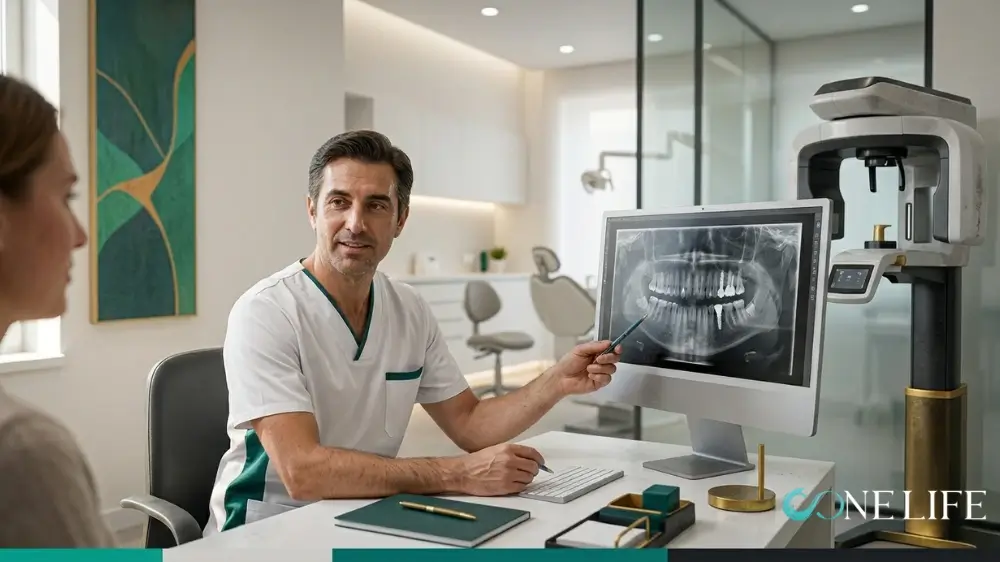
You’ve done your research. You’ve booked your flights. And in Turkey, the dentist tells you the plan needs to change. And so does the price. This has consequences for you as a patient. Price changes are among the most common complaints heard from patients travelling to Turkey for dental implants. But how much can your dental implant cost increase? And what can you do about it?
Why Can Dental Treatment Plans Change in Turkey?
Before you start yelling, mind it’s not always dishonesty. In many cases, the clinic never had the right information to begin with. The reason? Most patients don’t provide panoramic X-rays before flying to Istanbul.
To create your treatment plan, your dentist in Turkey needs to see your mouth. The ideal is a panoramic X-ray, but if you don’t provide one, Dr. Astolfi will have no other option than to establish a treatment plan based on mobile photographs of your mouth.
A photograph of your mouth shows only what is visible to the naked eye: gum tissue, tooth surfaces, and obvious structure. It is not a diagnostic tool. A panoramic X-ray, on the other hand, captures your entire upper and lower jaw, all your teeth, and the surrounding bone –– and it costs often under £20 privately.
What only an X-ray scan can show:
- Bone height and density beneath the gum
- Distance of the maxillary sinus to the jaw
- Position of the inferior alveolar nerve
- Hidden infections or cysts at root level
- Bone resorption after tooth loss
- Root fragments after past extractions
The Most Common Treatment Changes That Happen on Arrival in Turkey
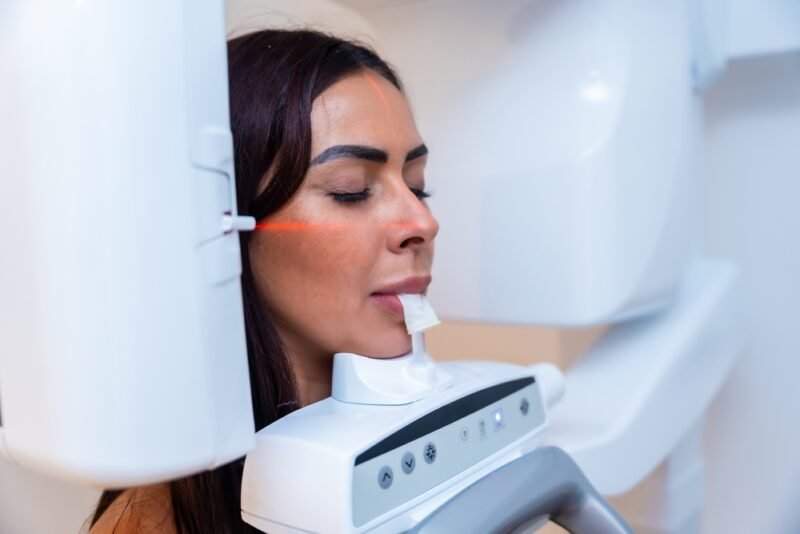
When Dr. Astolfi takes your CBCT scan on arrival and the image doesn’t match what photographs suggested, the treatment plan changes. This is a clinical decision. But what is a reasonable treatment change, and what is a red flag?
Bone Grafting
Bone loss is invisible without an X-ray. Many patients arriving in Turkey have been missing teeth for years, sometimes decades. What looked like a straightforward implant case in photographs turns out to require a bone graft before any implant can be safely placed.
Potential extra costs for bone grafting typically range from £150 to £350 per site — but in complex full-arch cases, the impact across multiple sites can push the total significantly higher.
Sinus Lifting
The sinus sit directly above your upper back teeth. When those teeth have been missing for some time, the sinus floor can drop. This is one of the most common surprises in upper jaw implant cases. A photograph gives no indication whatsoever of sinus position. Even a panoramic X-ray can underrepresent the problem. Only a CBCT scan gives the surgeon the precise measurement they need.
A sinus lift typically adds £250–£400 per side at standard clinics — and considerably more in the UK, where it is classified as specialist surgery.
Hidden Infections, Failed Roots and Other Surprises
Not all plan changes are about bone volume. Sometimes the CBCT reveals:
- Periapical infections around existing teeth or beneath old crowns — requiring extraction and a healing period before implants can be placed
- Retained root fragments from past extractions that were never properly removed — requiring surgical retrieval
- Failed or failing implantsfrom previous treatment elsewhere — requiring removal before new implants can be considered
- Advanced periodontal disease in remaining teeth — changing the scope of the entire restoration plan
How Much More Can Dental Implants Cost in Turkey?
This is the question patients are most afraid to ask — and the one they most need answered. The table below shows the most common additions discovered on arrival, and their typical cost impact for dental implants in Turkey.
Additions | Why It’s Needed | Typical Cost Added |
Bone graft (per site) | Insufficient bone volume for implant stability | £300 – £600 |
Sinus lift (per side) | Sinus floor too low for upper jaw implants | £400 – £800 |
Tooth extraction | Infected or failing teeth identified on CBCT | £80 – £150 per tooth |
Implant type upgrade (e.g. zygomatic) | Severe bone loss rules out standard implants | £1,500 – £3,500+ |
Additional implants (e.g. All-on-4 → All-on-6) | Bone distribution requires more anchor points | £600 – £1,200 |
Treatment staged across two visits | Grafting must heal before implant placement | Additional travel costs |
What Is a Legitimate Treatment Change — and What Is a Red Flag?
A legitimate treatment change is explained, evidenced, and shown to you on screen. The surgeon sits with you, opens the CBCT images, points to the specific issue (insufficient bone height, a dropped sinus floor, a hidden infection), and explains why the original plan cannot proceed safely as quoted.
You can see it. You can ask questions. You decide.
A red flag looks very different. Some clinics — this is documented, not speculative — operate with a deliberate policy of quoting low to secure the booking, then inflating the plan on arrival. The patient, already in Istanbul, having paid a substantial deposit, is told their new price may be 50% higher. In some cases, it has been reported as double the original quote. And they are told it is non-refundable.
This is a commercial trap.
The warning signs to watch for:
- A new CBCT finding is announced verbally, with no image shown to the patient
- Multiple new procedures are added simultaneously, with no single clear clinical justification
- The price increase is round, large, and presented as non-negotiable
- Pressure is applied to sign or pay the same day, before the patient has time to think
- Requests to speak to a second clinician are refused or deflected
- The deposit refund policy becomes suddenly unclear or aggressive
If any of these occur, do not proceed. Request your CBCT images in digital format — you are legally entitled to them — and seek a second opinion before committing further funds. Reputable clinics will never object to this.
How OONE LIFE Handles a Treatment Change
Even at OONE LIFE, treatment plans can change on arrival. What distinguishes us is how we handle it.
Every patient at our Istanbul clinic undergoes a CBCT cone beam scan before any treatment begins. If it confirms the treatment plan, we proceed exactly as agreed. If it doesn’t, we stop, sit with you, open the images on screen, and walk you through exactly what we found and why it changes things.
- The surgeon shows you the scan and explains the finding in plain language
- You receive a revised treatment plan in writing, with the updated cost clearly itemised
- You are given time to think, ask questions, and if needed, seek a second opinion
- No procedure begins until you have given explicit informed consent to the revised plan
Cases Where We Go Further
We understand that a significant cost increase — even a legitimate one — puts patients in a difficult position. You have paid for flights. You have taken time off work. You have planned around this trip. That context matters to us.
There are specific situations where OONE LIFE will make a gesture to support you:
- When the change was foreseeable from the photographs and should have been flagged more explicitly during the remote consultation — we will absorb the entire additional cost as a goodwill adjustment
- When the additional procedure is minor — a small bone graft at a single site, a straightforward extraction — we will include it within the original quoted price
- When a patient has travelled a significant distance and the change makes the full treatment unviable within the trip — we will work with you to restructure the plan across visits at no additional cost
- When the patient is on a fixed budget and the change is beyond their means — we will explore alternative pathways that achieve a safe, functional result within what is possible
How to Protect Yourself Before You Fly
The single most effective thing you can do before dental implants in Turkey is get a panoramic X-ray before you commit to anything.
A panoramic X-ray takes less than five minutes. It costs, in most cases, under £20 privately. And your remote treatment plan becomes anchored in real diagnostic data. For a case of full-mouth dental implants in Turkey, that investment is negligible.
Here is what to do before you fly:
- Book a panoramic X-ray at your local dental practice — ask specifically for an OPG (orthopantomogram)
- Request a CBCT if your case involves significant tooth loss, upper jaw implants, or you have been told previously that you have bone loss
- Send the images digitally to your clinic before your consultation — any reputable clinic can work with standard DICOM files
- Ask your clinic explicitly: “Is this treatment plan based on my X-ray, or on photographs only?”
- Get the treatment plan in writing before paying any deposit, with a clear note of what imaging it was based on