
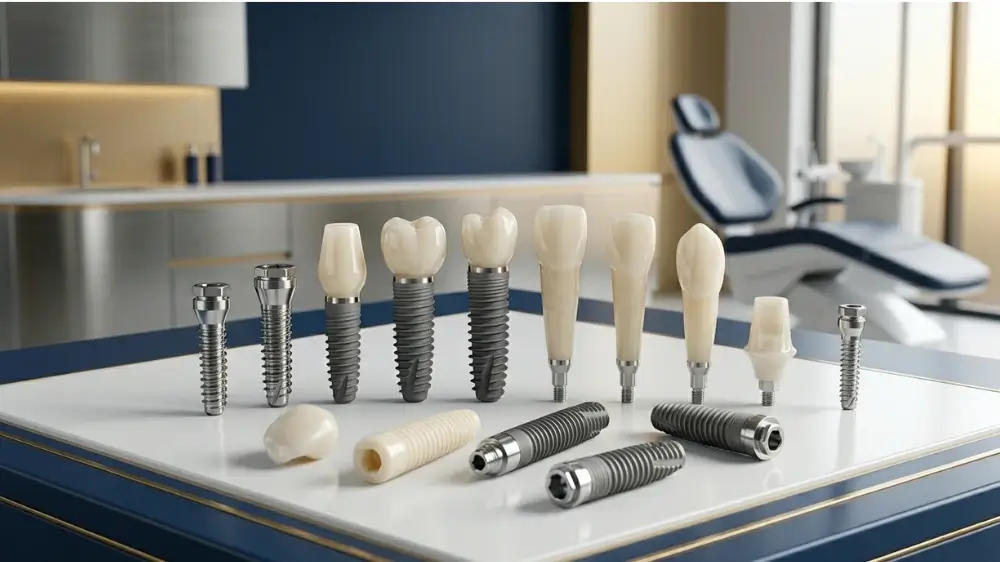
A dental implant consists of three primary parts: the implant body (the screw), the abutment (the connector), and the crown (the visible tooth). They are sophisticated biotech, and so the different types of dental implants can confuse patients when navigating options. Below, you will find Dr. Astolfi’s list of the 12 different dental implants. Don’t hesitate to contact us for free medical consultations.
Dental Implant Types by Placement & Anchor
Implant classification by placement refers to where and how the device is surgically anchored. This is determined primarily by the volume and quality of the patient’s jawbone.
1. Endosteal Implants
Endosteal implants are the most common type, usually shaped like small screws or cylinders. Because they are anchored within the bone, they provide the highest level of stability for single crowns or multi-unit bridges. If a patient lacks sufficient bone, a bone graft is often required to place them.
2. Subperiosteal Implants
Subperiosteal implants sit under the gum tissue. They consist of a metal frame that rests on the bone with posts that protrude through the gums to hold the prosthesis. These are indicated for patients who do not wish to undergo extensive bone grafting. While less common, they remain a viable alternative when vertical bone height is severely compromised.
3. Zygomatic Implants
Zygomatic implants are extra-long implants that anchor into the zygoma (cheekbone). They are designed for patients with extreme bone atrophy who are not candidates for sinus lifts. This technique allows them to receive a full set of fixed teeth, often using the Immediate Load protocol.
4. Screwless (Press-Fit) Implants
Screwless implants, also known as press-fit or locking taper implants, utilize friction and a specialized “Morse taper” connection to stay in place. Their primary advantage is the reduction of micro-gaps between the implant and the abutment, which lowers the risk of bacterial colonization and peri-implantitis. They are an excellent option for patients seeking a more biological restoration with fewer mechanics.
By Method & Loading
According to the American Academy of Implant Dentistry, over 3 million people in the U.S. have implants, a number growing by 500,000 annually. This category focuses on how many implants are used for a full set and when the prosthetic teeth are attached to the implants.
5. Full Mouth Implants (Implant-Supported Bridges & Dentures)
Full mouth implants are a solution for edentulous patients (missing all teeth) or with advanced dental decay. Instead of replacing each tooth, between 4 and 8 implants support a fixed bridge or denture. This method restores 95% to 100% of natural chewing function, compared to the 20% offered by traditional removable dentures.
6. All on 4
This technique uses four titanium implants per arch. Two are placed straight in the front, and two are tilted at a 45-degree angle in the back to maximize contact with available bone. It is the most cost-effective full-mouth solution and often eliminates the need for bone grafting.
7. All on 6
Providing a higher level of stability, the All-on-6 protocol uses six implants to distribute biting forces more evenly across the jaw. This is often recommended for patients with larger jaw structures or higher biting forces.
8. 3 on 6 Dental Implants
A specialized bridge design where six implants support three separate dental bridges. This allows for a more natural distribution of teeth and easier maintenance if a specific segment of the bridge requires repair in the future.
9. All on 8
The gold standard for stability, All-on-8 uses eight implants to support a full bridge. It is typically reserved for patients with exceptional bone density who require maximum support for high-impact chewing.
10. Immediate Load Implants
Immediate Load dental implants, marketed as “Teeth in a Day,” allow for the placement of a temporary crown or bridge on the same day the implant surgery is performed. It requires a strict soft-food diet during the first few weeks to ensure osseointegration. At OONE LIFE Dental we do not recommend the procedure, preferring the healing period of 3 to 6 months before loading.
By Material
In 2026, dental implants remain the only proven method that promotes natural bone growth and prevents facial sagginess after tooth loss. The material of the implant is the most critical factor for biocompatibility and long-term aesthetic success. Currently, the industry is dominated by two primary materials.
11. Titanium Implants
Titanium dental implants have been the clinical standard since the 1960s. Made from commercial-grade titanium or titanium alloys, they are renowned for their biocompatibility, mechanical strength and its long-term track record. It has a high success rate (over 97% over 10 years). At OONE LIFE Dental, we use high-grade titanium to ensure maximum longevity.
12. Zirconia (Ceramic) Dental Implants
Zirconia implants are the leading metal-free alternative in modern implantology. Made from a high-performance ceramic (zirconium oxide), they are favored for patients with metal sensitivities. Other than being hypoallergenic, they are also aesthetically superior. Zirconia is white and opaque, so there is no risk of a “dark metal line” appearing if gums recede, while accumulating less bacteria than titanium.
What type of dental implants last the longest?
Titanium dental implants currently hold the record for the longest clinical lifespan. According to a 20-year prospective study published in Clinical Implant Dentistry and Related Research, titanium implants showed a 94.7% survival rate over two decades.
While the zirconia (ceramic) alternative is highly durable, titanium’s advantage lies in its 60-year track record.
- The Implant Post:Can last a lifetime (25+ years).
- The Crown/Prosthesis:Typically needs replacement every 10–15 years due to mechanical wear.
Dental Implants Cost
Globally, the price dentists pay for dental implants is practically the same, but the price patients pay for Swiss Straumann® implants (considered the best in the world), varies from $2,500+ in the US to $700 in Turkey. Clinical overheads, staff and rental add up to 90% of the total dental implant cost from patients.
Region | Single Implant | All-on-4 (Per Arch) |
United States | $3,000 – $5,000 | $20,000 – $35,000 |
United Kingdom | £2,000 – £3,500 | £12,000 – £18,000 |
Turkey | $500 – $900 | $3,000 – $6,500 |
Why Are Dental Implants so Cheap in Turkey?
Dental implant cost up to 83% less in Turkey. The same Swiss brand, distributed by the same firm, verified with LOT and REF codes. This is possible because of 3 structural factors:
- Lower Operational Costs:Real estate, laboratory fees, and administrative salaries are significantly lower in Turkey than in London or New York, allowing for profits with a lower sell price.
- Weaker Currency:The strength of the USD/GBP/EUR against the Turkish Lira gives international patients massive purchasing power.
- Government Support:The Turkish State provides tax incentives to clinics that meet international standards (ISO/TUV).
What Can be Done Instead of a Dental Implant?
Depending on your clinical history, bone density, or budget, other methods may be applicable. The following comparisons highlight how alternatives measure up against modern implant technology.
Feature | Dental Implant | Dental Bridge | Partial Dentures | Dental Crown |
Fixed/Removable | Fixed (Permanent) | Fixed | Removable | Fixed |
Longevity | 25+ Years / Lifetime | 10–15 Years | 5–10 Years | 10–15 Years |
Bone Health | Prevents Bone Loss | Does Not Prevent | Causes Resorption | N/A (Root needed) |
Bite Force | 95% – 100% | 70% – 80% | 20% – 30% | 100% |
Healthy Teeth | Preserves them | Requires grinding | Uses metal clasps | Protects 1 tooth |
Dental Implants vs. Dental Bridges
A dental bridge is a fixed restoration that “bridges” the gap created by one or more missing teeth. To secure the bridge, a dentist must shave down the enamel of the healthy adjacent teeth (abutments) to serve as anchors. Dental implants are superior because they do not require the sacrifice of healthy tooth structure and prevent the jawbone from shrinking over time.
Dental Implants vs. Veneers
There is often confusion between these two, but they serve entirely different medical purposes. Veneers are bonded to the front surface of existing teeth. They cannot replace a missing tooth. In contrast, a dental implant is used when the entire tooth, including the root, is gone. If you are missing a tooth, a veneer is not a clinical option.
Dental Implants vs. Dentures
Traditional dentures are removable and sit on the gum tissue. Because they lack a physical connection to the bone, they often slip and provide only 20% to 30% of natural biting force, making certain foods difficult to eat. Dental implants eliminate these issues by fusing with the jawbone. Whether through a single crown or an All-on-4 bridge, implants restore nearly 100% of chewing function and eliminate the need for messy adhesives or nighttime removal.
Dental Implants vs. Crowns
A dental crown is a protective “cap” placed over a damaged, cracked, or decayed tooth that still has a viable root. Its goal is to save the natural tooth. However, when a tooth is so severely damaged that it must be extracted, a crown is no longer possible. At this stage, a dental implant becomes the only way to replace that missing unit.
FAQs
What are the best types of dental implants?
Endosteal titanium implants are the gold standard for single teeth due to their 97% success rate. For full-arch restoration, All-on-6 provides superior stability, while Zirconia is the premier choice for patients seeking metal-free, high-aesthetic results in the smile zone.
What are the three types of dental implants and cost?
The three primary placement types are Endosteal ($500–$900 in Turkey), Subperiosteal (custom pricing for low bone), and Zygomatic ($1,500+). Prices in Turkey remain 70% lower than the US ($3,000+) due to lower operational costs and government health incentives.
What is the newest type of dental implants?
The latest advancement in 2026 is AI-Guided Smart Implants. These utilize 3D-printed surgical templates and real-time navigation to ensure micron-level precision, significantly reducing recovery times and virtually eliminating the risk of nerve or sinus interference during surgery.
What happens to titanium implants after 20 years?
Clinical data shows a 95% survival rate after 20 years. While the biocompatible titanium post typically lasts a lifetime, the visible crown or abutment may require replacement after 10–15 years due to natural mechanical wear from daily chewing.