
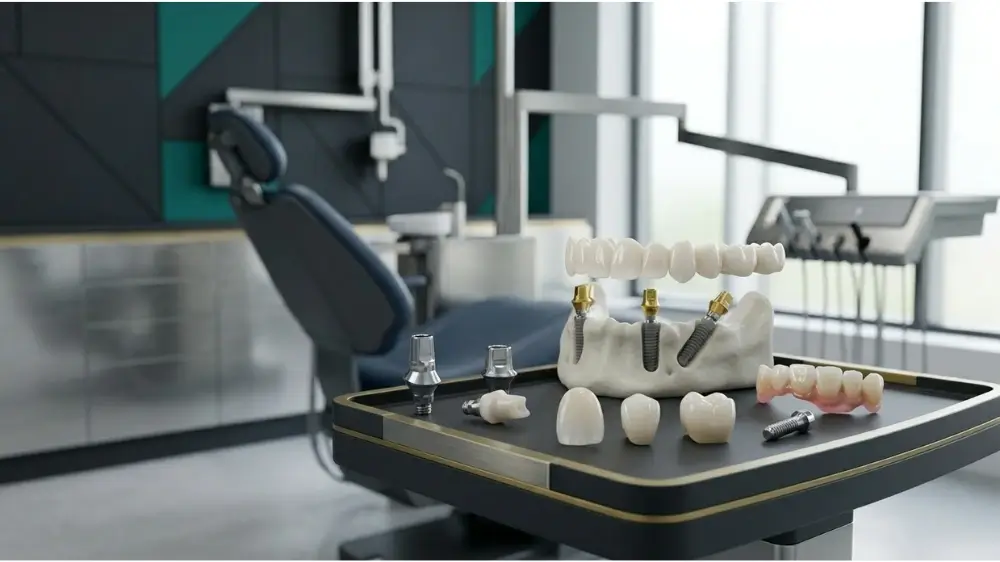
Full mouth dental implants replace an entire arch of teeth and restore 95% to 100% of biting force. While results are life-changing, the cost of full mouth dental implants remains a barrier for most patients. With +75% savings in Turkey for Swiss Straumann® implants placed by maxillofacial surgeons, many see “Turkey Teeth” as a no-brainer. But what are you paying for exactly? And is it truly worth it?
Below, we provide all the information you need to secure the best product for your budget, breaking down lab and clinic costs and showing you how to verify authentic Swiss implants with REF codes.
Key Takeaways:
- The average cost of full mouth dental implants in the USA is $56,000
- The average cost of full mouth implants in Turkey is $9,000
- Always ask for the REF codes to ensure you get authentic Swiss implants
- Verify clinic credentials and certifications for legal compliance
- Make sure you are operated by a certified oral & maxillofacial surgeon or an expert periodontist
How Much Are Full Mouth Dental Implants?
Full mouth dental implants cost from $45,000 to $65,000+ per arch depending on the final prosthesis (Acrylic vs. Zirconia), and the number of implants. While a single arch in the United States often exceeds $25,000, the cheapest full mouth dental implants cost is found in Turkey, where prices average between $3,000 and $7,000.
Below is a detailed comparison of how much are full mouth dental implants in 2026.
Country | All-on-4 (Per Arch) | All-on-6 (Per Arch) | Saving vs. USA |
United States | $20,000 – $30,000 | $24,000 – $35,000 | 0% |
Turkey | $3,000 – $6,000 | $4,000 – $7,500 | ~75% |
Full Mouth Dental Implants Cost in the US
In the United States, the cost of full mouth dental implants is influenced by the high cost of insurance, real estate for clinics, and laboratory markups. A standard complete mouth dental implants often requires multiple specialists—an oral surgeon and a prosthodontist—each charging separate fees. The quote often excludes essential hidden costs like bone grafting, extractions, or temporary healing bridges.
Full Mouth Implants Cost Without Insurance
Full mouth dental implants cost without insurance is the reality for 90% of patients. Even premium dental plans that include implant coverage typically have a yearly maximum benefit of $1,500 to $2,500, which barely covers the cost of a single implant post.
When paying out-of-pocket, patients must account for the surgical phase (implant placement) and the restorative phase (the final bridge). Without insurance, the financial burden leads many to choose removable dentures, which leads to progressive bone loss.
How Much Are Full Mouth Dental Implants in Turkey?
Full mouth dental implants cost in Turkey $3,000 to $7,000 per arch. This typically covers the initial consultation, 3D Tomography (CT scans), the implant surgery, the temporary removable bridge, and the final prosthesis. Even after adding flights and a stay in Istanbul, the total savings exceed $20,000-$30,000 per person.
Are You Getting Authentic Swiss Implants in Turkey?
Specialized dental clinics in Turkey offer premium brands like Straumann or Nobel Biocare for up to 75% lowerprice. To ensure the cost of full mouth dental implants is traceable and verifiable, every patient at OONE LIFE receives a Medical Implant Passport. This document contains the unique REF (Reference) and LOT (Batch) codes for every implant.
These codes allow you to verify the authenticity of your complete mouth dental implants directly with Straumann, Nobel Biocare, or Megagen. You can confirm the material purity, origin, authenticity and the sterilization date.
Why Are Dental Implants So Cheap in Turkey?
Dentists globally pay similar prices for implants like Straumann, but the clinical overheads (rent, staff, and laboratory fees) are much lower in Turkey. These savings, combined with government subsidies and favorable exchange rates, allow for a total 75% reduction in patient costs.
Types of Full Mouth Dental Implants
Below is the breakdown of the primary techniques for complete mouth dental implants and their cost differences.
Implant-Supported Prosthesis
An implant-supported prosthesis is a fixed, non-removable set of teeth that is screwed directly into the dental implants. Unlike removable options, these do not slip or irritate the gums.
All on Four
All-on-4 uses four titanium implants to support a full arch. Two implants are tilted at 45 degrees to maximize bone contact, often eliminating the need for bone grafts. It is the most popular, cheapest full mouth dental implants solution for those with moderate bone loss.
- US Cost: $20,000 – $30,000
- Turkey Cost: $3,000 – $5,500
All on 6
All-on-6 adds two implants for increased stability and a more even distribution of biting forces. This is recommended for patients with larger jaw structures or higher mechanical force.
- US Cost: $24,000 – $35,000
- Turkey Cost: $4,000 – $6,500
3 on 6
The 3-on-6 technique involves six implants supporting three separate dental bridges. This specialized design allows for a more natural distribution of teeth and easier localized repairs if a specific bridge segment is damaged, without needing to replace the entire arch.
- US Cost: $28,000 – $40,000
- Turkey Cost: $4,500 – $7,000
All on 8
All-on-8 is the ultimate restoration, utilizing eight implants to support a heavy-duty bridge. This provides the highest possible level of stability and bone stimulation. It is typically reserved for patients with exceptional bone density who require maximum support for high-impact chewing.
- US Cost: $32,000 – $45,000
- Turkey Cost: $5,500 – $8,000
Implant-Supported Dentures
Often called “snap-on dentures,” implant-supported dentures are removable but “click” onto 2 to 4 implants for stability. While they prevent the slippage of traditional dentures, they still provide less biting force than fixed options. This is the most affordable way to stabilize a loose lower denture.
- US Cost: $8,000 – $15,000
- Turkey Cost: $1,500 – $3,000
Implant-Supported Bridges
Implant-supported bridges are used when multiple teeth in a row are missing. Instead of crowns on every implant, the bridge “floats” over the middle gap, anchored by implants on either side. This is a common component of the 3-on-6system to replace full dental arches efficiently.
- US Cost: $5,000 – $15,000 (per bridge)
- Turkey Cost: $800 – $2,500 (per bridge)
How Are Full Mouth Dental Implants Placed?
The placement of full mouth dental implants is a sophisticated surgical process. By utilizing 3D CBCT scans and digital surgical guides, dentists can map the exact density of your bone and the location of vital nerves before the first incision is made.
At OONE LIFE Dental, the procedure is executed in five distinct clinical stages:
- Initial Digital Mapping:A high-resolution CT scan creates a 3D blueprint of your jaw.
- Site Preparation:Any remaining non-viable teeth are removed, and the jawbone is contoured to create an ideal prosthetic platform.
- Implant Insertion:Titanium or zirconia posts are threaded into the bone at precise angles.
- Immediate Loading:In many cases, a temporary fixed bridge is attached the same day, allowing you to leave the clinic with functional teeth.
- Final Restoration:After 3–6 months of healing, the permanent, high-aesthetic bridge is securely fitted.
Are You Put to Sleep for Full Mouth Dental Implants?
Yes, you can be “put to sleep” for full mouth dental implant surgery through IV sedation or general anesthesia, ensuring you feel no pain or anxiety during the procedure. While local anesthesia numbs the surgical site, most patients undergoing full arch restoration prefer some level of sedation to remain completely relaxed during the 2–4 hour surgery.
The level of “sleep” depends on your medical history and anxiety levels:
- Local Anesthesia:Only numbs the specific area; you are fully awake.
- IV Sedation (Twilight Sleep):You are deeply relaxed and drifting in and out of sleep. You can still respond to basic instructions but will likely have no memory of the surgery.
- General Anesthesia:Performed in a hospital-grade setting where you are completely unconscious. This is typically reserved for the most complex cases or extreme dental phobia.
Recovery and Aftercare
Initial recovery from full mouth surgery takes approximately 3 to 7 days, during which mild swelling and tenderness are normal. However, the biological “deep healing”—where the bone fuses to the implant—takes between 3 and 6 months. Following strict aftercare protocols is the single most important factor in preventing implant failure.
- The First 72 Hours:Rest with your head elevated and apply ice packs to minimize swelling.
- Dietary Restrictions:You must follow a soft-food diet (soups, smoothies, mashed potatoes) for the first few weeks to avoid putting mechanical pressure on the healing implants.
- Hygiene:Use a soft-bristled brush and prescribed antimicrobial rinses. Avoid smoking, as it significantly reduces blood flow to the bone and is the leading cause of implant rejection.
Advantage of Full Mouth Implants vs. Dentures
Full mouth dental implants provide a permanent solution that restores over 95% of natural biting force, whereas traditional dentures typically offer only 20–30%. Because implants are anchored into the bone, they stimulate the jaw, preventing the facial collapse and bone resorption that inevitably occurs with removable dentures.
Feature | Full Mouth Implants | Traditional Dentures |
Stability | Fixed; cannot slip or fall out | Removable; prone to slipping |
Bone Health | Preserves jawbone | Causes progressive bone loss |
Chewing Ability | Eat all foods (steak, apples) | Limited to soft or cut foods |
Maintenance | Brush/floss like natural teeth | Must be removed and soaked |
What Are the Negatives of Full Mouth Dental Implants?
While highly successful, the negatives of full mouth dental implants include a significant initial financial investment and a lengthy biological healing period. It is a major surgical procedure that carries standard risks such as infection, minor nerve irritation, or the rare possibility of the bone failing to bond with the implant (rejection).
Additionally, patients must be prepared for the time commitment. A “final” permanent implant bridge often requires a 4-to-8 month journey from the first surgery to the final fitting. Patients with uncontrolled diabetes or those who continue to smoke are at a much higher risk for complications, making them less-than-ideal candidates for this specific treatment.
FAQs
Are full mouth dental implants a good idea?
Yes, full mouth implants are the superior medical solution for total tooth loss. They prevent jawbone atrophy, restore 95% of natural chewing power, and provide a permanent, non-removable result that traditional dentures cannot match in comfort or health.
How much should a full mouth of implants cost?
A full mouth of implants should cost between $3,000–$7,000 per arch in Turkey, compared to $20,000–$35,000 in the US. Total costs depend on the number of implants (All-on-4 vs. All-on-6) and the final bridge material used.
How painful is a full mouth implant?
The procedure is virtually painless due to local anesthesia and sedation. Post-surgery, patients typically report a dull ache or “bruised” sensation manageable with over-the-counter medication. Most discomfort subsides within 3 to 7 days after the surgery.
How long do full mouth implants last?
The titanium implant posts often last a lifetime, with success rates over 95% after 10 years. While the biological foundation is permanent, the visible prosthetic bridge may require refurbishment or replacement every 10 to 15 years due to wear.
How do people afford full mouth dental implants?
Patients afford full mouth implants by seeking treatment in high-quality hubs like Turkey to save 70% or through third-party medical financing. Many clinics offer installment plans, allowing the investment to be managed as a monthly payment.
Is it hard to eat with full dental implants?
No, eating becomes significantly easier once the healing process is complete. While a soft-food diet is mandatory for the first 3 months, fully integrated implants allow you to eat tough foods like steak and apples with natural confidence.
Is it worth it to get full mouth implants?
Yes, it is a life-changing investment. Beyond the aesthetic transformation, implants stop bone resorption and eliminate the social anxiety of slipping dentures. Most patients describe it as regaining their natural teeth and a much higher quality of life.