
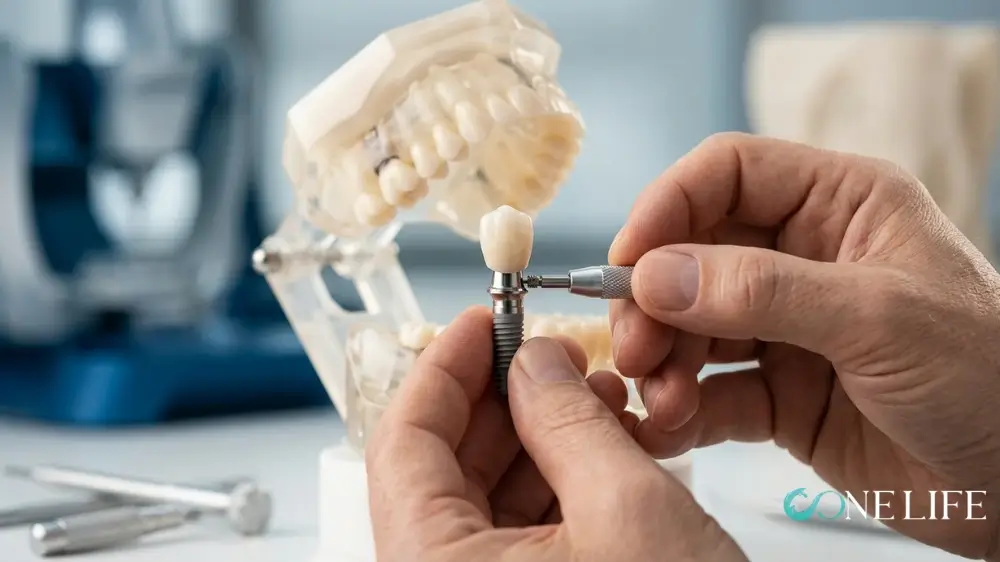
How can an inch-long screw be so expensive? A dental implant is a titanium post, a connecting piece, and a ceramic tooth. Yet in the UK, you’ll be quoted £2,000 to £3,500 for one. And if you need a full mouth? Brace yourself: that’s as much as a family car.
The good news is the cheapest dental implants in the UK can be as cheap as free –– but just for a lucky few. For everyone else, we discuss £1,500 deals, finance options and the best alternatives.
Who Qualifies for Free Dental Implants in the UK?
Unfortunately, very few people.
The cases that can qualify include patients who have lost teeth as a result of oral cancer or its treatment, patients with ectodermal dysplasia (where multiple teeth fail to form), and some cases of severe facial trauma. In practice, less than 1% of patients qualify for NHS-funded implants and most people need private treatment.
If you think you have a clinical case, your GP or NHS dentist can refer you to an oral and maxillofacial surgeon for assessment. It costs nothing to ask. But if you don’t fall into those categories, the NHS route is closed.
Do NHS Dentists Cover Implants?
No.
What the NHS will provide are dentures (Band 3, currently £319.10 in 2026) or, in some cases, a bridge. If your dentist suggests an implant on the NHS outside the exceptional circumstances listed above, ask them to confirm it in writing — it’s extremely unusual and you’ll want clarity before proceeding.
Verified Affordable Implants in the UK: Best Deals Available
A single dental implant in the UK typically costs between £1,800 and £3,500, with an average sitting around £2,500. But there are genuine ways to pay significantly less — if you know where to look.
University dental schools and hospitals – £800–£1,400 per implant
The most reliable source of below-market prices. Treatments are carried out by supervised postgraduate students or junior specialists under the direct oversight of experienced consultants. Quality is high, but waiting lists can be long (sometimes 6–12 months). The British Dental Association publishes a directory of accredited dental schools.
- Regional price variation is significant and predictable. Central London practices charge £2,500–£4,000 per implant. Manchester, Leeds, Birmingham and other major cities outside London cluster around £1,800–£2,500. Scotland, Wales and smaller English towns range from £1,500–£2,200. Simply choosing a practice outside the M25 can save you hundreds.
- Finance plans don’t reduce the cost, but 0% APR options over 6–12 months are widely available and make treatment accessible without a lump sum. Always confirm what the total repayable amount is and whether any deferred interest applies after the 0% period ends.
Ask your clinic for the implant’s REF code!
A legitimate clinic using genuine Straumann, Nobel Biocare or Osstem implants will hand it over without hesitation. You can verify it directly on the manufacturer’s website. If a clinic is vague about brand or refuses to confirm it, that’s a red flag.
Why Are Some Clinics Quoting Me £1,250 and Others £2,500 per implant?
Because they’re not always quoting the same thing. One may include the implant post only (the “screw”), while the other includes everything (Crown, abutment, clinic fee).
Some clinics advertise the fixture price only. By the time the abutment and crown are added, you’re at a very different number. T
Always ask: Does this quote include the implant, abutment, crown, CT scan and all follow-up appointments? If any of those are listed as extras, adjust the number accordingly before comparing.
How Much Are Full Mouth Dental Implants in the UK?
This is where costs escalate sharply.
Full mouth dental implants can reach £20,000–£45,000 per arch at high-end clinics. Most patients have neither the bone nor the budget for this approach.
The practical solution for most full mouth patients is All-on-4 or All-on-6. Here’s what those options cost in the UK in 2026:
Treatment | Per Arch | Both Arches |
All-on-4 (acrylic bridge) | £9,000–£15,000 | £18,000–£28,000 |
All-on-4 (zirconia upgrade) | £12,000–£18,000 | £22,000–£34,000 |
All-on-6 | £12,000–£20,000 | £24,000–£40,000 |
*London prices run 15–25% higher than the UK average. Finance is available on full-mouth cases from most major providers, though interest rates on longer terms are worth scrutinising carefully.
What Is The Final Cost Accounting for All Extras?
Even an all-inclusive quote can miss costs that only emerge during treatment. The most common can increase the final quote by 10-15%:
- Bone graft — if your jawbone has thinned due to tooth loss, an implant needs a stable foundation. Bone grafting adds £800–£2,000. It’s only confirmed after a CBCT scan.
- Sinus lift — required for upper jaw implants when the sinus cavity is too close to the implant site. Adds £500–£1,500.
- Tooth extraction— if the failing tooth hasn’t yet been removed, add £100–£350 per tooth.
- Sedation — local anaesthetic is standard and included. IV or inhalation sedation for anxious patients typically adds £200–£500.
- Initial consultation and CT scan — some clinics charge £100–£300 for the diagnostic assessment. Ask upfront whether this is refundable if you proceed with treatment.
The Turkish Temptation
Dental implants in Turkey cost £400–£850 per tooth. That’s a fraction of UK prices for verified Swiss implants. It’s such an extraordinary deal that Turkey receives 150,000 to 250,000 foreign dental patients annually, with British patients making up the largest contingent.
There’s a catch, of course. Even if you get treated in a top-tier clinic by an outstanding dentist, implants need 3–6 months to fuse with the bone, and during that period, things occasionally go wrong.
These complications aren’t common, but they happen with every implant system everywhere in the world, and if yourdentist is in Istanbul, you’re either looking at booking an immediate flight or getting rejected by UK dentists who refuse to operate on Turkish work.
Now, dental implants in Turkey remain over 50% more affordable even with an emergency visit to a Mediterranean summer paradise. The best part of it though is such a trip would have to be entirely paid for by the clinic and dentist in question.
As of January 2026, Turkey has made medical complication insurance mandatory for all international patients undergoing dental implant surgery.
Under this regulation by the Turkish Ministry of Health, revision surgery, medications, and in many plans, the cost of return flights and accommodation for the follow-up trip, are fully covered.
Dental implant plans specifically carry a 12-month validity period — longer than the standard 6-month cover for other procedures — precisely because osseointegration takes time.
The sensible checklist before booking in Turkey is:
- Verify the implant brand — ask for the REF code and confirm it with the manufacturer.
- Confirm the clinic is Ministry of Health accredited — check the USHAS (Turkish Health Tourism Development Agency) registry.
- Read the complication insurance policy before you travel — confirm it covers dental implants, flights and accommodation, and check the excess.
- Plan for two trips — the first for implant placement (5–7 days), the second 4–6 months later for the final prosthetic fitting.
Is There a Cheaper Alternative to Dental Implants in the UK?
Yes — but none of them are quite the same thing. Implants are the only option that preserves bone density, and feels like a natural tooth. Everything else involves a trade-off.
Here are the main alternatives and what they cost:
- Dental bridges — £500–£1,500 on the NHS (Band 3 in England: £319.10); £1,500–£5,000 privately depending on materials and span.
- Partial dentures — NHS cost: £319.10 (Band 3). Private: £500–£2,500. Functional and accessible, but removable dentures are less stable than implants, can accelerate bone loss, and many patients find them uncomfortable for eating and speaking.
- Full dentures — NHS: £319.10. Private: £1,000–£5,000 for a full set. But bone resorption continues underneath, meaning fit changes or replacement is needed every 5–10 years.
- Implant-supported dentures (snap-on dentures) — a middle ground. Cost in the UK: £3,000–£8,000. In Turkey: £1,200–£3,000.
The table below summarises how the main options compare:
Option | Approx. UK Cost | Feels Natural? | Preserves Bone? | Lasts How Long? |
Single implant | £1,800–£3,500 | ✅ Yes | ✅ Yes | 20–30+ years |
Dental bridge | £1,500–£5,000 | Mostly | ❌ No | 10–15 years |
Partial denture | £319–£2,500 | ❌ No | ❌ No | 5–10 years |
Full denture | £319–£5,000 | ❌ No | ❌ No | 5–10 years |
Implant-supported denture | £3,000–£8,000 | ✅ Mostly | Partially | 15–20+ years |
All-on-4 (full arch) | £9,000–£15,000 | ✅ Yes | ✅ Yes | 20–30+ years |
FAQs
Are dental implants safe?
Yes. Dental implants have a 95.2% 10-year success rate and are considered the best tooth replacement option available. They are made from medical-grade titanium, biocompatible with human bone, and have been used clinically for over 40 years.
How long do dental implants last?
20–30 years or more with proper care. The titanium fixture can last a lifetime. The crown on top may need replacing after 15–20 years. Long-term success depends on oral hygiene, non-smoking status and regular dental check-ups.
Are dental implants painful?
The procedure itself is not — local anaesthetic makes it comparable to a routine extraction. Mild soreness and swelling for 3–5 days afterwards is normal and managed with over-the-counter painkillers. Most patients report the experience was easier than they expected.
Will implants be visible?
No. The implant itself sits below the gumline. The crown on top is custom-made to match your natural teeth in shape, size and colour. A well-placed implant is indistinguishable from the surrounding teeth.
How do you get implants when you can't afford them?
Three options: university dental schools offer implants from £800–£1,400 under supervised care; most private clinics offer 0% finance over 6–12 months; treatment in Turkey with a premium-brand clinic costs 60–75% less than UK prices, with mandatory complication insurance now included.
How much is 2 dental implants in the UK?
Two single implants in the UK cost £3,600–£7,000 in 2026, depending on location, brand and what’s included in the quote. Always confirm both quotes include the implant fixture, abutment, crown, CT scan and all follow-up appointments.
Why are dental implants so cheap in Turkey?
Lower wages, property costs and regulatory overheads — not lower quality. Reputable Turkish clinics use identical premium brands to UK practices: Straumann, Nobel Biocare, Osstem. Ask for the manufacturer REF code to verify. The implants are the same. The overhead structure isn’t.
What is the cheapest way to get dental implants in the UK?
The cheapest legitimate route is through a university dental school or NHS hospital implant clinic, where supervised postgraduate students carry out treatment under consultant oversight. Expect to pay £800–£1,400 per implant, with longer waiting times. Outside that, practices in Scotland, Wales and northern England consistently offer lower prices than London and the South East.
How much does a single dental implant cost in the UK in 2026?
A single dental implant in the UK costs between £1,800 and £3,500, with an average of around £2,500 at a private practice. The final price depends on your location, the implant brand used, whether bone grafting is needed, and what the quote actually includes.
How much does All-on-4 cost in the UK?
All-on-4 full-arch implants cost between £9,000 and £15,000 per arch in 2026, with £12,000 being typical. Both arches combined run approximately £18,000–£28,000.
Is it safe to get dental implants in Turkey?
Yes, provided you choose the right clinic. Verify that the clinic is accredited by the Turkish Ministry of Health and listed in the USHAS registry. Ask for the implant brand REF code and confirm it directly with the manufacturer. From January 2026, complication insurance is mandatory for all international patients undergoing implant procedures in Turkey, covering revision surgery, medications, and in most plans, return flights and accommodation if complications arise.