

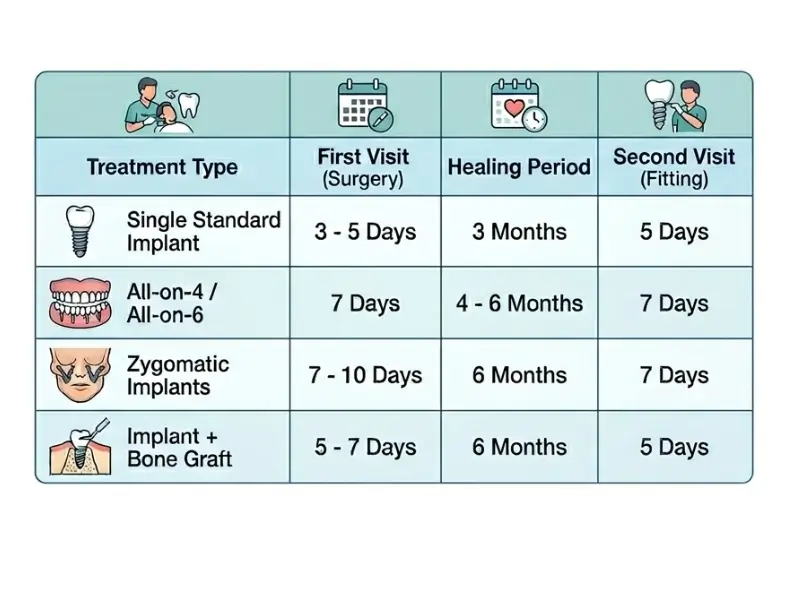
Total time required to stay in Turkey for dental implants involves two separate trips. For the first visit, the stay will be between 3 to 7 days for the surgical placement of the implants. After a healing period of 3 to 6 months, a second visit of 5 to 7 days is required to fit your permanent crowns.
While Same-Day Implants allow for immediate loading, the vast majority of international patients follow the two-stage process to ensure maximum osseointegration success. In 2026, clinical data shows a 98.2% success rate when this biological healing timeline is respected. When Same-Day Implants protocol is chosen, the success rate falls over to 90%. A dental implant requires time to naturally fuse with your bone to ensure permanency.
Even with same-day loading, a secondary visit is often required 3–6 months later to replace the temporary restoration with a permanent, high-durability crown.
Don’t rush your recovery. A full stay allows a safe surgery and a post-op check-up, ensuring your new smile is built to last.
The First Visit: Surgical Placement and Initial Stay
Your first visit to Turkey is the most important step in your smile journey. Most patients find a 5-day stay in Istanbul or Antalya is the “sweet spot” for a safe and successful procedure.
- Day 1: Arrival and comprehensive clinical examination.
- Day 2: Implant surgery and placement of temporary healing abutments.
- Day 3-4: Rest period and initial recovery.
- Day 5: Final inspection and “Fit-to-Fly” clearance from your surgeon.
The first 72 hours are critical for minimizing swelling. Turkish clinics now utilize PRF (Platelet-Rich Fibrin) technology to accelerate this early healing phase, often allowing patients to return to light work activities shortly after returning home.
The Healing Phase: What Happens Between Your Visits?
After the posts are placed, your bone needs 3 to 6 months to naturally bond with the implant (a process called osseointegration). This period is the most important step for a permanent, stable smile.
What to Expect During Healing:
-Location: You will typically spend this time at home.
-Aesthetics: You may wear a temporary denture or healing cap so you never leave without teeth.
-Care: Avoid heavy pressure on the implant for the first 8 to 12 weeks. Even tiny movements can stop the bone from attaching properly.
- Months 1-2: The jawbone grows into the microscopic pores of the implant surface.
- Months 3-4: Secondary stability is achieved; the implant is now a “permanent” part of your anatomy.
- Month 6: Recommended for patients with low bone density or those who underwent significant bone grafting.
The Second Visit: Permanent Prosthesis and Final Fitting
our second trip to Turkey is the “reward” phase where your new smile is finalized. This typically requires a 5 to 7-day stay to ensure a perfect fit.
The Final Step-by-Step:
- Day 1: Digital scans are taken of your mouth—no messy molds required.
- Day 2–4: Custom Zirconia or E-max crowns are crafted in the lab to match your face and bite.
- Day 5–7: Final fitting and a 24-hour test drive. You’ll wear the crowns with temporary cement for a day to ensure total comfort before they are permanently bonded.
This technical stage ensures your new teeth don’t just look great, but feel natural when you eat and speak.
Factors Influencing Your Required Stay in Istanbul
Every dental journey has a different timeline. Several variables can extend your stay in Istanbul by 2 to 3 days.
Bone Grafting and Sinus Lifts are the primary reasons for an extension. If your maxillary sinus is too low or your jawbone has atrophied, the surgeon must add bone material. This adds complexity to the surgery and requires a longer observation period.
Additionally, full-mouth restorations like All-on-4 or All-on-6 require more detailed lab work than a single crown. To ensure your new teeth are precisely milled and hand-finished, please allow at least 7 days for your second visit.
Comparing Stay Durations: Simple vs. Complex Cases
Essential Recovery Tips During Your Stay in Turkey
Maximizing your implant success rate starts when you leave the dental chair. The first 48 hours in Turkey are the most critical for managing inflammation and protecting the surgical site.
- Nutrition: Stick to a cold, soft-food diet for the first 3 days. High-protein shakes and lukewarm soups are ideal for supporting tissue regeneration.
- Activity Levels: Avoid strenuous exercise or heavy lifting for at least 5 days. Increased blood pressure can lead to post-operative bleeding.
- Clinical Follow-up: Never skip your final check-up before your flight. Your surgeon needs to verify that the sutures are intact and that there is no unexpected swelling.
Why 1.5 Million Health Tourists Choose Turkey for Dentistry
Turkey is a top destination for dental tourism, offering a 98% success rate and world-class safety standards. With expert surgeons and the latest technology, patients receive high-quality care that rivals the best clinics in the USA and Europe.
Many facilities hold JCI accreditation, meeting the same rigorous safety standards as top hospitals in the USA and Europe.